



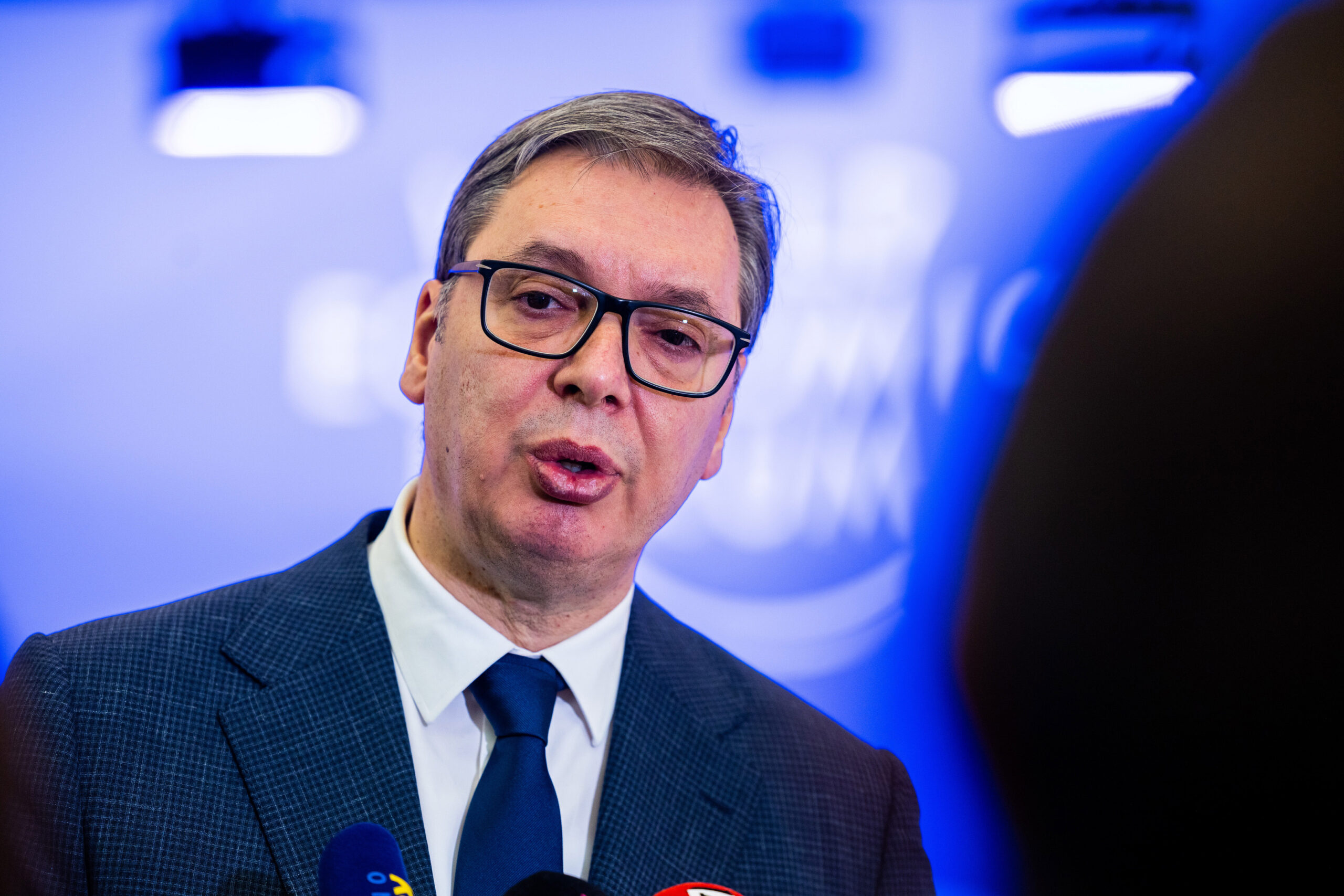
Brussels – Aleksandar Vučić, Serbia’s authoritarian president in power since 2014, is taking a gamble to try to mitigate the protest movement that has been shaking the Balkan country for months, demonstrating against corruption and the slide towards Moscow orbit. But his offer of dialogue does not seem to convince students and opposition, who want the Belgrade strongman to resign.
In a rather unexpected move, Serbian President Aleksandar Vučić has extended his hand to the protesters who have been filling the squares of the Balkan country for more than nine months to demand an end to the rampant corruption and a general change of the political class. Including the head of state: “Arrest Vučić” is one of the placards one happens to read at protests, which broke out last November following the collapse of a bus shelter in Novi Sad, causing 16 people to die.
Thus, in a televised address to the nation today (22 August), the president ventured his proposal, offering to hold “discussions and debates on all our televisions, on all our websites, with the legitimate representatives” of the protest movement. Vučić says he intends to “address the different visions” with the aim of “resolving the issue through dialogue and confrontation” and with the ultimate goal of “rebuilding the country, to bring it back to the situation it was in nine months ago.”
Until now, the authoritarian leader seemed irrevocably committed to repression, delegating it to law enforcement agencies authorised to use even illegal devices such as sonic cannons to disperse protesters. In the last few days, the tension had risen dangerously with even violent clashes between protesters and pro-government factions, peppered with assaults on some offices of the parties that make up the executive and widespread abuses of power committed by the security apparatus.

But Vučić’s critics—both on the streets and in parliament—do not seem willing to buy the story of his sudden repentance. “A president who resorts to violence is not someone you can discuss political issues with. This is a corrupt government that tramples on democracy and human rights,” the caustic comment of Savo Manojlović, leader of the centrist Kreni-Promeni party.
Oppositions and students are calling on Vučić to prove his good faith by stepping aside and calling early presidential elections as soon as possible, before 2027, when his second term of office (and also his last, according to the Constitution) expires. The head of state “does not have an answer to the popular rebellion,” reads a note from students at the University of Belgrade, in which they agree to discuss but only “during the election campaign.”
So far, the only concrete result to which the oceanic popular protests have led—probably
the largest in the history of the Balkan country since the implosion of Yugoslavia—is the resignation of the former prime minister Miloš Vučević in late January, in an egregiously unsuccessful attempt to appease the protesters.
For years, the strongman from Belgrade has posed a geopolitical dilemma for the EU. Serbia is officially a candidate country for membership in the twelve-star club, but, in addition to the repression of protests and mass violations of fundamental rights, Vučić’s embarrassing closeness to Vladimir Putin is also causing Brussels considerable headaches.

Heedless of the warnings of the EU High Representative Kaja Kallas, the Serbian president
went to Moscow on 9 May to celebrate the 80th anniversary of the Soviet victory over Nazi Germany, in the Red Square grandstand of honour together with the Tsar and the Slovak Prime Minister Robert Fico, one of the two enfants terribles of the Union. With the other, the Hungarian Prime Minister Viktor Orbán, Vučić is working to extend the Druzhba oil pipeline and bring the Federation’s crude oil all the way to Serbia, further exacerbating the diplomatic friction between Budapest and Kyiv.
At the same time, however, Vučić is ambivalent towards Ukraine.
In June, he made a surprise visit to Odessa, where he attended a meeting convened by Volodymyr Zelensky himself, and for some time now, Moscow has been accusing Belgrade of betraying the traditional friendship between the two countries by selling arms to Kyiv.
The upper echelons in Brussels have always claimed to be on the side of the students, but during their most recent visits to the Serbian capital, both Kallas and António Costa, President of the European Council, were rather soft in holding Vučić accountable for his actions. By a curious coincidence, the European Commission has included Serbia among the 11 third countries in which it will finance projects for the supply of critical raw materials, essential for maintaining the competitiveness of the Old Continent in the 21st century.
English version by the Translation Service of Withub



![[foto: Guillaume Baviere/WikimediaCommons]](https://www.eunews.it/wp-content/uploads/2026/01/Cuba_Che-120x86.jpg)
