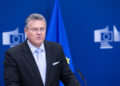
Brussels – As is always the case at the end of institutional terms of office, it is also time to take stock at the European Economic and Social Committee (EESC). Oliver Röpke, the Austrian trade unionist who has chaired it since April 2023, shared with Eunews his reflections on the work done over the past two and a half years and on the near future. Today (18 September) marks the end of the 599th plenary session of the EESC, and yesterday there was a ceremony to mark the end of the advisory board’s five-year term, which began in October 2020.
The Committee comprises 329 members from all member states, divided into three groups to represent the various social partners: employers (Group I), workers (Group II), and civil society organizations (Group III). Röpke is a member of Group II and was elected two and a half years ago based on a program entitled “Defending Democracy, Defending Europe.”
He says the Committee “is more than a consultative body; it is the voice of European civil society for democracy, social justice, and sustainability.” Looking back, the outgoing president lists among the main achievements of the term that just ended those related to EU enlargement and international cooperation, the consolidation of European democracy, equality, inclusion, and social rights, as well as sustainability and competitiveness.
Today we close one chapter, but the story of the EESC continues: stronger, more visible, more united than ever.
This is what we built together. This is what we can be proud of.
Because we are the @EU_EESC . And we are Proud to be EESC.#EESCPlenary pic.twitter.com/EAtqeXmJ3z
— Oliver Röpke (@EESC_President) September 17, 2025
In particular, regarding enlargement, Röpke advocated for an institutional innovation that would directly involve representatives of civil society from the nine candidate countries in the workings of the European political process. The EESC launched the so-called Enlargement candidate members’ Initiative (ECM) in February 2024, adding 146 new members: 18 from Albania, 15 each from Bosnia and Herzegovina, Georgia, Macedonia, Moldova, Montenegro, and Serbia, 16 from Turkey, and 23 from Ukraine.
Although they have no voting rights, these representatives have “actively contributed to the Committee’s activities, providing decisive input, specifically in 21 resolutions in 2024 alone” on a wide range of topics: from cohesion policy to climate change, from digital to the rule of law, from the single market to labour and skills shortages on the Old Continent. The trade unionist explains that it is “an opportunity to shape EU policy from within,” even before joining.
The now former EESC president is proud of the “record speed with which this initiative,” which he himself proposed in September 2023, was implemented, and that recently “received the green light from the European Commission to become a permanent element” in the work of the Committee. Among the best achievements, Röpke highlights the “extremely positive contacts with the representatives of the candidate countries on the ground,” which have made it possible to “facilitate and strengthen the social dialogue” inside and outside the EU.
And there is enthusiasm, he says, even from the ECM Initiative beneficiaries themselves. “The feedback we have received is extremely positive,” he says, and”‘not only from the authorities of the candidate countries but also from civil society organizations and the EU institutions themselves.” Speaking at the Committee’s plenary in Brussels yesterday, Albanian Prime Minister Edi Rama renewed the call, already launched last year, to extend similar models of step-by-step integration to the other bodies of the twelve-star club. “The EESC is where Albanians felt treated as equals,” he said.
Röpke is careful not to step on anyone’s toes. “Each institution must determine for itself” how to introduce similar structures, he reasons, admitting that “for us, as an advisory body, it was relatively easier.” However, he noted that “something is moving,” for example, in the Council and the Commission, where policy experts from the candidate countries already participate in some sectoral working sessions.
On the other hand, there is no shortage of critical issues and challenges. One of them is the complete “structural and financial sustainability.” It is true, the trade unionist admits, that the EESC has managed to secure the necessary resources to maintain the initiative even in the next mandate from the Directorate General for Enlargement and the Eastern Neighborhood, the department of the EU executive that reports to the Enlargement Commissioner Marta Kos (on a trip to the South Caucasus in the past few days).

However, it is also true, Röpke complains, that the share allocated to enlargement policies in the next multi-annual budget (2028-2034) “is not as ambitious as it should be,” given the costs of inflation and accrued interest on the Next Generation EU debt. The EESC is “disappointed” not only by the insufficient allocation of funds but also by the poor coherence between the different sectoral instruments.
To his successor (in all likelihood, his deputy Krzysztof Pater, from Group III), Röpke leaves a Committee that is “more visible, more relevant, and more united than ever,” which, thanks to the reforms of recent years, has carved out a role for itself as “defender of fundamental rights” in the Union. Now, he warns, it will be necessary to continue to “ensure that the EU’s strategic choices,” from competitiveness to climate action, “are firmly rooted in the voices of citizens, workers, businesses, and civil society.”
Röpke, on the other hand, will step down from the EESC. “It would be difficult to find a proper role in the Committee after chairing it,” he confesses. But his CV will not stop there. As of 1 November, he is taking up a post as director of the Bureau for Workers’ Activities (ACTRAV) at the International Labour Organisation (ILO) in Geneva. Not exactly close to his Vienna, he jokes, but certainly less distant than Brussels.
English version by the Translation Service of Withub