




Brussels – Tariffs that US President Donald Trump imposed, regardless of how things unfold, will impact the eurozone and its economy in terms of reduced bank lending and lower investment, despite the EU-US agreement. The European Central Bank had already warned of the risks associated with trans-Atlantic trade tensions, pointing out that the deal may not be enough to convince markets and traders, and now that warning has been confirmed.
“We find that increased uncertainty about economic policies – stemming, among other things, from trade policy developments in the United States – spills over into the euro area, by reducing lending via both loan demand and loan supply“, the ECB’s technical experts wrote in an analysis paper entitled – ‘More uncertainty, less lending: how US policy affects firm financing in Europe,’ the title of which says it all about the scenarios ahead. “High levels of uncertainty also make policy rate cuts less effective,” the experts warn further.
So far, the ECB has cut interest rates eight times, including four in 2025, before opting for a pause that is likely to continue. Traders do not expect a cut at the Governing Council meeting at the end of October, also in view of the increase in inflation. In Frankfurt, on the other hand, experts expect a slowdown in the economy: “While waiting for greater clarity, firms react to heightened uncertainty about economic policy by postponing investment decisions, while banks contract credit supply to manage potential risks.” This last aspect is inherent to the credit system’s own characteristics: “when unexpected changes happen, banks give out fewer and fewer loans,” the analysis paper states.
The underlying problem, getting to the point, is that “policy uncertainty – especially when coupled with financial stress – can hinder the flow of credit and slow down economic activity just when stimulus is most needed.” And there is no doubt that this is the time for the EU and its eurozone to invest, as highlighted by the Draghi report. Trump’s tariffs are thus an obstacle to European competitiveness, and the ECB merely confirms this yet again.
English version by the Translation Service of Withub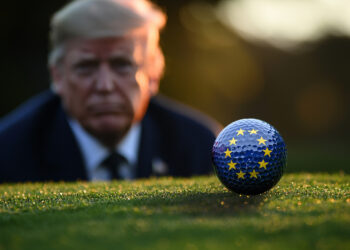





![La video riunione dell'Eurogruppo [27 marzo 2026. Foto: European Council]](https://www.eunews.it/wp-content/uploads/2026/03/eurogruppo-260327-120x86.jpg)
