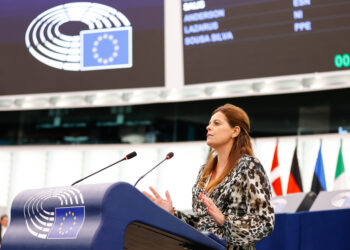
Brussels – Russia’s war in Ukraine, the commercial aggressiveness of the United States and China, and the prospect of a new and necessary enlargement of the Union. To avoid falling behind, we must move quickly and “rethink the decision-making processes.” In his speech to the European Parliament, the Prime Minister of Luxembourg, Luc Frieden, revived the idea that Angela Merkel proposed ten years ago: a two-speed Europe, which would allow “a small group of member states” to advance in the integration process before the others.
A project on which the German Chancellery had insisted to emerge unscathed from the sovereign debt crisis, which wore down some peripheral Eurozone countries and also inevitably slowed Paris and Berlin, the then strong ‘Franco-German engine’, and the more prosperous central and northern European countries. “We should re-examine the idea of a Europe with concentric circles,” Friedon told the hemicycle today (October 7), in light of “increasingly fierce international competition” requiring decisions to be taken quickly.
“We have no time to waste in addressing the challenges facing our citizens and countries today. We need bold ideas and actions to maintain Europe’s role on the world stage,” Frieden insisted. The Grand Duchy, a founding country of the Union, indicated many fronts. Europe “needs to reduce bureaucracy” and “is losing the necessary urgency and ambition.” It must make “tangible progress in the internal market and in the savings and investment union.” It must put in place a series of measures to “give new impetus to Europe as an economic location.”

Little does it matter whether the location is Frankfurt, Paris, Amsterdam, or perhaps Luxembourg itself. The important thing is that the most prosperous countries can work as vanguards, “always allowing the others to join this select group when they wish.” On closer inspection, one tool already exists. It is that of enhanced cooperation, provided for in the Treaties, which allows a minimum of nine Member States to establish advanced integration or cooperation in a specific area within the European Union, “when it has become clear that the EU as a whole cannot achieve the goals of such cooperation within a reasonable period.”
There is another point. Ten years ago, the Franco-German engine might have been able to drive the entire European economy if it had been freed from the deadweight. Today, that engine is in dire straits: Paris is spiraling into an unprecedented political crisis and has accumulated a substantial debt; Friedrich Merz in Berlin faces both a collapsing automotive sector and mounting pressure from a resurgent far right; and leading the continent’s third-largest economy, Italy, is a sovereignist government. Not exactly the image of those who want to promote greater European integration.
English version by the Translation Service of Withub
![La presidente del Parlamento europeo, Roberta Metsola, con il presidente del Consiglio europeo, Antonio Costa [Bruxelles, 15 ottobre 2026. Foto: European Council]](https://www.eunews.it/wp-content/uploads/2026/10/metsola-costa-350x250.png)

![Da sinistra: il presidente del Consiglio europeo, Antonio Costa; il presidente dell'Ucraina, Volodymir Zelensky: la presidente della Commissione europea, Ursula von der Leyen [Bruxelles, 18 giugno 2024. Foto: European Council]](https://www.eunews.it/wp-content/uploads/2026/06/euco_ua260618-120x86.jpg)
![[foto: Saverio De Giglio/imagoeconomica]](https://www.eunews.it/wp-content/uploads/2026/10/cpt-120x86.png)