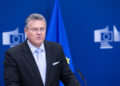

Brussels – “It is impossible to imagine cohesion without the regions.” Executive Vice-President for Cohesion and Reform, Raffaele Fitto, wants to be clear: even if the structure for the upcoming multi-annual budget changes, it will not change in substance. “The regions will continue to have the same role in the future,” as they have had so far. While the cohesion policy of the previous cycle (2014–2020) was a success story, the current one (2021–2027) aims to be even more so, and the next cycle (2028–2034) will need to face the test of a reform that, so far, is only partly convincing. The European Commission and the regions are working to lay the groundwork for post-2027 at the 23rd European Week of Regions and Cities, the annual regional policy event.
Fitto is inevitably under scrutiny for the EU executive’s idea of merging cohesion and agriculture resources into one fund in the next seven-year budget, as well as having the European Committee of the Regions (COR) breathing down his neck, contesting the decision to divert resources to finance defense. The Italian member of the von der Leyen team is trying to navigate these stormy waters unscathed by appearing at a press conference with COR President Kata Tüttő and showing that the European Commission and the European Committee of the Regions have not lost their team spirit. “The title of this year’s Regions Week is ‘Let’s shape tomorrow, together’, and the key word is ‘together’,” stressed Fitto.

“Cooperation and partnership are crucial for the success of cohesion policy“, Fitto again stressed. On behalf of the entire college, he assures and promises that “we are committed to improving the lives of our citizens, reducing disparities, and promoting territorial development in all regions,” This is precisely what the local governments are calling for, with Tüttő urging Brussels to “preserve strategic and day-to-day cooperation also in the future, as regional and local leadership can make a difference for the EU to achieve its goals, also concerning new priorities such as internal security and international competitiveness.”
Past cohesion policy achievements, COR’s doubts for the future
In the face of mounting criticism, Fitto assures that the centrality of cohesion is not in doubt. He does so by rattling off useful data to understand how much Europe has already done for the territories. In the 2014-2020 period, cohesion policy supported over 2.5 million small and medium-sized enterprises, created 370 thousand jobs, and provided childcare facilities for 24 million children. The structural funds of the cohesion policy also supported the twin green and digital transition: over EUR 66 billion has been invested in climate-related projects, while the EU’s renewable energy production capacity has increased by more than 6.000 megawatts, and eight million households have had broadband access. Cohesion policy has also contributed to improving the EU’s GDP by 0.6%, as well as to job growth and the mitigation of regional disparities.
For the future, however, the European Committee of the Regions has doubts and reservations, starting with the approach of the next seven-year budget (MFF 2028-2034): “There is a centralization that we look at with concern,” admits Tüttő. There are 73 regions in economic decline, and “competitiveness must take place locally,” with a transition that “does not have to disappear.” There is also the “demographic crisis” that increasingly involves Europe and its regions.

The Chair of the European Committee of the Regions, Kata Tüttő [Brussels, October 13, 2025]
While Fitto forges ahead, stating that “there is a need for an integrated approach between agriculture and cohesion,” Tüttő fears “hunger games” between sectors, warning that many regions “are rejecting the proposed new MFF.” These comments underscore the persistent gap between the European Commission and the Committee of the Regions, along with the skepticism of local authorities, who would not only be unfazed by a potential rejection of the budget by the European Parliament, but even hint that proposing a new, improved spending strategy would be both welcome and preferable.
English version by the Translation Service of Withub![[foto: Comitato economico e sociale europeo]](https://www.eunews.it/wp-content/uploads/2022/11/cohesion.png)
![Il vicepresidente esecutivo della Commsisione europea, Raffaele Fitto, in commissione Sviluppo delle regioni del Parlamento europeo [Bruxelles, 17 luglio 2025]](https://www.eunews.it/wp-content/uploads/2025/07/fitto-regi2-350x250.png)