
Brussels – Young farmers and where to find them: The European Commission tries to solve an issue that affects everyone and has been dragging on for years through an intervention aimed at convincing Member States to spend more. Yes, because the EU executive lacks fresh resources, and so it is asking governments to make precise use of the resources from the next multiannual budget (MFF 2028–2034) and to develop their own strategies. “The national plans must be approved by the Commission,” recalls the Commissioner for Agriculture, Cristophe Hansen, who explains one of the key points of the reform proposal for the sector at a press conference.
The von der Leyen team shows the member states how to set up future national plans for agriculture, suggesting raising the minimum amounts of European resources for the sector to 6 per cent from the current 3 per cent to promote generational change on farms. Added to this is the idea of proposing a compulsory incentive for young farmers who start a business, including a lump sum of up to €300,000 for business start-up—from the EU budget for agricultural policy—and the idea of including the participation of young farmers in the Erasmus for Young Entrepreneurs, so that they can better understand how to make agriculture a productive and profitable business. Because, Hansen suggests, agriculture is not only ploughing fields but also agrotourism.
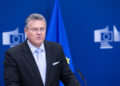
 Christophe Hansen, Commissioner for Agriculture [photo: Xavier Lejeune/imagoeconomica]
“We are making the support for young people and new farmers a political priority,” the Agriculture Commissioner continues. The support for Hansen is almost necessary because he acknowledges that “we cannot find young people and banks do not give loans when incomes are uncertain.” That is why he looks to the European Investment Bank (BEI) to “develop guarantee schemes or interest rate subsidies to facilitate access to finance.” Raffaele Fitto, executive vice-president for Cohesion and Reforms, has no doubts: “With this strategy, we support young people and new farmers, defending their right to stay and build their future in the territories they call home.”
Ideas and proposals are, however, all subject to the test of facts. Meanwhile, the suggestions are contained in a communication, a non-legislative and non-legally binding act, apart from the reference to national plans to be endorsed in Brussels, but which refer to a multiannual budget proposal under attack from all sides, including national governments, which remains to be seen to what extent it will remain as proposed by the von der Leyen team. Moreover, the BEI has already been mandated to prioritise defence, without distorting the ambition of the European Investment Bank to be a climate bank. Much, practically everything, is left to the states. The Commission, in essence, provides European support instruments, and not only in terms of money.
The package, designed to allow for a generational change in agriculture, also includes the creation of a European Land Observatory tasked with ensuring land transparency. This, according to the Commission, will help farmers access available land, support agricultural succession, guide policies and prevent land speculation, facilitating farming start-ups by new entrepreneurs.
English version by the Translation Service of Withub