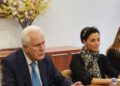
![da sinistra: i ministri delle Finanze di Germania, Svezia e Finlandia, Lars Klingbeil, Elisabeth Svantesson e Riikka Purra. I tre Paesi hanno di fatto affossato la proposta di MFF 2028-2034 [Lussemburgo, 10 ottobre 2025. Foto: European Council]](https://www.eunews.it/wp-content/uploads/2025/10/ecofin-DE_SE_FI-scaled.jpg)
Brussels – “We reject this proposal.” Lars Klingbeil, Minister of Finance of Germany, a country that has thwarted the multiannual budget proposal of the European Commission (MFF 2028–2034), is unambiguous and adamant. On a delicate and complex dossier such as the budget, which also requires unanimity, even a simple complaint from any state is enough to bring everything to a standstill, but if it is Germany digging its heels in, then everything becomes more difficult.
The economy and finance ministers of the 27, meeting in Luxembourg for the Ecofin council, debated only the proposal for new own resources, but the debate inevitably became the reason to criticise the whole package. Thus, Klingbeil recites the De Profundis to the next financial framework when he announced that “the budget amount is too high.” Two trillion is too much, and must be cut. And again: “We don’t see how these own resources can reach the €44 billion stated in the proposal,” adds the German minister, convinced that the Commission’s framework “goes against the competitiveness goals.” Moreover, a firm “nein” to any form of “common debt.”
Germany, therefore, rejected a seven-year budget that has already been rejected by Finland and ends up being shot down by a second founding country: “This proposal is unacceptable to the Netherlands,” thundered Dutch Finance Minister Eelco Heinen, who is also convinced that two trillion is too much. “It should be spent better, not more.” A position, the latter, also shared by Sweden: “It must be spent better,” agreed Stockholm’s Finance Minister, Elisabeth Svantesson, who demolished every single proposal for direct revenues for the benefit of the EU Commission. “We see no reason for new own resources,” she said bluntly.
Also speaking out against the own resources proposal were Poland (doubts about e-waste), Ireland (against corporate taxes), the Czech Republic (environmental taxes are considered “too aggressive” and corporate taxes are disliked), Hungary (“they hold back competitiveness,” said Minister Mate Loga) and also Italy. “We need comparative data with regard to electronic waste, and as far as plastics are concerned, the method is not convincing,” explained the Minister for the Economy, Giancarlo Giorgetti, who is, however, less sharp than his colleagues: “The Commission’s proposal is a starting point.” Even if the debate developing in Luxembourg seems to suggest a multi-year budget at the end of the line.
English version by the Translation Service of Withub


![[Copyright: European Union]](https://www.eunews.it/wp-content/uploads/2026/10/euco-261015-120x86.png)