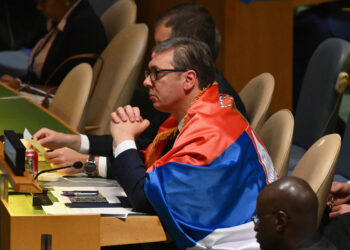
Brussels – After almost a year of uninterrupted protests, the EU Parliament is keeping the spotlight on the tense situation in Serbia. With a large but not overwhelming majority (457 votes in favour, 103 against, and 72 abstentions), the Strasbourg plenary passed a resolution today (22 October) on the “polarisation and increased repression” in the Balkan country, just under 12 months after the collapse of the bus shelter in the city of Novi Sad.
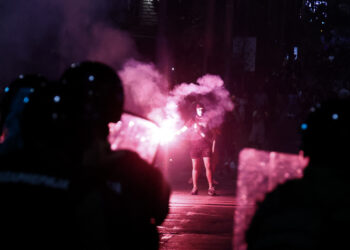
That event, which resulted in the deaths of 16 people, was the catalyst for a broad-based popular mobilisation on a scale never seen before (at least since the collapse of Yugoslavia in the 1990s). To the citizens—led mainly by the student movements—who are forcefully demanding an end to corruption, a European future for their country, and an end to the authoritarian regime of the pro-Russian president Aleksandar Vučić, the security apparatus responded with an iron fist, deploying a massive crackdown on democratic dissent.
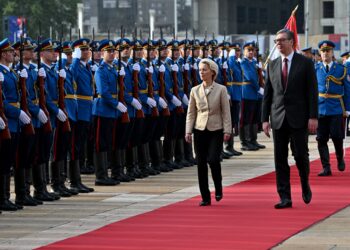
A situation that, if it only seems to bother the EU leadership to a certain extent (as can be seen from the balancing act of Ursula von der Leyen, who recently met the Serbian head of state, but also from those of the President of the European Council, António Costa, and the High Representative Kaja Kallas), continues to worry MEPs. If Belgrade wants to show that it is serious about accession to the EU, the joint resolution reads between the lines, it must stop the machinery of violence, respect the rule of law and human rights, and stop winking at Moscow.
Now is the time for strategic choices.
Also for Serbia.
It needs implementing EU reforms it has repeatedly promised to deliver.
It needs responding to what citizens ask loud and clearly.Now is the time to deliver & lead Serbia to the EU.
The EU’s offer will not be matched.
pic.twitter.com/NrdHD0YQga– Marta Kos (@MartaKosEU)
October 22, 2025
Speaking during yesterday’s debate in the hemicycle, Enlargement Commissioner Marta Kos condemned the violence against students, protesters, and journalists and warned Belgrade: “We expect Serbia to respect the core values of the EU” if it really wants to join the twelve-star club, she noted, including “respect for human dignity, freedom, democracy, equality, the rule of law, and human rights” including “freedom of peaceful assembly, media and academic freedom.” The Union, she added, expects that investigations into the events in Novi Sad will be duly conducted, as an investigation has begun but has not yet led to any results.
Kos welcomed the recent progress on the pre-accession reforms agreed with Brussels (e.g. on the unified voting register and the electronic media commission), but emphasised that “concrete steps must now be taken to restart the dialogue with the whole society.” Vučić himself boasted that he wanted to open a dialogue with the protesters, only to leave the situation unchanged. “Bringing a democratic Serbia into the EU is in the interest of the Serbs and also in ours,” she says, but for this to happen, we need concrete commitments “on democratic principles and reforms.”
Above all, she urged, the Balkan country must put an end to its balancing act on the international chessboard—President Vučić
is traditionally close to Vladimir Putin‘s Russia but recently seems to have softened tones also towards Ukraine—and “choose with transparency” which side it wants to be on. “Close relationships with Beijing and Moscow accompanied by critical statements about the EU, including with a Russian narrative, is not what is expected of a candidate country,” notes Kos, who also condemns the spreading disinformation and intimidation suffered by some MEPs. Finally, she concludes, “the alignment with the common foreign and security policy should be strengthened.”

Also along the same lines were the interventions of the Italian representatives of the Socialists (S&D) and Conservatives (ECR). From the benches of the latter, the Melonian Alessandro Ciriani warned of a “balance that is cracking” in Serbia, as indicated by the
polls that show that only 33 per cent of the citizens of the Balkan country openly support accession: “Those who stand to gain from this,” he said, “are actors with interests competing with us, such as Russia and China, with negative repercussions for regional stability.” “The EU must maintain a balanced and constructive approach, relaunching the European offer of development and inclusive dialogue,” he continued, and “avoid disappointment turning into detachment and detachment into geopolitical estrangement.”
From the PD, Alessandra Moretti condemned the Serbian authorities’ response against the protesters: “It is not worthy of a candidate country,” she remarked, “nor of a state governed by the rule of law”. “The dangerous polarisation created in the country risks normalising violence and weakening democratic institutions,” she added, calling for a change of pace. “Serbia’s commitment to the European path cannot be limited to mere words but we need concrete progress on the rule of law, the fight against corruption, independence of the media and judiciary, a free electoral system and alignment with European foreign policy,” she concluded.
Franco-Italian Liberal MEP Sandro Gozi also emphasised that the path to the EU implies “benefits but also commitments for democracy, the rule of law and freedom'” starting with that of students “to demonstrate and express criticism of President Vučić,” to whom he addressed an “appeal to democratic responsibility” to take a step back and really listen to the demands of his fellow citizens, instead of having them truncheoned.

A dissenting voice comes from the Left, that of Danilo Della Valle(M5S). Picking up on a leitmotif dear to the pro-Kremlin narrative, the 5-Star MEP railed against the temptation to “use the same disastrous method adopted at Euromaidan, which helped bring war to Europe’s doorstep.” The reference is to the alleged hand of the EU, the US, and NATO in the street protests (which Ukrainians call the Revolution of Dignity) that, in the autumn between 2013 and 2014, led to the overthrow of the pro-Russian president Viktor Yanukovych and set in motion a chain of tragic events that resulted in the annexation of Crimea, the conflict in Donbass and, in 2022, the large-scale Russian invasion.
According to Della Valle, who also recognised the liveliness of Serbian society “capable of activism and of demanding real change,” during the demonstrations “there are no EU flags” and “the Serbian people have not forgotten the NATO bombings of 1999 and the colonial attitude of many European countries, including Italy, which has turned the Balkans into a powder keg.” “Let us be very careful not to add fuel to the fire,” he warned, because the region would be “a pressure cooker ready to burst.”
English version by the Translation Service of Withub