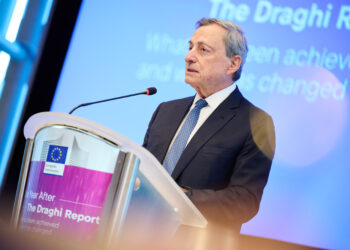
The “pragmatic federalism” relaunched by Mario Draghi at the end of last week is not a new or original idea. But it is the right idea and probably indispensable to give the European Union a future. As this morning’s Mattinale recalled, “The design is reminiscent of that of a Europe with concentric circles or multi-speed Europe,” a theme that has been discussed in European universities for years, and was also discussed, with plenty of graphs, at a conference organised in Rome by our newspaper with a presentation by Professor Giampaolo Rossi.
Draghi’s idea is nothing more than this, in essence, ”coalitions of the willing,” said the former ECB president, ”around shared strategic interests, recognising that the different forces in Europe do not require every country to move at the same pace.” According to the former premier, as reported by Il Mattinale, “this pragmatic federalism would allow those with greater ambition to act with the speed, scale, and intensity of other global powers. Just as importantly, it could help renew the democratic momentum of Europe itself, because joining would require national governments to gain democratic support for specific shared goals.”
The Brussels newsletter did well to devote a paragraph to this speech, just as well did Draghi to insist. Because if it is true, as it is, that with the European leaders we have now, it will never be possible to realise this reasonable project (which becomes all the more reasonable in the face of an enlargement of the Union to well over thirty members), it is also true that the idea, the project, must somehow be kept alive because sooner or later it will come in useful, if in the meantime the Union has not broken up, which is in fact possible, though not probable.
It is therefore important to talk about it, it is important that it has unquestionably prestigious supporters, it is important that “technicians” continue to study its possible mechanisms.
However, it is also important that the debate leaves the academies and reaches the citizens, and that they, if they agree, do their best to support it. Months ago, in Italy, there was a demonstration in support of the European Union, inconclusive because it lacked a programme. It was a good thing, very naive, but nevertheless positive, as in my opinion are positive the many initiatives, even tiny ones, that take place every day to support the European Union project.
The Union is crashing, jumps through the hoops are being made to avoid the obstacles that countries like Hungary, Slovakia, Italy and others put in the way every day, but if we continue in this way, sooner or later we will reach an impasse (or perhaps we are already there). Decisions are being made less and less, in a manner that I would say is inversely related to the lofty proclamations being made by the Commission. In fact, the much-needed project on European defence is slowly shifting decisions back to the national level, albeit within an officially unified framework, and it does not seem to be the only sector making this retreat.
It is necessary that we, the citizens, take this into our own hands, that we do not allow ourselves to be fooled by nationalist, sometimes authoritarian, generally short-sighted, and in some cases perhaps even incapable leaders. The “new Europe” (a term that has been used for decades to mean a bit of everything, but in any case, the sense makes it clear) must be demanded by us, the citizens, pushing in this direction, and demanding that, as Draghi also mentions, governments listen to us.
English version by the Translation Service of Withub