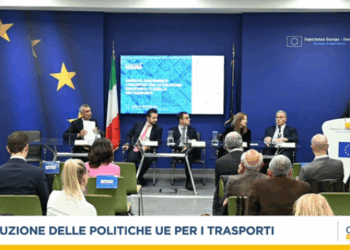
Brussels – Momentum and uncertainty. These are the lights and shadows of the Italian and EU air and maritime transport sectors, facing the immense challenge of decarbonisation and energy transition. The snapshot was taken today (30 October) by some of the key players in the Italian supply chain, together with representatives of European institutions, at the Connact focused on the evolution of EU transport policies.
The starting point is that aviation and maritime transport are the two sectors most in difficulty—compared to road and rail transport—in the path indicated by Brussels in the Green Deal. Here, more than elsewhere, electrification cannot be the only solution. The European Commission, which in Ursula von der Leyen’s second term of office is reviewing some of the cornerstones of the green architecture built up over the previous five years, is about to present on the one hand an action plan for high-speed rail, and on the other hand an investment plan for sustainable transport (STIP), which will focus precisely on the port and airport systems of the Member States.
But the race to reduce the sector’s environmental impacts has already begun. At the port of Civitavecchia, for example, “two projects symbolic of the transition” are being developed, stressed Susanna Ceccardi, MEP for the Lega, speaking at the meeting. They are Cold Ironing, a system to reduce harmful emissions from ships while in port, and Hydrogen Valley, which envisages the creation of a plant to produce green hydrogen from renewable sources in the area behind the port.
Ceccardi issued a warning: “Technology is not enough if strategy is missing.” The fear is that these “flagship” projects financed with NRRP funds will remain “isolated” and therefore “incapable of really making the transition operational.” Without a strategy for their replicability, there is only a risk of “wasting resources,” said the Lega MEP.

These two projects, along with bringing “substantial funding”, have created “particular momentum” at the Civitavecchia port. This was said by Raffaele Latrofa, Extraordinary Commissioner of the Port Authority of the Central-Northern Tyrrhenian Sea. Along the same lines as Ceccardi, Latrofa also highlighted the need for “a more extensive network,” because otherwise shipowners will not convert their fleets to the appropriate technology and, therefore, the port would not have an “answer that is also sustainable from an economic point of view.” “Sustainability,” the engineer insisted, “rests on three legs: economic, social, and environmental.”
In short, the supply chain must proceed in harmony. Infrastructure, fuel producers, shipowners, and shipbuilding. As Davide Cucino, Senior Vice President for EU and NATO Affairs at Fincantieri, reiterated, the strategy for the European maritime industry and that for the port system “must necessarily go hand in hand.” Cucino emphasised that the subject of the maritime sector “is a sensitive one” and ultimately concerns “the security of the continent.”
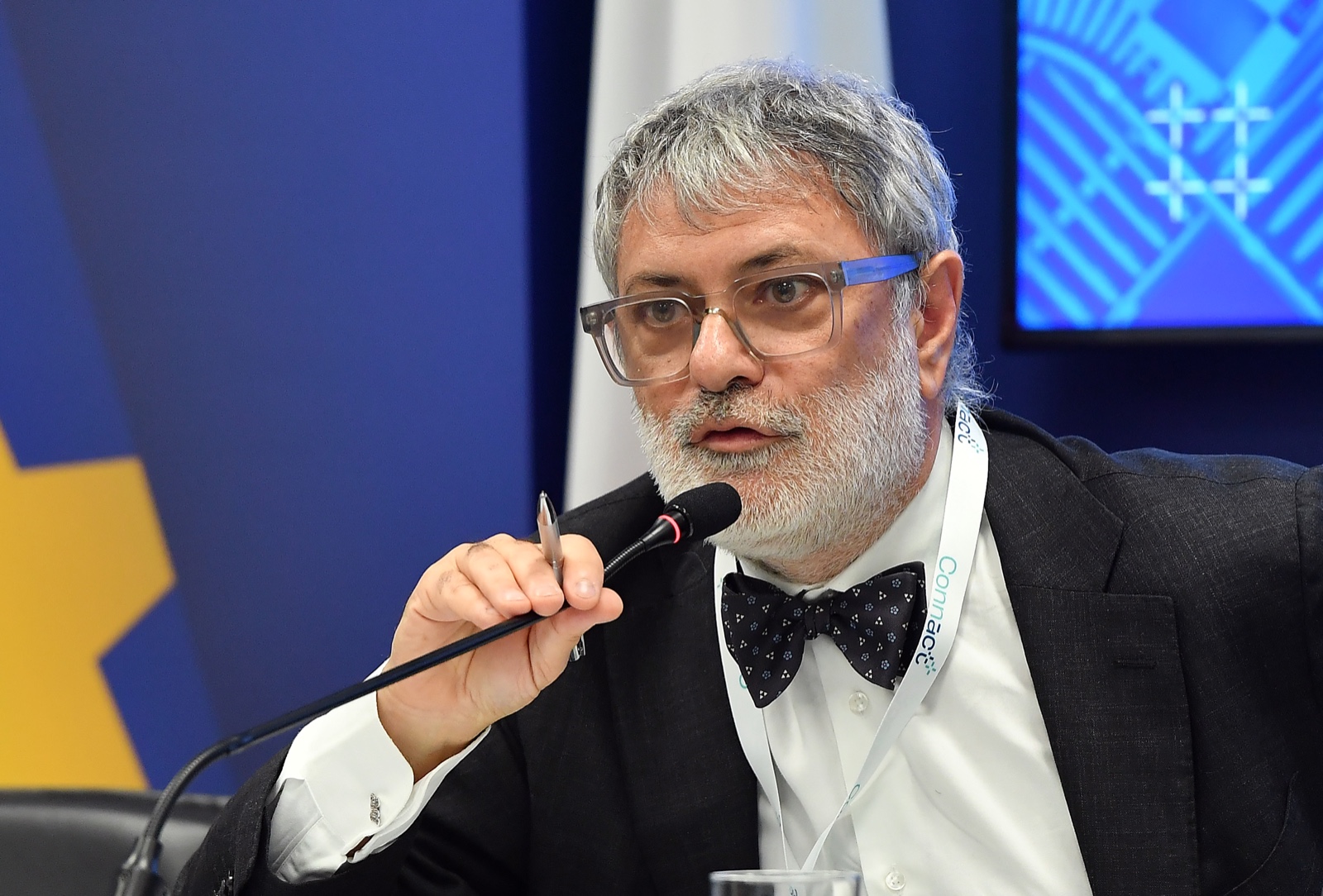
On the affirmation of the principle of technological neutrality, Cucino pointed out that for the maritime system, “it is not possible to think of a single mode of propulsion,” because ships “are different and serve different purposes.” The problem is that, faced with the intermittent openings and closures coming from Brussels, “today prevails a feeling of uncertainty.” Planning investments is a leap in the dark, because “the legislative situation we had until a year ago, today is completely different.” The uncertainty is all the more evident in the face of the already uphill debate on the Union’s new multiannual financial framework: “We need budgets” to accompany maritime transport in the transition, warned Cucino.
Giuseppe Lupo, MEP of the Democratic Party and Vice-Chairman of the Budget Committee (BUDG) at the European Parliament , spoke on the 2028–2034 budget. “The importance of the new multiannual framework for the sector is clear,” Lupo confirmed, announcing that just today the pro-European majority groups—Popular, Socialist, Liberal and Green—wrote a joint letter to Ursula von der Leyen asking for “substantial changes” to the two trillion budget proposal fragmented into 27 national plans put on the table by the European Commission. “We will work for corrections; there is time,” Lupo continued. “It would be important to approve it quickly in order to give an overall reference framework to Member States and operators in the sector. The Dem MEP finally invited stakeholders to pay attention to the new Pact for the Mediterranean, recently presented by the European Commission, which “will have important implications” for the supply chain.
Closing the debate came the response from Pierpaolo Settembri, deputy head of the cabinet of the European Commissioner for Transport, Apostolos Tzitzikōstas. Settembri reassured that the two communications that will be adopted by the College of Commissioners next week (the one on high-speed trains and the one on sustainable transport) “reflect the requests” of stakeholders. Settembri also warned that, to overcome uncertainties and ground an energy transition across the entire supply chain, “we will need resources, not only European and national, but private investment.”
The event concluded with an interview with Enrico Pujia, Chief of the Department for Infrastructure and Transport Networks at the Ministry of Infrastructure and Transport, who explained that despite a necessarily restrained financial law, the government is also working on the issue of civil infrastructure. For example, “optimising the EU project on military mobility, on which we are dutifully working, but with an eye to dual use, to allow the movement of goods as well, when possible.”
Pujia then urged caution with comparisons with other countries on the subject of “sustainable” investments. “Then there are difficulties with individual countries; for example, in Germany,” he explained, “the hydrogen train is designed on networks that run on flat terrain; here, with mountains and therefore tunnels, it is much more complicated, there are risks with respect to hydrogen tanks,” and therefore the design is much more complex.
Now, the manager explained, “We are experiencing a particular economic situation. We are finishing the NRRP commitments, and we understand the inconveniences. Still, improvements are being made that will significantly change things for the future.” Now, he hopes, “we have to think about the medium to long term. We have five European corridors and we must complete the so-called “last mile” (the local connections of the large networks, ed.). But the current logistics system will eventually be completely different; we will be able to become the Mediterranean logistics platform we have been aspiring to for years.” But, he warns, “when we open the Brenner Pass, for example, our operators will have to be ready with an integrated logistics strategy. We must avoid foreign players, we must defend our competitiveness, and for all objectives, state intervention is not enough; we must create a system with producers, operators….”
English version by the Translation Service of Withub