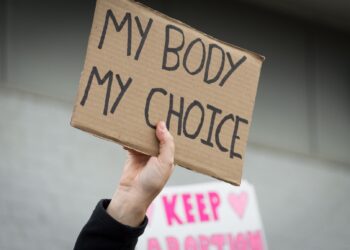
Brussels – One step closer to free and safe access to abortion in the EU. The EU Parliament’s Committee on Women’s Rights and Gender Equality (FEMM) adopted today (5 November) a draft resolution to be submitted to the plenary of the hemicycle and an oral question addressed to the EU executive, as requested by the transnational campaign “My Voice, My Choice“.
With today’s vote (26 in favour, 12 against and no abstentions), MEPs gave the first formal green light to the popular initiative signed by over 1.2 million citizens of the Union (the minimum legal threshold for a bottom-up proposal to reach the Berlaymont is 1 million signatures), exceeded by this campaign last September) which asks the European Commission to guarantee the voluntary interruption of pregnancy (VIP), whereas in some member states this right is in fact denied.
The draft resolution—to be voted on by the chamber at a forthcoming plenary session in Strasbourg—is based on the consideration that many women in the Twenty-Seven still lack full access to safe and legal abortion, given the many legal and practical obstacles that remain in many contexts. The FEMM commission’s call to chancelleries is to reform their domestic laws to bring them in line with international human rights standards, as well as to improve the quality and dissemination of information on sexual and reproductive rights, family planning, contraception, abortion, and maternal health care (with support from Brussels).
Thank you, thank you, thank you pic.twitter.com/LpQHwCDDP5
— My Voice My Choice (@MVMC_24) November 5, 2025
At the same time, the MPs expressed “deep concern” about the growing backlash against women’s rights and gender equality all over the world, including very civilised Europe, and “strongly condemned” anti-gender movements that seek to minimise equality and human rights. Very good timing, considering that these days the Latvian case broke out (again): the Parliament in Riga first voted to withdraw the Baltic Republic from the Istanbul Convention against Violence against Women and then, following pressure from public opinion and the head of state,
backtracked, postponing the issue until November 2026.
In line with the demands of the campaigners, the MEPs also urge the Berlaymont to set up, on a voluntary basis, an optional financial mechanism open to all Twenty-Seven to “guarantee solidarity.” These funds, which the EU would provide, should allow member states to make VIP concretely accessible to women who are still unable to take advantage of it, even across borders (i.e., allowing abortion in a country other than one’s own, if in the latter such a possibility is de facto precluded). In the oral question to the Commission, the chamber will ask for details of the roadmap it intends to follow to implement the initiative.
FEMM’s rapporteur, Swedish liberal Abir Al-Sahlani, stated that “no woman should be forced to leave her country to exercise her human rights,” recalling that “sexual and reproductive health care is a fundamental human right” to be guaranteed not only on paper but also in practice. “This initiative,” she added, “shows what is possible when citizens and institutions join forces to promote equality and democracy”.

Benedetta Scuderi, a FEMM member on the AVS quota, claims that “sexual and reproductive rights are not a matter of national borders, but universal human rights,” lamenting that “in too many European countries, women and people with the capacity to manage a pregnancy are still forced to travel, to hide, to suffer institutional violence just to be able to decide on their own bodies.” Europe, she argues, must “ensure that freedom of choice is real, not a geographical or economic privilege.”
The M5S MEP Carolina Morace, another FEMM member, specifically welcomes the introduction of “a European fund to allow women to safely and legally abort in another European country if this right is not guaranteed in their own.”
For the promoters of the initiative, today’s result is a success to be celebrated without resting on their laurels, since the real turning point will be the vote in plenary. “We will have to convince more than half of the MEPs,” explained My voice, my choice coordinator Nika Kovač. “It will be very hard,” she commented, promising, however, that “we will continue to fight until the end.“
English version by the Translation Service of Withub