




Brussels – The European Parliament has adopted its position on two legislative proposals that will help shape the future of the continent’s competitiveness and sustainability: the amendment of the European climate law—setting a 2040 emissions reduction target—and the regulatory simplification of the directives on sustainability reporting and due diligence for companies. The affair, however, is above all political, and tells of a party, the European People’s Party, which does as it pleases in Europe and can ally itself at will with the progressive or the ultra-conservative wing of the EU Parliament to impose its diktats.
On the surface, the outcomes of the two votes today (13 November) are so similar that they almost overlap: Parliament’s negotiating position on the amendment to the climate law was approved with 379 votes in favour, 248 against, and 10 abstentions; that on the simplification package Omnibus I with 382 yes, 249 no, and 13 abstentions. The only constant, however, are the alignments around the EPP: on the one hand the other groups of the so-called “platform”—the coalition with Socialists (S&D) and Liberals (Renew) signed at the beginning of the legislature—and the Greens; on the other hand the three extreme right groups— Conservatives (ECR), Patriots (PfE) and Sovereignists (ESN). In the first case, it was the “platform” that won. In the second, the right-wing alliance. It is the EPP that chooses where the balance tips.
The result is schizophrenic: on the climate law, the EU Parliament confirmed the ambitious target of a 90 per cent reduction in emissions compared to 1990 levels by 2040. A few minutes later, on the simplification of reporting and sustainability obligations for companies, it called for going further than the Commission’s proposal exempting even more companies from complying with the environmental and social constraints set out in the Corporate Sustainability Reporting Directive (CSRD) and Corporate Sustainability Due Diligence Directive (CSDD), two symbolic directives of the Green Deal adopted with great difficulty at the end of the last legislature.
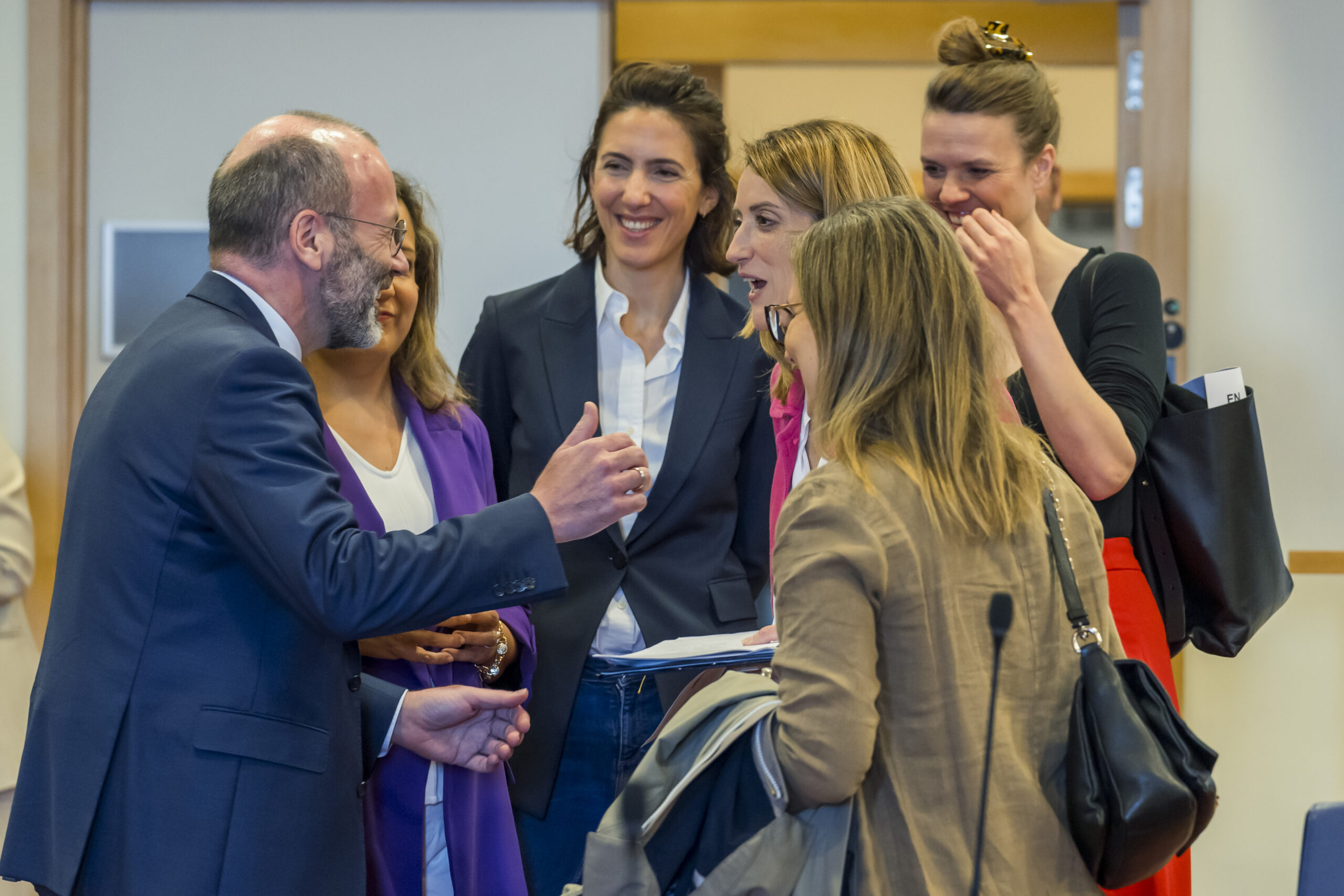
The contradictions are evident in the immediate comments made by the co-presidents of the Greens, a group that, as a stable member of the majority, is now helplessly witnessing the EU’s gradual retreat from its most ambitious environmental policies. Bas Eickhout welcomed the 2040 climate pledge, “a victory for the climate, but also for Europe’s economic future.” Terry Reintke accused the EPP of “obstructionism and blackmail” in the due diligence negotiations, and of ultimately “dismantling legislation that not only protected the environment and prevented child labour in the value chain, but also preserved our businesses and workers.”

The fact is that the People’s Party is capitalising, a year and a half before the European elections, on its overwhelming victory at the ballot box. It has 188 MEPs (the second group, S&D, has 136), it has on its side the President of the European Commission and the President of the Parliament, both popular, and 13 European commissioners out of 27, the expression of 13 national governments led by EPP. At the same time, the rise of the right-wing parties has meant that there is an alternative majority in the EU Parliament to that with the progressive parties, and that, conversely, no majority is in practice possible without the populars.
Little by little, the EPP has fully realised the potential at its disposal and is learning to make use of it. The alliance with the extreme right initially occurred on tiptoe, on files of secondary importance: a resolution on Venezuela, the choice of the Sakharov Prize for Freedom of Thought, opposition to the creation of an interinstitutional ethics body. It has also suffered some defeats, because for it to work, all the EPP national delegations must remain united with the ultra-right. All it takes is a score of rebel voters to wreck the “Venezuela majority”, as it was initially renamed.
The degree of awareness the EPP has reached was evident today. On the climate bill, it tried to stay within the ranks, because on the flexibilities to the target—a share of international credits to meet the target, a review clause, safeguards for specific sectors—it had already reached an agreement with the “platform” in the Environment Committee. Moreover, the same flexibilities had already been indicated by the environment ministers of the 27 Member States and set out in writing by the Heads of State and Government in the conclusions of the European Council. To tell the truth, the EPP attempted to break away to the right, requesting a secret vote on an amendment proposed by the Polish delegation that would have reduced the target from 90 to 83%. The request infuriated Socialists and Liberals; the amendment—despite the secrecy of the ballot box—was rejected, and on the final vote, the EPP fell apart, with the Spanish, Polish, Slovenian, and part of the Italian delegations opposing the agreement.

As for the simplification package, the “platform” had already been derailed three weeks ago when, at the European Parliament’s plenary session in Strasbourg, around thirty socialist MEPs rejected the compromise agreement (a watered-down version of the EPP’s “take it or leave it” proposal) that had been reached at the last minute between the EPP, S&D, Renew, and the Greens and had already been approved by the parliamentary committee. At that point, the EPP’s MEP Jörgen Warborn, the text’s rapporteur, refused to return to the table with the pro-European majority groups and tabled a series of amendments to reduce further the scope of the directives on reporting and due diligence. The EPP amendments were all adopted, thanks to the support of the ECR, PfE, and ESN.
With regard to the obligation to report on social and environmental impacts, the EU Parliament thus reduced the scope to companies with more than 1750 employees and an annual net turnover of more than €450 million. Control and verification obligations over the entire supply chain only apply to companies with more than 5,000 employees and a net turnover exceeding €1.5 billion.
Gone—compared to the failed compromise in the “platform”—are the obligation for companies to prepare a climate transition plan and the fines of up to 25 per cent of turnover for non-compliant companies: the size of the fines will be determined by Brussels together with the member states. On the backward step on the transition plans, Warborn justified himself by pointing the finger at the socialists. “In the first compromise, I had managed to include them,” he admitted, despite the fact that a large part of the group was against. But after the “no” to the agreement in the plenary session, “the mood has changed.”
Herein lies the key to the EPP’s strong position. And Warborn—as well as its president, Manfred Weber—is one of those who has understood this perfectly. Offering the progressive groups compromises that come enormously close to their own political priorities, and then waving the card of a possible alliance on the right to make the socialists, liberals, and greens swallow the bitter pill. “Today we voted together with the platform on the 2040 climate target. I will enjoy working with them in the future, but when you don’t have a majority, you have to find a majority,” Warborn confirmed.

On the other hand, after the failed vote on the Omnibus I package, the President of the EU Parliament, Roberta Metsola, invited her group to “find the numbers” elsewhere. Today’s “absolute novelty,” exulted Nicola Procaccini, ECR group leader, was possible “thanks also and above all to the role of the European Conservatives, who act as a bit of a bridge between the different groups” on the right wing of the chamber. Carlo Fidanza immediately tried to draw the consequences: “Given that a previous compromise made by the EPP with the left had been scuttled, while today’s was voted through,” for the Melonian, “even for the next steps in the simplification, the pattern will have to be the same, it can only be the same.”
True, the EPP will most likely adopt the same pattern again. Because in the centre and to the left, no one seems to have the courage to pull the plug on a majority that is actually subjugated to EPP’s will. And because on the right, you can be sure that, if necessary, the ECR will continue to “act as a bridge” between the two far-right groups, Viktor Orbán’s Patriots and the Sovereignists of Alternative für Deutschland, whom Weber’s Christian Democrats themselves—including European Commission President Ursula von der Leyen—still consider unpresentable. Perhaps here lies the only way out for the Socialists, Liberals, and Greens: to force Brussels to continue the legislature with a majority made up of unpresentables, to be the only possible one, and in the light of day. That would indeed be a real headache for Weber and von der Leyen.
English version by the Translation Service of Withub
![La presidente del Parlamento europeo, Roberta Metsola [Bruxelles, 23 ottobre 2025 Foto: European Council]](https://www.eunews.it/wp-content/uploads/2025/10/metsola-251123-350x250.jpg)




![La video riunione dell'Eurogruppo [27 marzo 2026. Foto: European Council]](https://www.eunews.it/wp-content/uploads/2026/03/eurogruppo-260327-120x86.jpg)
