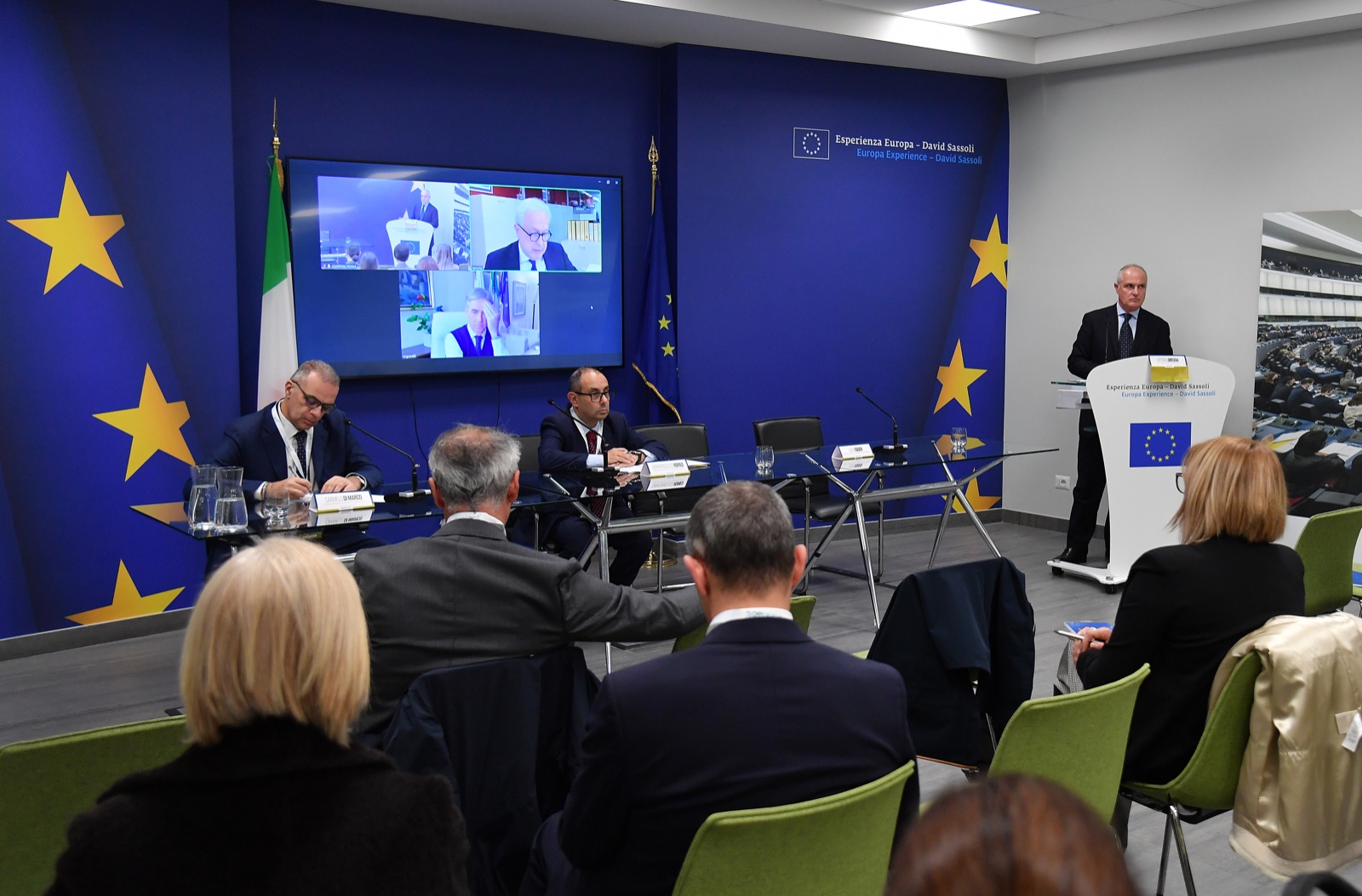
Brussels – Sustainability—yes, but business-proof. Up to now, the European Commission has pursued a policy that has been unbalanced to the extreme in favour of ‘green’, without paying attention to the productive world, which is now calling for greater attention. This is the recipe for EU competitiveness, offered during the round table on “Clean Industrial Deal and Single Market Strategy: the new path to sustainable EU growth“, organised by Connact, the platform that fosters dialogue between enterprises and institutions through meetings and networking.
The most glaring example of a way of doing things that did not take the business world into account is the regulation on deforestation, according to Paolo Fantoni, Deputy Vice President of FederlegnoArredo and President of Assopannelli. The measure was first postponed to December 2024, only to be put on standby again less than a year later. “We observe how this legislation was brought to an end two years ago without consultation with the categories, which could have avoided the bellyaching we are witnessing in recent months,” says Fantoni, who wants to be clear: “The reflections we make as a confederation are polemical” towards an uncaring EU. “The lesson we must learn from the mistakes made in drafting this legislation is not having listened to the European federations.”
What is needed, therefore, is a change of course that puts businesses at the centre. This is something that Marco Granelli, President of Confartigianato Imprese, also calls for when he says that “we share the basic idea of a better balance between sustainability and competitiveness, but decarbonisation must be accompanied by a strategy for strengthening the European economy,” which inevitably requires a vision that is not ideological but as factual as possible. “However, in theGreen Industrial Deal, the Commission seems to start from a vision oriented towards large companies without considering small and medium-sized enterprises,” which risks leading to neither growth nor competitiveness, given that SMEs “make up 94 per cent of the industrial fabric.” For Granelli, there is no alternative: for sustainable growth in the EU, “we need measures that enhance this model.”

Carmelo Di Marco, Vice President of the National Council of Notaries, proposes instead a model for certifying data relating to companies. “The legality check before the birth of a company and the publicity in business registers are two parts of a pair for a model that is important,” he emphasises. He then specifies: “The certification of the data is absolute, indisputable, indestructible. Thanks to publicity, certified data becomes certified for everyone and forever. This combination works well.” In terms of the twelve-star agenda, then, “the principles of simplification, harmonisation, and competitiveness find the Italian notariat in agreement,” and in this sense, “we want to participate in these processes, and we are convinced that all three objectives are within reach if we export the Italian model.”
Quite another model is being proposed by a section of politics. The recipe offered by European MP Isabella Tovaglieri (Lega/Pdf), a member of the Industry Committee, is to completely abandon the sustainability agenda: “Once upon a time, there was a green deal? If only! There are still those who persist with it, and we have to come to terms with that.” In her opinion, it is the green strategy and the resulting measures that are the real brake on Europe’s growth. “The EU’s environmental targets are unachievable,” she criticises. “We can no longer afford these measures; our manufacturing sector must be protected.” Translated: ‘We must continue to make sustainable businesses without ceding market share to other players who do not respect environmental rules, and that is market share that we no longer recover.”
Of the same opinion is Stefano Cavedagna (FdI/ECR), member of the internal market committee and vice-president of the special committee on the European Democratic Shield: “We cannot, on the altar of ecological transition, sacrifice our competitiveness. We are one of the few in the European Parliament to push this principle forward.” Business-friendly growth requires a U-turn. Cavedagna insists. “If we do not understand that we have to reverse course on the green deal, on deforestation, on the bank for emission bonds, we are heading towards happy degrowth.” He then relaunches the alliance that already exists in the European Parliament and alternatives to the so-called “Ursula majority” (popular-socialists-liberals-greens): “We must reverse this course, with all the forces and with all those who want to be there, our patriot friends, our EPP friends.”

Tries to lash out at governments Brando Benifei (PD/S&D), member of the Committee on International Trade: simplification is welcome, but “simplification does not mean deregulation,” he premised. This means that “we need to strengthen the implementation in a harmonised way of standards that are European and then implemented nationally.” States must play their part, then. And not only in this sense. “The capital market must be completed; we are lagging behind. We cannot waste any more time. If nationalist forces put the brakes on, other countries must step up, with common debt and common loans.
This, in his opinion, is how to revive growth and competitiveness.
From the European Commission, Salvatore D’Acunto, head of unit DG GROW E.2, points out that the EU executive has not ignored businesses. On the contrary, he emphasises, “thanks to the first omnibus packages, €2.8 billion in simplification measures have been freed up, and other omnibus packages are to follow.” However, he also shares the view that it is up to the countries to get busy. “It is first and foremost up to the Member States to implement the rules of the internal market. In order to overcome barriers and fragmentation and thus release the full growth potential, “it must be national authorities and operators who defend these rules, which must be reasoned, transparent, but also fair and impartial.”
This approach also seems to be shared by Gianfrancesco Romeo, Director General of DG Consumers and Market of the Ministry of Enterprise and Made in Italy (MIMIT): “The single market is a market of 450 million consumers, €18 trillion, 26 million companies. It is certainly a value to be pursued.” So, it follows that “a completed and improved internal market can provide an opportunity for a better offer.” For this to happen, everyone must play their part: ‘We are all in the middle of the river. Operators must also be aware that the goals we set ourselves on the single market are achievable if we all work together.”
What is certain is that the EU must get its act together. “Twenty years ago, the GDPs of the United States and the European Union were more or less similar; today, the GDP of the United States is 60 per cent higher than that of Europe,” laments Fabrizio Spada, Head of Institutional Relations at the EU Parliament’s Liaison Office in Italy. “I hope that Europe can find its way back to growth, always respecting the environment.”
English version by the Translation Service of Withub