Brussels – Protests are good for something, Bulgaria confirms. If in Serbia and Georgia people take to the streets to demand the resignation of their rulers who cling to power, in Bulgaria, where democracy still has its place, it was a different story.
This morning, 11 December, Prime Minister Rosen Zhelyazkov, a member of the conservative GERB party (EPP), resigned following the massive marches over the past few days. The largest took place last night, when thousands invaded the centre of the capital, Sofia. The mobilisation was spurred by two opposition formations: the centrist Democratic Bulgaria alliance and the liberal, pro-European Continue the Change party. However, the protest was transversal, uniting Bulgarian dissent beyond political orientation.

The manoeuvre that blew up the government
The resignation did not come out of the blue: Bulgarian citizens have been taking to the streets for several weeks to accuse the government of corruption aimed at favoring the interests of the political elite. The main protest concerns the intention to pass a budget law that would increase taxes on the private sector. According to the protesters, the only purpose of this is to finance the increase in civil servants’ salaries, the electoral base of the governing parties.
The budget manoeuvre was already historic in itself for Bulgaria. Zhelyazkov’s executive was about to adopt a euro law for the first time. Sofia will, in fact, adopt the single currency as of 1 January 2026. The choice has never excited the population, with many Bulgarians believing that adopting the euro would raise prices, further impoverishing citizens’ pockets. The introduction, if mishandled, could in fact cause significant disruptions to the Bulgarian economy, which has the lowest GDP per capita in the Union.
Let’s take a look at the most popular stat of last month ⬇️
The EU’s GDP per inhabitant was 38 100 in PPS in 2023.
Among EU regions, highest in:
Dublin (139 500 PPS)Lowest in:
Mayotte (10,500 PPS)Learn more https://t.co/Ni2NYkHjBl#EurostatTopPosts pic.twitter.com/TohnbDpHU2
— EU_Eurostat (@EU_Eurostat) November 1, 2025
Seven elections in three years and heading for an eighth
Linked to the economic problems, a certain political instability persists in Bulgaria. In three years, there have been seven elections, the last in October 2024, after which the formation of the government required lengthy, complex negotiations.
The now-resigning prime minister had managed to secure his appointment thanks to the support of three other parties: his GERB, the BSP socialists, and the populist formation “There is a people like this” (ITN).
The majority, to reach the required 121 seats, had relied on external support from the “Movement for Rights and Freedoms – New Beginning” (DPS-NN) party, an expression of the Turkish minority in Parliament. It was precisely the crutch of DPS-NN, led by Delyan Peevski, owner of a vast media empire, that had generated impatience among the Bulgarian population. Peevski is a controversial figure, sanctioned by the US and UK for corruption, bribery, and embezzlement. Radio Free Europe called him “the embodiment of collusion between media, politicians and oligarchs.”

The push of the protesters
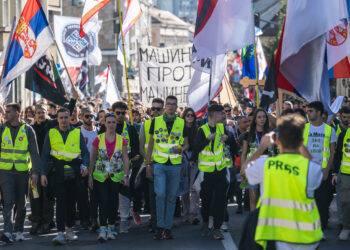
In such a political context, the demonstrations tipped a very delicate balance. Protesters took to the streets with placards such as “Mafia rule is over!”, making it clear that the civil population is far from the “unclear” dynamics of Bulgarian power. The scenarios now opening are those of early elections, as demanded by President Rumen Radev.
Looking at the precedents, however, it can already be predicted that forming a stable majority will not be easy even after a new election round. To date, the formations that have managed to take over the protests, such as Democratic Bulgaria (composed of three centre and centre-right parties) and Continue the Change, a centrist and pro-European party, can be considered on the rise.
Related to strictly current events, Bulgaria’s Permanent Representation to the European Union confirmed that “according to the Bulgarian constitution, until there is a new appointment, Prime Minister Rosen Zhelyazkov will remain on current business and thus attend the European Council,” scheduled for 18 December.
English version by the Translation Service of Withub


![[foto: European Council]](https://www.eunews.it/wp-content/uploads/2025/02/ue-georgia-350x250.png)