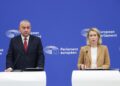
Brussels – It is in everyone’s interest to reach a positive outcome on the commercial agreement between the European Union and Mercosur. This was said by the Minister of Agriculture, Francesco Lollobrigida, on the sidelines of the Agriculture and Fisheries Council of the European Union in view of the opening of a week—the next one—that will be crucial for the dossier: the President of the European Commission, Ursula von der Leyen, aims to fly to Brazil on Saturday 20 December to sign the agreement in the context of the Summit of Mercosur States, but support among EU member states is still uncertain.
“As far as Mercosur is concerned, discussions are ongoing and we hope to have all conditions in place for a signature next weekend,” said the European Commission’s chief spokesperson, Paula Pinho, at the daily press briefing responding to a request for confirmation of von der Leyen’s trip next weekend, as the appointment does not yet appear on the EU leader’s official agenda. “I believe that it is in everyone’s interest” to arrive at a positive outcome, “and, therefore, that there should be no ideological preclusions,” Minister Lollobrigida summarised, at a press point on the sidelines of the EU Agriculture and Fisheries Council. “If time allows, the sooner it is done, the better. If the timescale does not allow it, it will mean that there will be more time” to get to the end of the road. “But the tendential objective for Italy remains to protect the European production system and, within the European production system, the Italian one,” he pointed out.
Italy is, along with France, among the countries most doubtful about the agreement with Argentina, Brazil, Paraguay, and Uruguay, and which has asked for the most guarantees. A history, that of Mercosur, 25 years long, with negotiations that have been concluded twice—the second time in December last year—but without ever leading to the real start of the agreement due to strong internal opposition within the EU, in particular in the agricultural sector. The goal of the political agreement brought home in December 2024 by der Leyen—which Brussels has repeatedly described as “different” from the one of 2019—is to create a free trade area, which, especially in times of tariffs, the need for diversification of supply chains and complicated relations with China and the United States, takes on the contours of a necessity for the Union.

Some figures: the agreement would open the market of 270 million people to European companies, cut current duties (35% on car parts, 20% on machinery, 18% on chemicals, 18% on pharmaceuticals), and save exporters more than €4 billion annually. In the agriculture and food sector, the agreement would remove current duties (28% on dairy products, 20% on chocolate; 35% on spirits, 25% on wines). In addition, 340 EU protected geographical indications would be recognised by the agreement. On the other hand, “very limited” access to the EU market is granted for sensitive agri-food products from overseas, such as beef, poultry, or sugar.
The EU executive has worked to meet the demands of countries and sectors for guarantees. In particular,
it introduced a fund in the next long-term EU budget to help farmers in the event of market disruptions and to safeguard sensitive products (beef, poultry, dairy products, sugar, and ethanol) against price changes. “Many sectors of the industry, but also of the agricultural world—I am thinking of the wine sector, cheese producers, and related supply chains—are likely to benefit objectively. Others, on the other hand, could be penalised. What has been Italy’s exact objective since 2024? That of trying to safeguard everyone,” Lollobrigida pointed out.
“To do this, we have requested and obtained that there be a guarantee fund to rebalance any criticalities” and “we have also obtained the so-called handbrake, the possibility in the event that there is a reduction in the value of some productions, even in a single country, to reactivate protection clauses linked to the tariff system,” he recalled. But “we are not quite there yet, because the third argument that applies for us on Mercosur, but also in principle for future agreements, is the principle of reciprocity: if you impose rules on your producers, you cannot allow products to enter that are produced in a way that is totally distant from this type of virtuous process,” the minister noted.
Next week is, therefore, crucial. On Tuesday, the Parliament will vote on safeguard clauses to strengthen the protection of EU farmers in the context of the EU-Mercosur partnership agreement. In fact, the proposal foresees that the Commission will launch investigations into price changes. If it concludes that there is “serious damage,” the EU may temporarily withdraw tariff preferences on products causing damage. Translated, duties would be reinstated.
The stance of the member states is also expected this week. And here come the clear noes of Hungary and Poland and the abstentions of Belgium and Austria. At the same time, other countries—France, Italy, the Netherlands, Ireland, and Romania—have not yet withdrawn their reservations. “How our country will position itself will be decided by the government as a whole,” summarised Lollobrigida. “Italy, unlike other important nations, has not had an ideological position, but simply a practical one: we say yes to Mercosur and to any agreement of a commercial nature, as long as we do not think of benefiting some economies or some sectors while devastating others. It is possible, we have proved it in practice, to achieve a full result,” Lollobrigida recalled.
English version by the Translation Service of Withub![[foto: Rr Gimenez/Wikimedia Commons]](https://www.eunews.it/wp-content/uploads/2025/11/ue-350x250.png)