- Europe, like you've never read before -
Saturday, 21 February 2026
No Result
View All Result
  • it ITA
  • en ENG
Eunews
  • Politics
  • World
  • Business
  • News
  • Defence
  • Net & Tech
  • Agrifood
  • Other sections
    • Culture
    • Diritti
    • Energy
    • Green Economy
    • Finance & Insurance
    • Industry & Markets
    • Media
    • Mobility & Logistics
    • Sports
  • Newsletter
  • European 2024
    Eunews
    • Politics
    • World
    • Business
    • News
    • Defence
    • Net & Tech
    • Agrifood
    • Other sections
      • Culture
      • Diritti
      • Energy
      • Green Economy
      • Finance & Insurance
      • Industry & Markets
      • Media
      • Mobility & Logistics
      • Sports
    No Result
    View All Result
    Eunews
    No Result
    View All Result

    Home » Mobility & Logistics » INTERVIEW / Nowacki (EESC): Sustainable mobility should be for all. As for the Messina Strait Bridge — hard to justify today

    INTERVIEW / Nowacki (EESC): Sustainable mobility should be for all. As for the Messina Strait Bridge — hard to justify today

    The Polish entrepreneur explains to Eunews what he means by 'green transport,' especially in relation to the Commission's desire to connect the entire Union with high-speed rail. And gives his blessing to the 'military Schengen' in the name of cross-border interoperability

    Francesco Bortoletto</a> <a class="social twitter" href="https://twitter.com/bortoletto_f" target="_blank">bortoletto_f</a> by Francesco Bortoletto bortoletto_f
    22 December 2025
    in Mobility & Logistics
    Marcin Nowacki

    Marcin Nowacki, membro del Comitato economico e sociale europeo (foto: Cese)

    Brussels – At least since the days of the green deal – which today, however, seems to go back to prehistoric times – sustainable mobility has been at the heart of the European Commission’s priorities. However, building a continental green transport network comes with significant costs, including social costs. Particularly at a historical juncture when EU policy (and others) focuses primarily on the economy and defence.

    We spoke about this with Marcin Nowacki, vice-president of the Polish Union of Employers and Entrepreneurs (ZPP) and president of the European Business Alliance (EEA), who chairs the Transport, Energy, Infrastructure and Information Society (TEN) commission at the European Economic and Social Committee (EESC). 

    The Trans-European Transport Network (TEN-T) is “the centrepiece of our ambitions,” Nowacki told Eunews, referring to the new regulation adopted last year by the EU co-legislators, the Council and the European Parliament. The text ‘”sets out a three-stage timetable for the completion of the network,” he explained. “The central network by 2030, the extended central network by 2040, and the global network by 2050.”

     Of the three, he notes, the 2040 deadline is “particularly significant because it focuses on closing cross-border gaps,” since “many regions of the EU still lack high-speed lines or face persistent interoperability problems at their borders,” leading to fragmentation along national lines.

    Marcin Nowacki
    Marcin Nowacki, President of the Transport, Energy, Infrastructure and Information Society Section of the CEE (photo: European Economic and Social Committee)

    How do we overcome these bottlenecks? We are not just talking about “laying the track:” the realisation of “a Europe-wide high-speed rail network,” he reasons, “requires interoperability (e.g. common standards, signalling, electrification), efficient cross-border operations, coordinated investment, and political will.” For Nowacki, the 2025 Plan recently proposed by Brussels to accelerate the construction of a continental rail network “implies an exceptional coordination of funding” and must therefore be implemented with the utmost care to avoid waste of resources.

    Speaking of funding, the EESC member admits that “the transition to sustainable mobility requires strong initial investments in infrastructure and technology,” including modernising public transport fleets, building charging stations, and integrating intelligent traffic management systems. Costs are “still higher in suburban and rural areas, where existing infrastructure is limited,” and citizens’ “equitable access” to green opportunities must be ensured. 

    “Making mobility sustainable means planning for everyone, not just for big cities,” Nowacki reiterates, adding that “local authorities, transport operators, and communities themselves must work together” to achieve shared results. “If we skip this process – which goes through effective mobility plans – we will end up with fragmented solutions,” he warns, “that leave someone behind.” 

    In short, is decarbonisation a privilege for the few? “Certainly it is an expensive process,” he concedes, and therefore “solutions appropriate to the possibilities at the local, national, and European levels must be sought.” The latter plan, at the community level, is indispensable according to Nowacki: “Without a European perspective, it is difficult to embark on truly ambitious projects,” he notes, due to matters of scale and financial viability.”
    Matteo Salvini Stretto Messina bridge
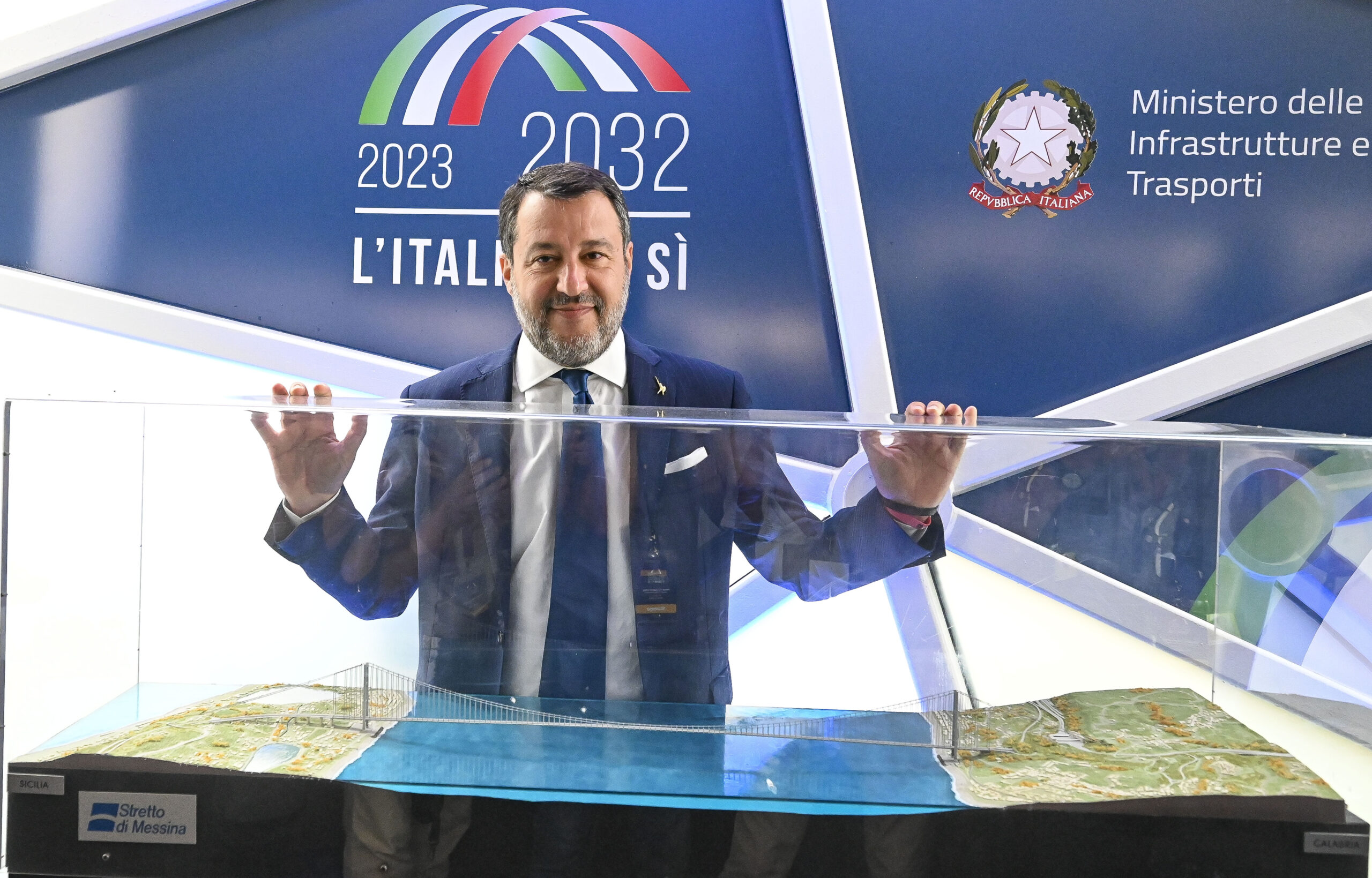
    The Italian Minister of Infrastructure and Transport, Matteo Salvini, with a model of the bridge over the Strait of Messina (photo via Imagoeconomica)
    What about the bridge over the Strait of Messina? Could the maxi-structure so dear to the Minister of Infrastructure and Transport, the League leader Matteo Salvini, represent a project of European interest? Nowacki treads carefully: “The controversies that have long surrounded the project indicate that it is difficult to produce analyses and data that clearly justify an investment of this magnitude,” he tells us, insisting on the need for an analysis of “the risks and economic feasibility,” taking into account “the infrastructure development needs on both sides” of the Strait.

     “Before building a bridge,” he points out, “we should ask ourselves whether improving rail and sea connections might not be a better and more ecological solution.” In other words, “if the bridge does not add clear value to the wider network or risks taking funds away from other important projects, then it is difficult to justify it,” he argues. “Connectivity is crucial, but from a European perspective it must serve a broader interest, not just local ambitions,” he concludes. 

    As for the recent discussions on the so-called “Military Schengen,” Nowacki recognises “the potential for strengthening operational capabilities, promoting interoperability, and aligning with the Union’s broader security strategies.” It is, he says, “a promising step towards strengthening defence cooperation” among the Twenty-Seven member states, recalling that “in times of war, the speed of movement between member states is crucial.” 

    The twelve-star executive would like to enable the movement of troops, weapons, and vehicles across EU territory to the other in three days. Currently, it would take about 45. The point, Nowacki specifies, is that “the concept of military mobility goes beyond simply moving equipment and is an essential element of Europe’s preparedness and resilience in the face of unforeseen challenges.” That is why he considers the legislative package presented last month by the Berlaymont “an important step forward, because we must remain capable of responding to potential threats.“

    English version by the Translation Service of Withub
    Tags: high speedmilitary mobilityrete ten-tSchengen militarestrait bridgesustainable mobilitytransportation

    Related Posts

    EINDHOVEN - King Willem-Alexander during a visit to the international airborne exercise Falcon Leap at Eindhoven Air Base. During this exercise, the Airmobile Brigade and the Air Mobility Command (AMC) will practice dropping cargo and paratroopers over the Netherlands. ANP POOL PATRICK VAN KATWIJK netherlands out - belgium out (Photo by PATRICK VAN KATWIJK / ANP MAG / ANP via AFP)
    Defence & Security

    Defence, EU aims for “military Schengen” by 2027. Kubilius: “Logistics wins wars”

    19 November 2025
    FRECCIAROSSAFRECCIA ROSSATRENO TRENI TRENITALIA FERROVIE DELLO STATO ALTA VELOCITA'
    Mobility & Logistics

    Transport: EU to focus on high-speed rail. Plenty of ideas, but financing needs to be secured

    5 November 2025
    JOINT STARS LA PIÙ IMPORTANTE ESERCITAZIONE DELLA DIFESA, CARRO ARMATO, MILITARE, MILITARI, SOLDATO,SOLDATI
    Defence & Security

    Military mobility: seven years lost since the first 2018 EU action plan

    11 July 2025
    map visualization
    Maros Sefcovic

    Trade, Sefcovic: “Speed up the agreement process. Act quickly on Mercosur, we lost 300 billion due to failure to implement it in 2021”

    by Giorgio Dell'Omodarme
    20 February 2026

    At the informal meeting of EU trade ministers, the European Commissioner for Trade called for the rapid ratification of the...

    dazi

    US Supreme Court rejects Trump’s tariffs: Federal law violated

    by Giulia Torbidoni
    20 February 2026

    The EU Commission: "We remain in close contact with the US Administration to obtain clarity on the measures it intends...

    Virkkunen IA

    The “AI Continent” objective: Europe tightens its schedule (and its ties with India)

    by Annachiara Magenta annacmag
    20 February 2026

    The opening of the European Legal Access Office, as well as the use of "applied" artificial intelligence to transform AI...

    I ministri della Difesa del gruppo 'E5' [

    E5 group launches cooperation on low-cost anti-drone technologies

    by Emanuele Bonini emanuelebonini
    20 February 2026

    Joint statement by the defence ministers of France, Germany, Italy, Poland, and the United Kingdom. Warsaw: "Devices that are revolutionising...

    • Director’s Point of View
    • Letters to the Editor
    • Opinions
    • About us
    • Contacts
    • Privacy Policy
    • Cookie policy

    Eunews is a registered newspaper
    Press Register of the Court of Turin n° 27


    Copyright © 2025 - WITHUB S.p.a., Via Rubens 19 - 20148 Milan
    VAT number: 10067080969 - ROC registration number n.30628
    Fully paid-up share capital 50.000,00€


    No Result
    View All Result
    • it ITA
    • en ENG
    • Politics
    • Newsletter
    • World politics
    • Business
    • General News
    • Defence & Security
    • Net & Tech
    • Agrifood
    • Altre sezioni
      • European Agenda
      • Culture
      • Diritti
      • Energy
      • Green Economy
      • Gallery
      • Finance & Insurance
      • Industry & Markets
      • Letters to the Editor
      • Media
      • Mobility & Logistics
      • News
      • Opinions
      • Sports
    • Director's Point of View
    • L’Europa come non l’avete mai ascoltata
    • Draghi Report
    • Eventi
    • Eunews Newsletter

    No Result
    View All Result
    • it ITA
    • en ENG
    • Politics
    • Newsletter
    • World politics
    • Business
    • General News
    • Defence & Security
    • Net & Tech
    • Agrifood
    • Altre sezioni
      • European Agenda
      • Culture
      • Diritti
      • Energy
      • Green Economy
      • Gallery
      • Finance & Insurance
      • Industry & Markets
      • Letters to the Editor
      • Media
      • Mobility & Logistics
      • News
      • Opinions
      • Sports
    • Director's Point of View
    • L’Europa come non l’avete mai ascoltata
    • Draghi Report
    • Eventi
    • Eunews Newsletter

    Attention