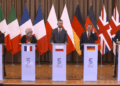
Brussels – The UK and France have put in writing for the first time that—in the event of a peace agreement ending the war in Ukraine—they would be prepared to send troops to the country attacked by Russia to ensure its future security. The trilateral declaration, signed yesterday (6 January) in Paris by Keir Starmer, Emmanuel Macron, and Volodymyr Zelensky, certifies a commitment that is the result of months of discussions between Kyiv and the so-called “Coalition of the Willing“. Back in London today, the Labour Prime Minister reassured the House of Commons: in order to take such a far-reaching decision, the consent of Parliament will be necessary in any case.
“Should troops be deployed according to the signed declaration, I will put the matter to a vote in the House,” he said, pressed by the Conservative opposition. Starmer rewound the tape: “Yesterday we made real progress on security guarantees,” he explained, “which are vital to ensure a just and lasting peace. Together with French President Emmanuel Macron and Ukrainian President Volodymyr Zelensky, we agreed on a declaration of intent to deploy forces in the event of a peace agreement. We will set out the details in a declaration as soon as possible.”
The statement does not provide further clarification on the size or scope of the potential security force, and Macron clarified yesterday—on the sidelines of the Coalition of the Willing meeting—that the aim would be to “provide reassurance after the ceasefire” and stressed that it would be deployed “far behind the line of contact.” Starmer announced that “after the ceasefire, the UK and France will establish military centres throughout Ukraine.”
In the House of Commons, he added that the deployment of troops, who will “conduct deterrence operations and build and protect military centres,” will only take place after a ceasefire. The PM continued: “The number will be determined on the basis of our military plans, which we are drawing up and for which we seek the support of the other members.”
Not all the Willing seem open to the deployment of military forces. The Italian Prime Minister, Giorgia Meloni, has clearly ruled it out, and Zelensky himself, on his arrival in Nicosia for the opening ceremony of the Cypriot six-month presidency of the EU Council, admitted that he had not received “unequivocal answers” from the European allies. In any case, the will of the leaders cannot suffice: Starmer made it clear that “if we get to the point where we have to resort to a legal instrument for deployment, which would be necessary, then I would organise a debate in this House so that all members can know exactly what we are doing, express their views, and then vote in this House on the issue, which is the correct procedure in a situation like this.”
English version by the Translation Service of Withub
![Il presidente ucraino Volodymyr Zelensky in conferenza stampa dopo aver incontrato i leader dell'UE [Bruxelles, 18 dicembre 2025. Foto: Emanuele Bonini]](https://www.eunews.it/wp-content/uploads/2025/12/zelensky-251218-350x250.jpeg)