Brussels – In February 2026, French President Emmanuel Macron was the most popular European leader in the European Union, with 46 per cent of respondents expressing a positive opinion of him—13 per cent “very positive” and 33 per cent “fairly positive”—compared with 39 per cent who expressed a negative opinion. Compared to the November 2025 survey, the approval rating for the head of the Élysée Palace rose by 18 points, from -11 in November to +7 in February. This is what emerges from the new Euroscope survey, a periodic research initiative carried out by Polling Europe, a Brussels-based market research and polling institute, the result of a joint venture between SWG and OpinionWay. The survey was conducted online using the CAWI (Computer-Assisted Web Interview) method with a representative sample of the EU population aged 18 and over. A total of 5,273 complete interviews were conducted, distributed proportionally across the population of the 27 EU countries with a slight correction to allow for pan-European analysis, broken down by the five largest countries (Germany, France, Italy, Spain and Poland) and by three different areas: Eastern Europe, Northern Europe and Southern Europe. Proportional quotas for age and gender were established for each country, based on the most recent Eurostat data. Germans are the most convinced supporters of the French president: in Germany, his approval rating is 53 per cent, while in Macron’s home country, he garners only 30 per cent support. The head of the Élysée convinces almost one in two Spaniards (48 per cent) and obtains 46 per cent of favourable opinions in Poland (46 per cent).
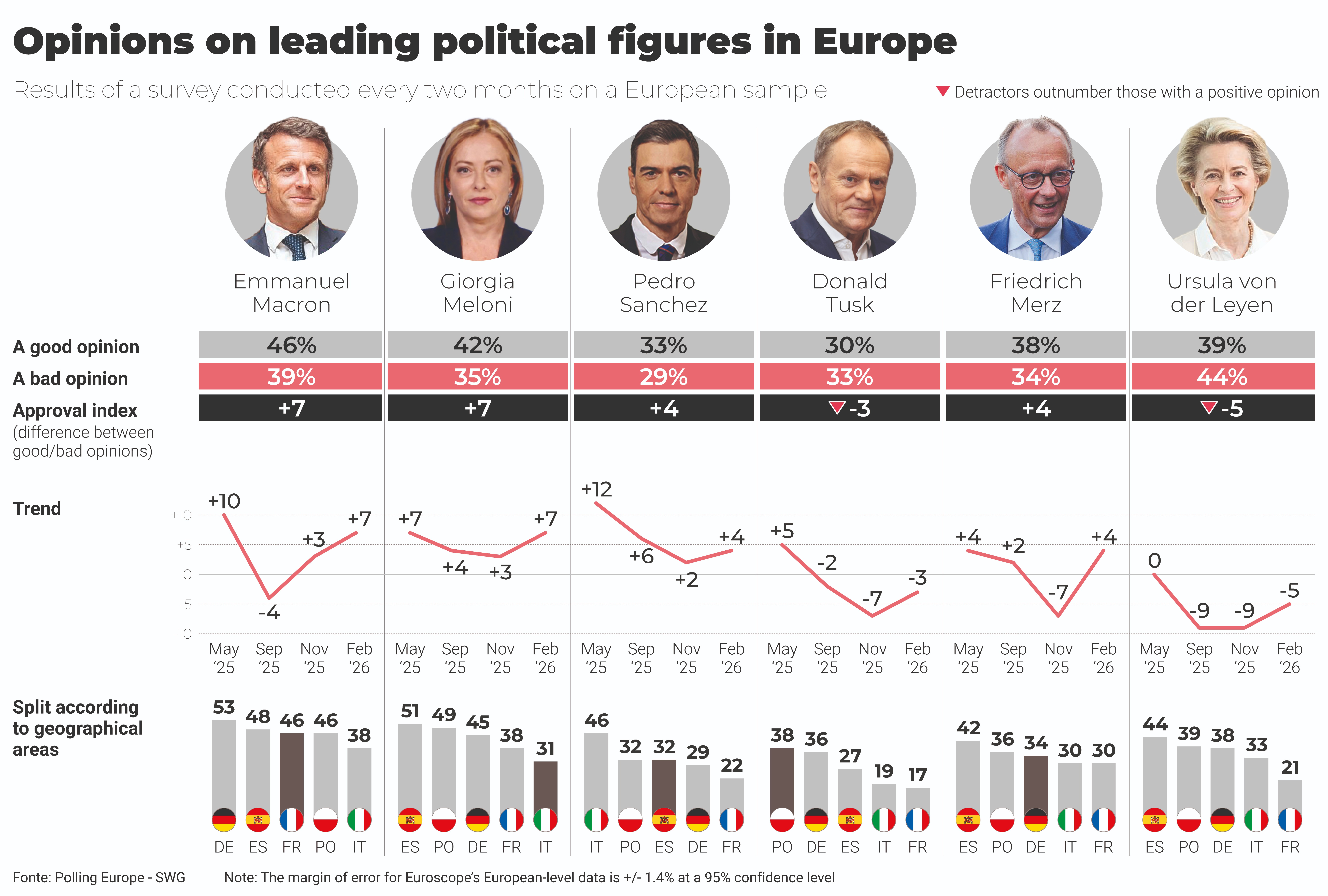
In second place is the Italian Prime Minister, Giorgia Meloni, with 42 per cent positive ratings—with 13 per cent of respondents expressing a “very positive opinion”, 29 per cent “quite positive”, and 35 per cent negative. Meloni also saw her approval rating rise in February compared to last November, by 4 points, from +3 to +7. She is most appreciated by the Spanish (51 per cent), followed by the Polish (49 per cent), the Germans (45 per cent), and the French (38 per cent). As with Macron, Meloni also enjoys the lowest approval rating in her home country, at 31 per cent.
The bronze medal goes to the President of the European Commission, Ursula von der Leyen, with 39 per cent favourable opinions (12 per cent very positive and 27 per cent fairly positive), but 44 per cent negative opinions. The German leader, now in her second term at the helm of the Berlaymont Building, nevertheless saw her popularity rating rise by 6 points in February compared to November, from -11 to -5. Across countries, approval ratings for von der Leyen range from 21 per cent in France to 44 per cent in Spain, with 33 per cent in Italy, 38 per cent in Germany, and 39 per cent in Poland.
In fourth place, with 38 per cent approval and 34 per cent negative opinions, is German Chancellor Friederich Merz. Compared to November 2025, his approval rating has grown by 11 points, from -7 to +4. Looking at individual countries, Merz is most popular in Spain, where he scores 42 per cent. He follows this with 36 per cent in Poland and 34 per cent in Germany. The French and Italians are tied at 30 per cent favourable.
Among the other four leaders in the ranking, those remaining above 30 per cent of favourable opinions among respondents are the Spanish Prime Minister, Pedro Sanchez, with 33 per cent, and the Polish Prime Minister, Donald Tusk, with 30 per cent. Both have grown since February compared to November—the former by two points (from +2 to +4) and the latter by four (from -7 to -3)—and both have a lower share of negative opinions than before: 29 per cent for the Spanish leader and 33 per cent for the Polish one. Looking at the countries in more detail, Sanchez has a 46 per cent positive rating in Italy and 32 per cent in his own country and in Poland. He is less popular in Germany (29 per cent) and France (22 per cent). In contrast to his colleagues, Tusk receives the highest approval in his home country, at 38 per cent, while it drops to 36 per cent in Germany, 27 per cent in Spain, 19 per cent in Italy, and 17 per cent in France.
The other leaders of the Union bring up the rear: the President of the European Council, António Costa, with 28 per cent, and the President of the European Parliament, Roberta Metsola, with 27 per cent. However, a significant finding emerges for Costa and Metsola: almost half of those interviewed (48 per cent for the Portuguese and 47 per cent for the Maltese) say they do not know them well enough to be able to express an opinion. Nevertheless, their positive opinions have increased since November by 5 points (from -1 to +4) and by 1 point (from 0 to +1), respectively. Costa is most popular in Spain (35 per cent), followed by Poland (32 per cent), Germany (26 per cent), Italy (23 per cent) and France (13 per cent). Metsola receives positive opinions ranging from 31 per cent in Poland to 30 per cent in Spain, from 28 per cent in Italy to 26 per cent in Germany and 11 per cent in France.
The political orientation of respondents
As regards the political orientation of respondents, what stands out is the greater support for Macron than for Sánchez among respondents who identify with the socialist family (S&D): the French president obtains 67 per cent of their support, while the Spanish leader stops at 51 per cent. In general, Macron receives a positive rating among voters of the so-called “Ursula” majority parties—Popular (EPP), Socialists (S&D) and Liberals (Renew Europe)—and the rainbow majority (the Ursula majority plus the Greens). In detail, in addition to 67 per cent among socialist party voters, the French president receives 68 per cent favourable opinions in the liberal group Renew Europe—the highest percentage of approval found by any of the leaders mentioned within their own political family—64 per cent among the Popular Party and 56 per cent among the Greens. The head of the Élysée Palace, on the other hand, drops to 37 per cent among La Sinistra voters—whose highest approval rating goes to Sánchez with 42 per cent—to 36 per cent among those who identify with the European Conservatives and Reformists (ECR) group, 33 per cent among the group of Patriots for Europe (PfE), and 29 per cent among the group of Europe of Nations (ESN).
As Macron consolidates the so-called pro-European majority, Meloni is rallying the ranks of a new bloc that ranges from the People’s Party and the Liberals to the sovereigntist groups. The Italian Prime Minister is viewed positively by voters of Renew Europe (51 per cent) and the People’s Party (56 per cent). Within her own political family, she enjoys a 63 per cent approval rating, 61 per cent among the Patriots and 56 per cent among the Sovereign Nations group.
Among other leaders, it is worth noting that Merz enjoys a higher percentage of positive opinions among liberal voters (58 per cent) than among popular voters (54 per cent). The Chancellor also enjoys favourable opinions among socialists (48 per cent) and greens (40 per cent). Sánchez is supported by one in two respondents who vote for S&D (51 per cent), more than four in ten Greens and Liberals (42 per cent and 44 per cent respectively), 36 per cent of those who vote for the EPP and 42 per cent of those who vote for the Left group. Finally, the Commission President receives the same percentage in the three groups of the historic majority, with little variation: EPP (55 per cent), Socialists (54 per cent) and Liberals (51 per cent).
English version by the Translation Service of Withub