Brussels – Women occupy the top positions in three of the seven main EU institutions for the first time, but the base of female political representation is losing ground. This is the contradiction facing the European Union in 2026, according to the latest report from the European Parliament’s Think Tank.
Ursula von der Leyen heads the Commission, Roberta Metsola the Parliament, Christine Lagarde the ECB, while the role of EU High Representative for Foreign Policy (and the diplomatic service of the European External Action Service EEAS) is entrusted to Kaja Kallas. Yet, the overall number of women in the institutions is declining. In the European Parliament, after uninterrupted growth from 1979 to 2019 (when it stood at 41 per cent), the proportion of female MEPs fell to 38.5 per cent after the 2024 elections, marking a worrying halt to a trend that seemed well established. As the research shows, progress towards equality has not only slowed but, in some cases, has literally come to a halt.
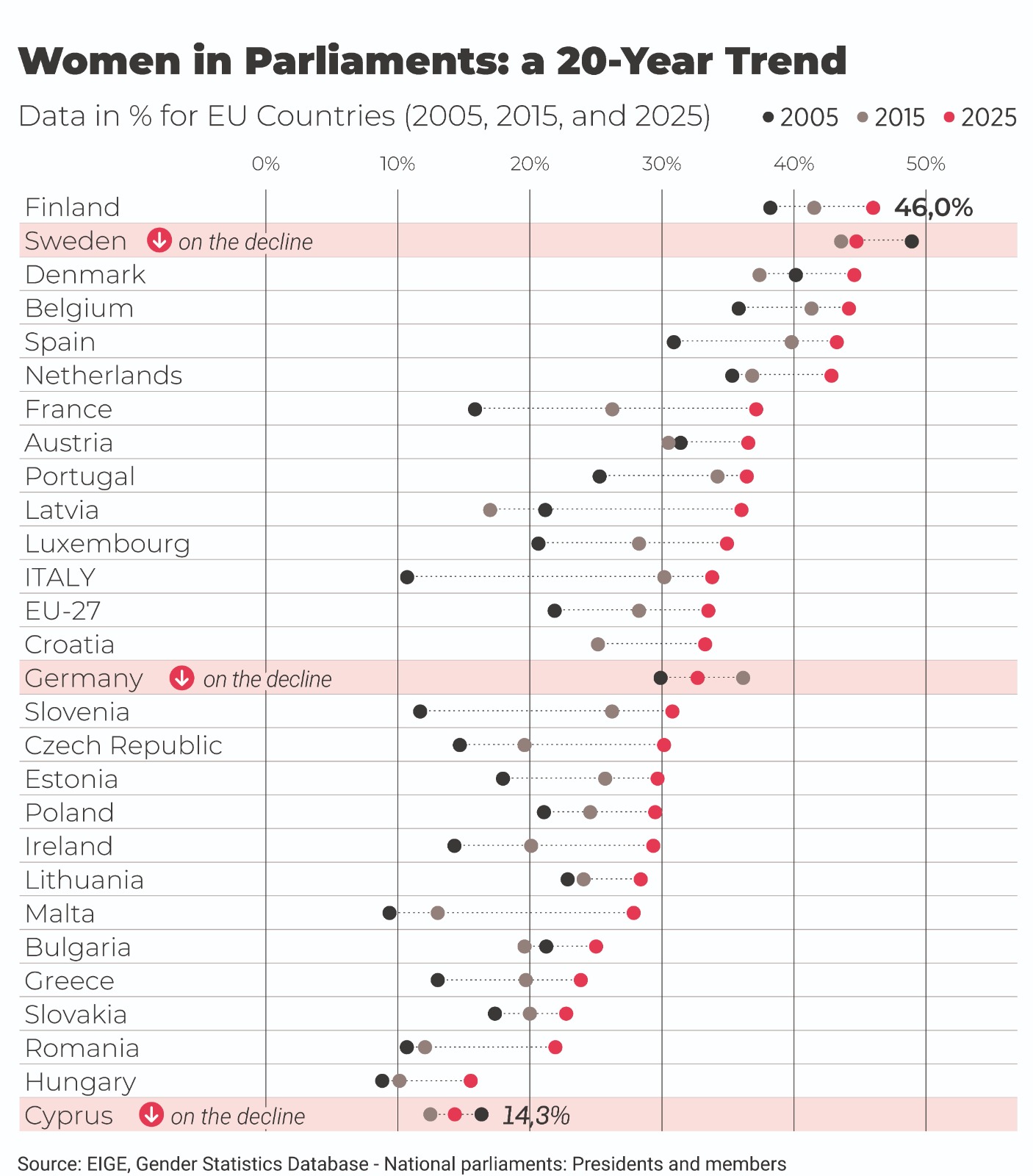
The data analysis reveals a two-track continent: on the one hand, countries such as Sweden, where women account for over 60% of European parliamentary representation, and Finland, which boasts a national government with 57.9% of ministers female. On the other hand, pockets of extreme resistance remain: Hungary has no women in its Council of Ministers, while Cyprus did not elect a single woman to the European Parliament in the last election.
The tools to bridge this gap are at the centre of the debate. Eleven Member States use binding quotas, with countries such as Italy, France, and Belgium applying the 50 per cent parity principle. In contrast, several Nordic countries achieve levels of excellence without legislative requirements, relying on more inclusive political cultures and voluntary party quotas. However, where rules or strong political will are lacking, women remain excluded from decision-making processes.
In Strasbourg, Italian female MEPs account for only 34.2 per cent, significantly lower than the parliamentary average of 38.8 per cent. This lag is confirmed by the 2025 political power index, which ranked Italy 41.2, still below the EU average of 47.3. Yet, the country has made significant progress: in the national Parliament, women now occupy 33.9 per cent of seats, marking extraordinary progress compared to 2005, when female representation stood at 10 per cent. The change is also visible across the country. At the regional level, representation has literally tripled in the last twenty years, reaching 30 per cent, while in municipalities, the presence of women has now steadily exceeded the 30 per cent threshold. However, the European comparison remains an open challenge: the EU average for local councils stands at 34.5 per cent, a target that Italy, despite steady growth, has yet to reach.
However, it is not just a question of numbers, but of “portfolios.” There is a thematic segregation of power: the so-called “heavyweight: ministries remain male strongholds. At the beginning of 2026, there were only five female defence ministers and the same number of female finance ministers in the entire EU. Women are more frequently assigned to socio-cultural sectors such as health, education, or social affairs. This dynamic is reflected in the composition of the EU Council: while meetings on health see female participation close to 50%, those on economic affairs or defence see it reduced to a few units.
The report states that maintaining gender balance is important not only for social justice, but also for the quality of democracy itself. Women in power promote cooperative styles, reduce polarisation, and increase citizens’ trust in institutions. However, new challenges are emerging in 2026: online violence and harassment, to which women in politics are particularly exposed, act as powerful deterrents.
Added to this is the impact of Artificial Intelligence. While it can boost the campaigns of those with fewer resources, women tend to have less confidence in this technology than men. According to the Carnegie California AI Survey, when asked whether AI can help voters become more informed, only 33 per cent said Yes, 41 per cent said No, and 26 per cent said I don’t know. Meanwhile, 41 per cent of men responded ‘Yes’, 36 per cent said ‘No’, and 23 per cent said ‘I don’t know’. According to Parliament, this poses a greater risk for women to be at a disadvantage in the use of advanced digital tools, as well as being victims of hate campaigns fuelled by algorithms.
The European Parliament has sought to intervene by proposing radical reforms, such as the introduction of mandatory equality criteria in the European Electoral Act and stricter measures against sexual harassment in political life. However, these proposals often remain blocked in the Council, where unanimity among Member States is required. The situation in 2026 reminds us that progress towards equality is neither linear nor guaranteed.