Brussels – There is growing public awareness of the importance of energy certification for buildings, and geopolitical developments – which undermine market stability and lead to higher energy bills – are prompting people to weigh up the costs and benefits of necessary building improvements. This is according to the director of Enea’s Department for Energy Efficiency (DUEE), Ilaria Bertini, who is in Brussels for the presentation of Italy’s 2025 Annual Energy Performance Certificate Report, drafted by Enea and CTI (Italian Thermotechnical Committee for Energy and the Environment) for the European Parliament. The document provides an up-to-date overview of the energy efficiency of Italy’s building stock and forms part of the Integrated National Energy and Climate Plan (NECP) 2024, which aims to reduce emissions by 43.7 per cent in the non-ETS sector (the EU Emissions Trading System) by 2030 and to increase the rate of building renovation, with particular attention to the least energy-efficient buildings and situations of energy poverty. “In this context, energy certification plays a central role, not only technical but also social,” the report states.
“The building performance certificate is a tool that gives homeowners an idea of the quality of their home” and “it is the first step: if you don’t measure it, if you don’t have a clear picture of the starting point, how can we improve?” she explains on the sidelines of the event ‘Energy Performance Certificates as a Policy Tool: Insights and Perspectives from Italy and Europe’, attended by the Vice-Chair of the Committee on Industry, Research and Energy (ITRE), Elena Donazzan (FdI). “So, it is inevitably a tool to support policies aimed at improving the energy efficiency of our property portfolio. We believe it is a fundamental tool for raising public awareness, but also for policy-making,” Bertini explains.
In Italy, the situation is improving. “We know that almost half of the buildings are not in high-class categories, but reports from previous years have also shown an important trend: since last year, the lower–performance buildings no longer account for half of all buildings“, she explains. A “result” that confirms that “something is changing”, but “clearly we need to work on it more.” Certainly, “we can see an increasing awareness on energy efficiency” and “all the tools that our country deploys are widely used by citizens.” So, there is an awareness and, of course, the situations of contingency that push prices ever higher increasingly produce those cost–benefit conditions that lead citizens to carry out the works,” she explains.
The report is based on an analysis of approximately 1.2 million Energy Performance Certificates (EPCs) issued in 2024 and submitted to SIAPE (the EPC Information System). These data, “subject to a rigorous verification process, constitute a representative and reliable sample for assessing the evolution of the energy performance of the national building stock,” ENEA explains. More specifically, the report explains that in 2024, compared to 2023, “the gradual reduction in the number of properties in the least efficient energy classes is confirmed. Classes F and G recorded a decline of around 3 percentage points, falling to a combined total of less than 44 per cent, in favour of properties in the intermediate classes (C, D, and E). The best-performing classes (A4 to B) remain essentially stable at 20 per cent.” The document specifies that “this trend confirms a gradual improvement in the average energy performance of the certified building stock, albeit with some differences between sectors and geographical areas.”
Furthermore, the Report shows a different distribution by energy class between the residential and non-residential sectors. “Both sectors have a lower proportion of EPCs in the top energy classes (A–B), at around 20 per cent, while the non-residential sector has a higher proportion in the intermediate classes (C–E: 49.7 per cent compared to 34.7 per cent). The worst energy classes (F-G) are, however, more prevalent in the residential sector (45.3 per cent) than in the non-residential sector (30.9 per cent),” it states. Compared to the previous year, in 2024 the residential sector shows “a slight
reduction in the share of buildings in the best classes (A4–B, -0.6 per cent), a
moderate increase in the intermediate classes (+2.7 per cent), and a decrease
in the worst-performing classes (-2.1 per cent).” The non-residential sector, on the other hand, “shows a more significant improvement, with an increase
in both the best-performing classes (+4.2%) and the intermediate ones
(+5.8%), and a sharp decline in the worst classes (-9.9%).”
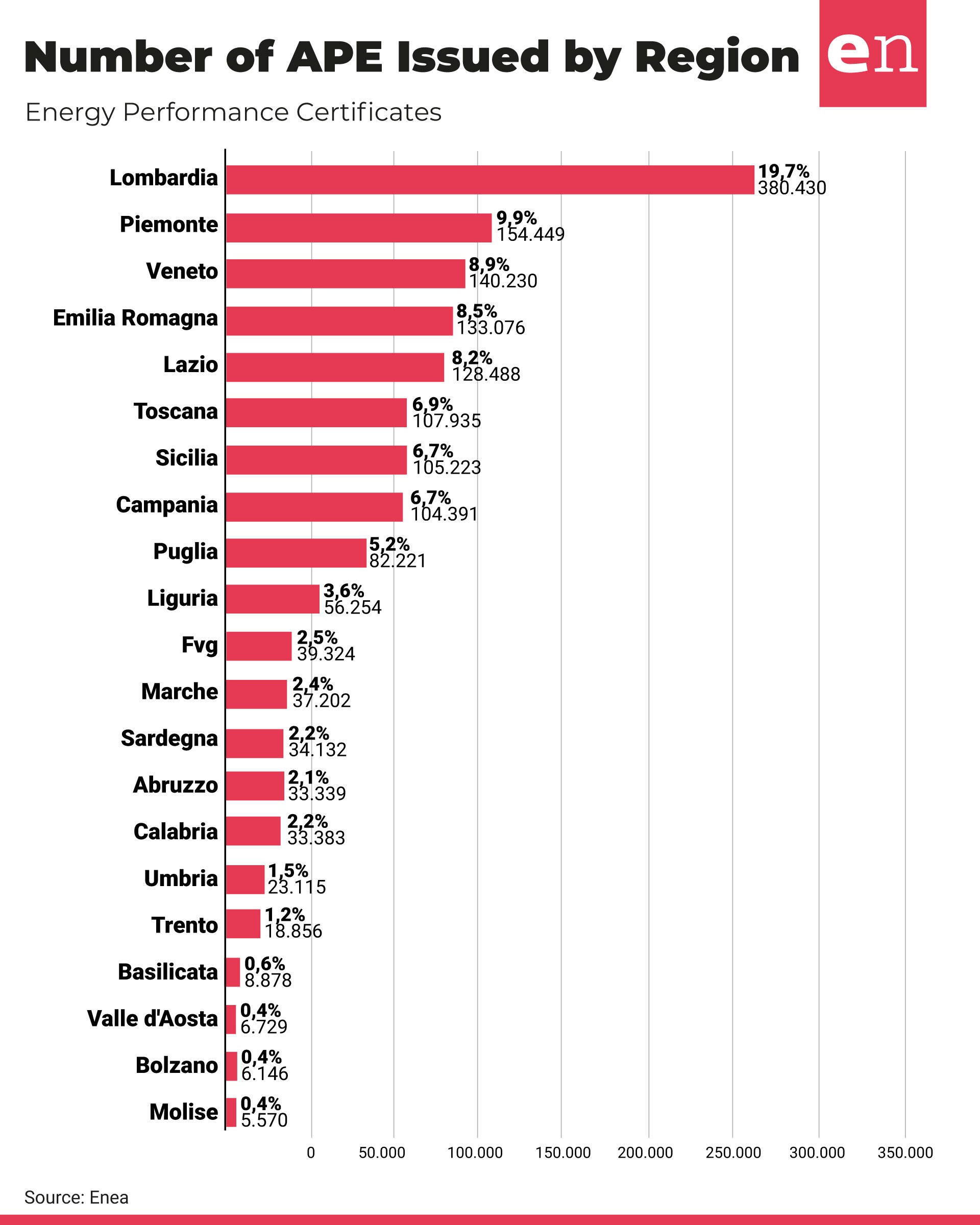
As regards coverage, “energy performance certification has gained momentum over time across all Italian administrative regions”, the report states. “The Lombardy Region remains the local authority with the highest number of EPCs issued, with approximately 308,000 certificates in 2024, followed by the Piedmont Region (around 154,000 EPCs), the Veneto Region (around 140,000 EPCs), and the Emilia-Romagna Region (around 133,000 EPCs). These four regions alone account for around 50% of the national total,” the document details. They are followed by Lazio (128,000), Tuscany (107,000), Sicily (105,000), and Campania (104,000).
On a broader front, “the European Union is doing a lot” and “the directives give us very ambitious targets,” Bertini noted. But “there’s no point denying that one of the fundamental aspects is the financial side,” to which “undoubtedly preparation must also be added,” because “one of the issues we are working very hard on concerns the workforce,” given that “to carry out all these works you need companies and professionals, but also installers.” For Bertini, this is an aspect “which in our view also presents a critical issue linked to demographic decline,” and one on which “we at Enea are working very hard” — with “several projects aimed, for example, at collaborations with ITS institutes” — because “in the end, it’s not only graduates we need, but also young installers who are familiar with new, more efficient technologies,” she concludes.
According to Donazzan, “there is a need to lower energy costs, to simplify life for businesses in particular, and to have a single market – which also means shared certifications – so we don’t always have to start from scratch, but can build on what already exists.” In this context, the event to present the report, “initiated by Enea and supported by me, is precisely to say that we already have a track record, we already have data that tells us what a certificate is; we must not invent something new, we must simplify as much as possible,” she said.
English version by the Translation Service of Withub