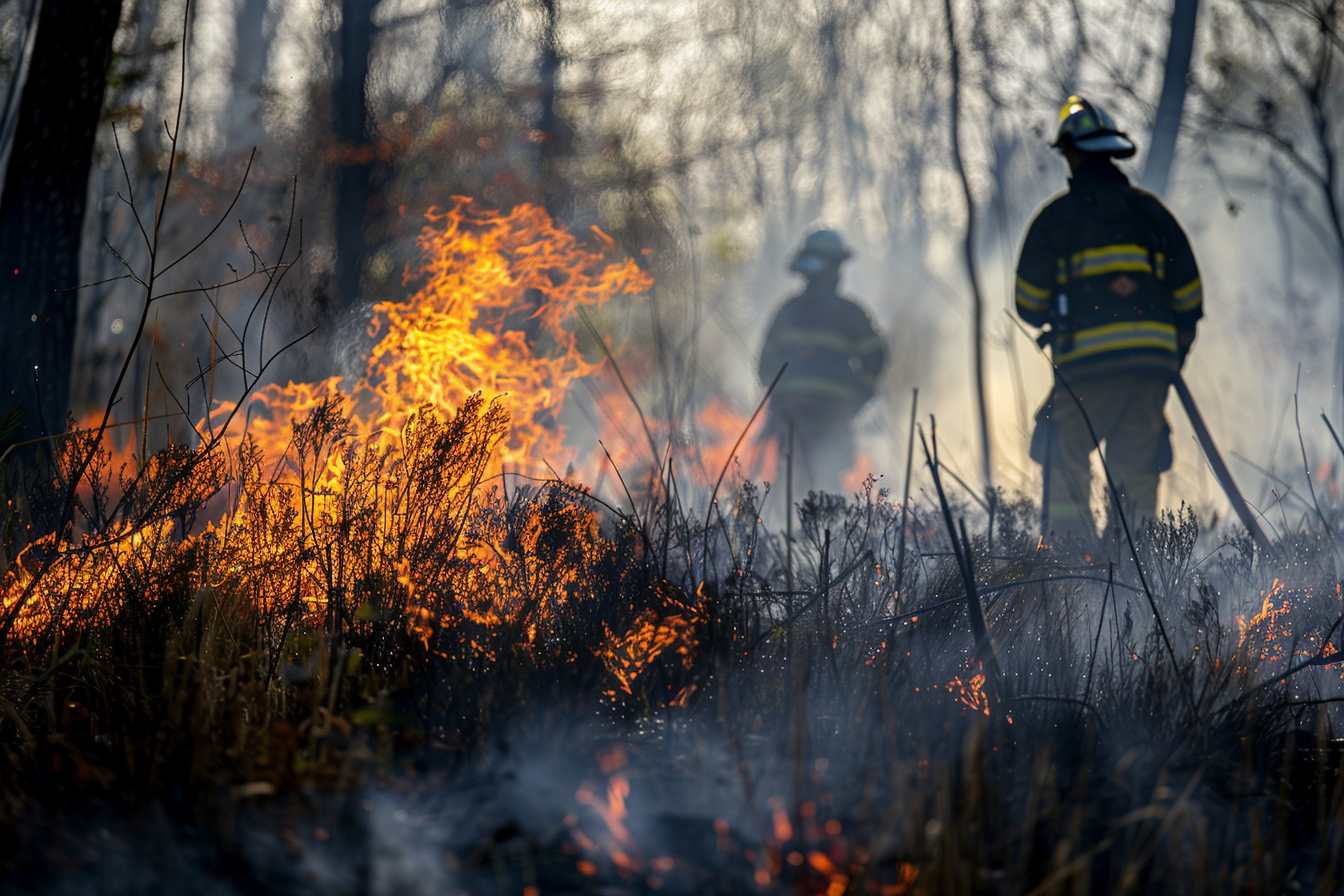
Brussels – During 2025, almost 1.08 million hectares of land—an area roughly equivalent to that of Cyprus—were destroyed by forest fires that raged across the European Union. With a figure sharply higher than the 400,000 hectares lost in 2024, last year was the worst season ever for the Old Continent in terms of damage caused by forest fires (the previous record was set in 2017, when the figure was just under a million hectares). These figures were released today (31 March) by European Forest Fire Information System (EFFIS), the web platform that monitors fires in Europe, the Middle East and North Africa, in a report highlighting what the European Commission, in a commentary currently under consideration, defines as “worrying new patterns: earlier and longer fire seasons, with blazes starting as early as March; more frequent and intense heatwaves, fuelling extreme fire behaviour; and wildfires spreading to higher latitudes, affecting regions previously considered low risk.”
EFFIS, which is coordinated by the European Commission’s Joint Research Centre, recorded 7,783 wildfires within the EU during 2025, with an initial peak already recorded in March. As the Berlaymont Building notes, the fire season began “unusually early“, given that by the end of the first quarter, more than 100,000 hectares of land had already been lost. After a period of relative calm between April and May, the situation rapidly—and predictably—worsened with the onset of summer: the flames engulfed more than 500,000 hectares of land in July and almost 900,000 hectares in August.
Looking at the data for individual countries, the epicentre of the wildfires lies in the Mediterranean region: during the August heatwave, in Spain and Portugal alone, 460,584 hectares of land were lost, a figure representing almost half of the total losses across the EU for the whole year. It is precisely these two countries on the Iberian Peninsula that top the ranking of European states by number of hectares burned by fires in 2025. Spain tops the list with around 401,000 hectares, followed by Portugal with 284,000, and rounding off the “top 3” is Romania with 134,000 hectares. In terms of the absolute number of fires, however, the European country most affected is Italy, with 1,910 fires throughout 2025 (resulting in a total of 96,539 hectares of land burnt). Spain comes in second place (1,359), whilst France occupies the lowest step of the podium (1,312).
A specific section of the report is devoted to the fires that affected areas of land forming part of the so-called “Natura 2000” sites, European protected areas designated for the conservation of biodiversity and the preservation of the natural habitats of rare or endangered plants and animals. According to the study, the fires that broke out during 2025 affected more than 424,000 hectares of land within these protected areas (approximately 39 per cent of the total) and, once again, the three countries most affected were Spain (around 171,000 hectares), Portugal (just over 51,000 hectares) and Romania (93,000 hectares). Italy, too, had to contend with significant damage, with around 27,200 hectares of Natura 2000 sites engulfed by the fires.
Finally, EFFIS has combined EU data with that from other regions of the world, providing a snapshot of an increasingly global phenomenon. Adding the EU figures to those for the rest of Europe, the Middle East and North Africa, the total comes to around 2.2 million hectares burnt by forest fires during 2025. In particular, the study draws attention to the situation in Ukraine: with 39 per cent of the total fires recorded in the report, it is by far the hardest-hit country among those analysed by EFFIS.
On 25 March, in anticipation of the figures in today’s report, the European Commission presented a new strategy to tackle the growing threat of wildfires. The initiative aims to “cover the entire disaster risk cycle,” from prevention to the restoration of the area once the flames have been brought under control. More specifically, the new strategy aims to “make territories more resilient to fire through sustainable ecosystem management and nature restoration; strengthen early warning and monitoring mechanisms through EFFIS and Copernicus (the EU’s main space programme dedicated to Earth observation, ed.) and to boost firefighting capacity with an EU fleet of fire-fighting aircraft, the pre-deployment of firefighters in critical areas, and the creation of a new European hub for firefighting on the island of Cyprus.”
English version by the Translation Service of Withub


![Da sinistra: il presidente del Consiglio europeo, Antonio Costa; il presidente dell'Ucraina, Volodymir Zelensky: la presidente della Commissione europea, Ursula von der Leyen [Bruxelles, 18 giugno 2024. Foto: European Council]](https://www.eunews.it/wp-content/uploads/2026/06/euco_ua260618-120x86.jpg)
![[foto: Saverio De Giglio/imagoeconomica]](https://www.eunews.it/wp-content/uploads/2026/10/cpt-120x86.png)