Brussels – Europe faces a growing problem of cigarette and tobacco smuggling and counterfeiting. According to the KPMG 2024 study, illicit tobacco consumption accounts for around 8–9 per cent of the total in the European Union, rising to around 10 per cent when the whole of the European continent is considered. These are significant figures, which show no signs of slowing down — quite the contrary. In the face of this increase, the European Union continues to move towards an increasingly stringent taxation on tobacco products. However, could these two trends be linked? It is primarily national governments and taxpayers who are paying the price: profits from the illicit market translate into lower tax revenues, resources that could otherwise be allocated to essential public services such as healthcare, education, and infrastructure.
Confirming the growth of this phenomenon is Vincent Byrne, global director of illicit trade operations at Japan Tobacco International (JTI) and a former member of the Irish police who, during an interview on the sidelines of the World Nicotine Congress, estimates that the illicit market could be as high as “20 per cent.” This is a higher estimate than the average figures, but one which, according to Byrne, reflects the reality in certain national contexts that are particularly affected. The main reason? Both Byrne and Howard Pugh, former head of the Europol excise fraud team, during an interview also held on the sidelines of the forum, point to a key factor: the rapid and significant increase in taxation on tobacco products. “By raising taxes so rapidly and so drastically,” Byrne explains, governments have made the product “very, very expensive”, without, however, reducing demand proportionally. The result: consumers are seeking cheaper alternatives, regardless of whether they are legal or not. “It’s a risk many people are willing to take.”
A criminal market on an industrial scale
The illicit tobacco trade is not driven by marginal or improvised activities, but by structured and highly organised networks. “Extremely well organised, extremely powerful, very dangerous,” says Pugh. “Groups that use violence, corruption, and extortion as standard tools to protect their interests.” This is therefore not a matter of small-scale trafficking, but of a fully-fledged parallel system: “An industrial-scale phenomenon, a completely unregulated market,” which must be considered an integral part of international organised crime.
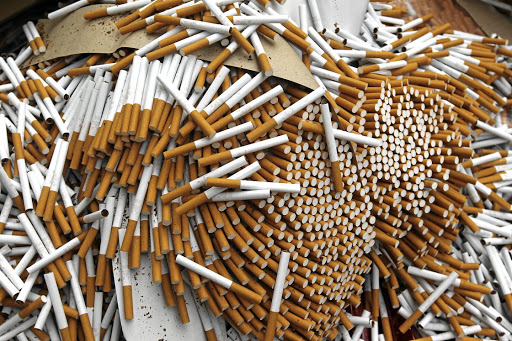
The figures confirm the scale of the problem. According to Pugh, “the volume of the illicit market in Europe amounts to approximately 38.9 billion cigarettes, with tax losses for the EU and national governments totalling around 14.9 billion euros.” Resources taken from public coffers and reinvested in criminal networks. Meanwhile, the distribution of illegal products is widespread: they are easily found in convenience stores, online, or on the street, at prices significantly lower than legal cigarettes. This easy access further fuels demand.
Belgium, the ultimate hotspot for tobacco
Belgium stands out as one of the hardest-hit countries and is now considered one of the main hubs for the illegal trafficking and production of tobacco in Europe. A case in point is the operation carried out on 20 February 2025 in Lommel, near the border with the Netherlands. During the raid, the Belgian authorities uncovered what has been described as the largest illegal cigarette factory ever found in the country: four production lines operating simultaneously, around 50 workers – mostly Ukrainian, Moldovan, and Romanian nationals – and over 30 million cigarettes seized, along with tonnes of processed tobacco and counterfeit materials. The tax losses to the Belgian economy have been estimated at over 14.4 million euros. An incident which, according to Byrne, demonstrates just how deeply rooted the phenomenon is: “Even here, in the heart of the European institutions, just a few kilometres away, clandestine factories are uncovered every year.”
And Belgium is not an isolated case. “Almost every country in Europe had an illegal factory seized in the last year,” Byrne points out. Among the main consumer markets, explains Byrne, are Belgium, France, and the United Kingdom: “Belgium and the United Kingdom account for up to 44 per cent; in France, the share of the illicit market has risen to over 40 per cent.”
The tip of the iceberg
It is not the leaders of criminal organisations who are involved in the day-to-day distribution of these products, but individuals who represent only the tip of the iceberg. According to Hayley van Loon, CEO of Crime Stoppers International, around 60 per cent of these people are undocumented migrants. These are often individuals trapped in exploitative situations: “They are involved in a kind of forced criminality, with very little chance of reporting it or escaping, precisely because of their irregular status,” van Loon explains. “Many have been deceived by false promises or are themselves victims of trafficking.”
The phenomenon must therefore be viewed from a broader perspective. Van Loon speaks of a “convergence of crime” networks linking human trafficking, drug trafficking, counterfeiting, and even state-related activities. “Today we see that everything is interconnected through the same logistical and financial networks,” he explains. The illicit tobacco trade thus becomes merely one component of a “global criminal ecosystem,” which, according to Crime Stoppers International, “is worth around 4.2 trillion dollars.” In this context, high taxation plays an ambiguous role: on the one hand, it is a public health tool; on the other, it can drive consumers towards the illegal market, indirectly fuelling these networks.
Where does the European Union stand?
At the European level, responsibility for combating this phenomenon lies primarily with the European Anti-Fraud Office (OLAF), which operates at both the policy and the investigative levels, working in collaboration with national and international authorities.
At the heart of the European tobacco strategy lie two key reforms: the revision of the Tobacco Products Directive (TPD) and the revision of the excise duties (TED). The former aims to tighten the rules on sales, flavourings, and new products — such as e-cigarettes and heated tobacco — as part of the goal of a “tobacco-free generation.” The latter, on the other hand, hits the wallet directly: Brussels wants to update excise duties, which have remained unchanged for over a decade, by raising minimum tax levels and reducing differences between Member States. Alternative products and raw tobacco, often used in illegal networks, are also in the firing line. These two measures aim to protect public health and harmonise the European market, but — according to various observers — risk having a collateral effect: making the illicit market even more attractive.
But is that enough? According to Byrne, the European Union risks adopting a counterproductive approach. He argues that recent revisions to the directives on tobacco products and excise duties could have unintended consequences. “I don’t believe the EU wants to encourage organised crime,” he says, “but the unintended consequence of these policies is precisely that of creating space for the illicit market.” An economic “vacuum” that criminal organisations are ready to fill.
According to Pugh, the stakes are extremely high. The money generated by smuggling is not limited to the tobacco sector; it also “funds other criminal activities.” Recovering these resources would enable reinvestment in essential public services. “Imagine the change that could be achieved,” he notes, “if these sums were returned to fund hospitals or education”. For now, however, that remains a “missed” opportunity.
English version by the Translation Service of Withub