Brussels – In the first four months of 2026, irregular migration to the European Union has fallen, but the human cost remains tragically high. According to preliminary data released today (15 May) by Frontex, the European Border and Coast Guard Agency, in the first four months of 2026, the number of irregular border crossings into the European Union fell by a significant 40 per cent (to 28,500 entries), compared with the same period last year. This result is attributed to a combination of factors, including cooperation with partner countries, preventive measures in departure countries, and adverse weather conditions at the start of the year.
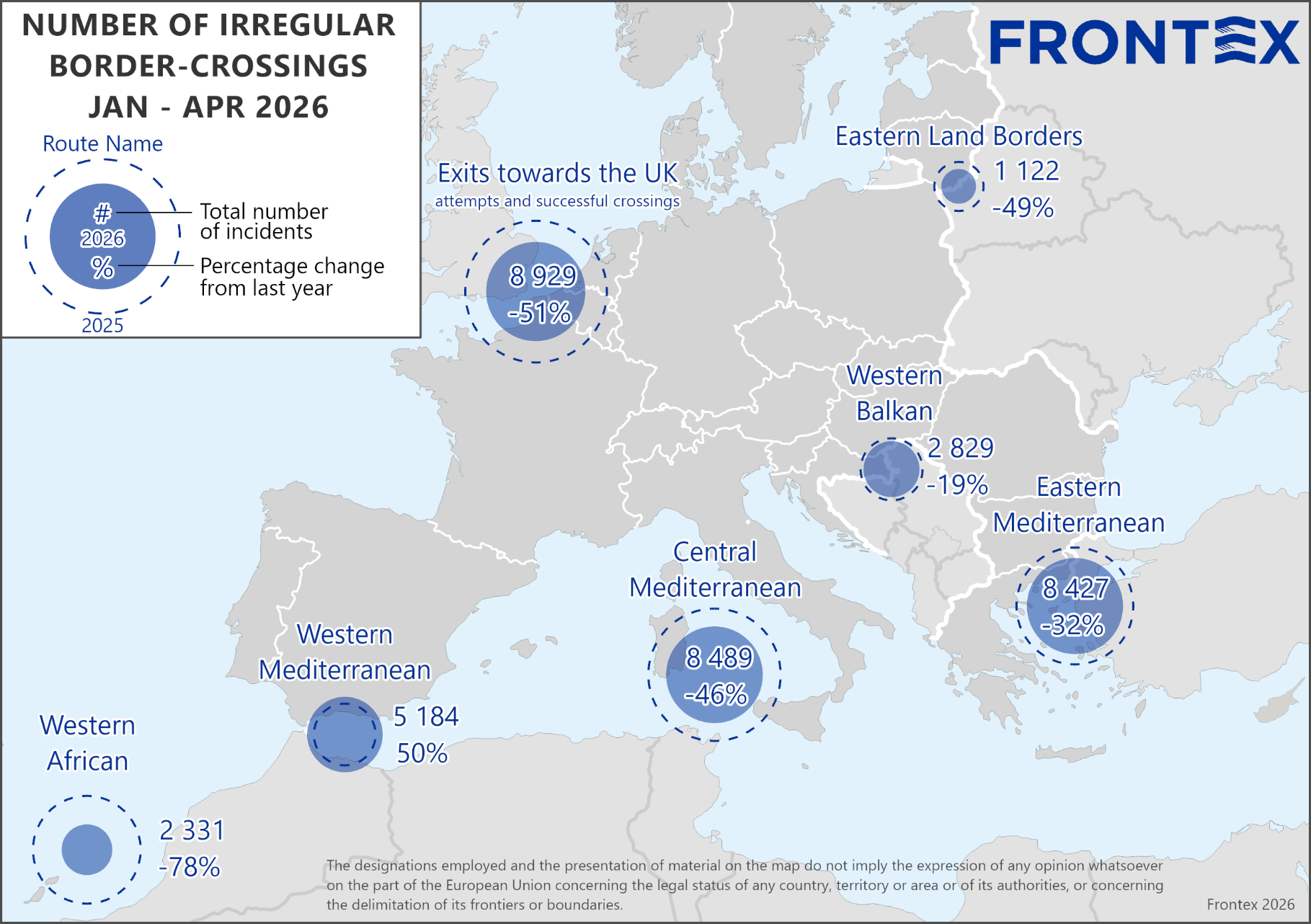
The most striking figure concerns the West African route, where records show 2,331 arrivals, mainly of Malian, Senegalese and Mauritanian nationals: a 78 per cent decrease, largely due to the preventive measures implemented by Mauritania, Senegal, and The Gambia in collaboration with Spain and the EU. However, Frontex warns that smuggling networks remain adaptable and that activity on this route can change rapidly.
The Central Mediterranean route, while remaining the busiest with 8,489 arrivals, also saw a 46 per cent decrease compared with the first four months of 2025. Libya remains the main point of departure, with flows consisting mainly of Bangladeshi, Somali, and Sudanese nationals. A slightly more moderate decline (-32 per cent) was recorded in the Eastern Mediterranean, with 8,427 crossings: here, the main flows consist of nationals from Syria, Turkey, and Egypt.
Turning to the eastern land border, Frontex reports that, despite an overall decline of 49 per cent, with 1,122 irregular crossings, pressure from Belarus rose sharply in March due to improved weather conditions. Those crossing the border were mainly Ukrainian men seeking to avoid military conscription. The Western Balkans route recorded 2,829 detections, down 19 per cent. The most common nationalities are Syrian, Turkish and Afghan, and the Croatian border with Bosnia and Herzegovina remains the main exit point from the region. As for attempts to reach the United Kingdom, these have practically halved (-51 per cent), falling to around 9,900 people, mainly Vietnamese, Afghans, and Syrians.
Bucking the general trend, the Western Mediterranean route was the only migration corridor to record a significant increase, with detections rising by 50 per cent (5,184 cases). This increase is driven mainly by departures from Algeria, Syria, and Mali. Experts believe that stricter controls in Morocco and along the West African and Central Mediterranean routes have driven traffickers towards the Algerian coast.
Despite the decline in arrivals, the human cost remains extremely high. The International Organisation for Migration (IOM) reports that over 1,200 people have lost their lives in the Mediterranean since the start of the year: smugglers continue to use overloaded and unseaworthy vessels, disregarding the dangers to migrants. Frontex also notes that the volatile security situation in the Middle East, particularly the instability in Lebanon, continues to pose a risk to the European migration landscape, with potential departures by sea towards Cyprus and other Mediterranean destinations.
English version by the Translation Service of Withub