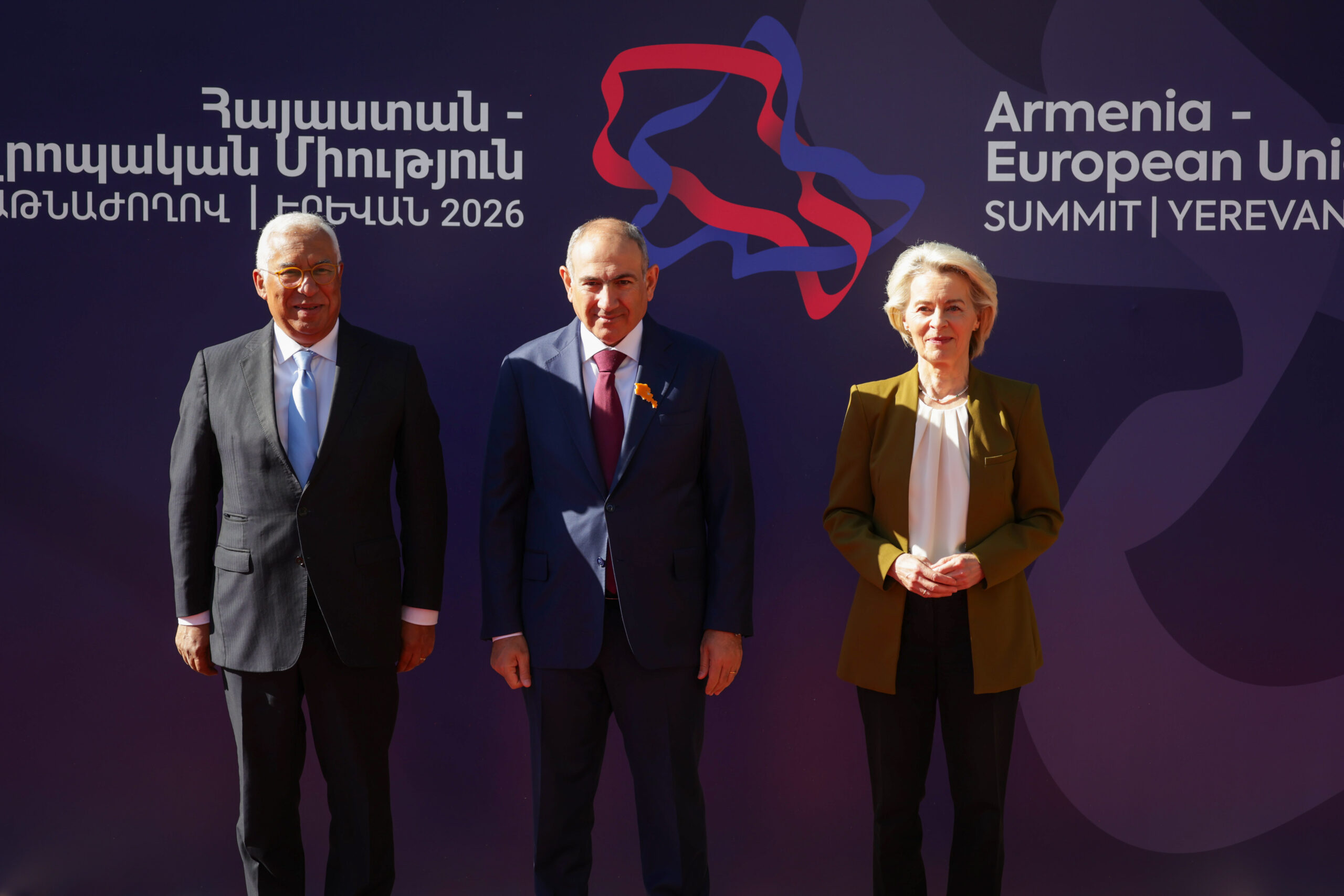
Brussels – To the notes of the “Ode to Joy” from Ludwig van Beethoven’s Ninth Symphony, Armenian Prime Minister Nikol Pashinyan welcomed the President of the European Commission, Ursula von der Leyen, and the President of the European Council, António Costa, at his official residence on Marshal Baghramyan Avenue in Yerevan, to launch the first summit between the European Union and Armenia. A summit that Brussels describes as “historic,” aiming to strengthen cooperation in the fields of connectivity, security, and defence in the South Caucasus, economic development and people-to-people contacts. “Today’s summit…reflects the significant achievements of recent years, and the strategic importance of our partnership, which brings tangible benefits to citizens and businesses,” according to a joint statement.
The summit comes at a time of increasingly intensifying dialogue between Armenia and the European Union. Brussels began investing in relations with Yerevan as early as 2021, through the Comprehensive and Enhanced Partnership Agreement (CEPA). At the same time, Armenia launched a reform programme based on democracy, transparency, and the rule of law, with a particular focus on combating corruption, reforming the judicial system, strengthening institutional accountability, and promoting equal economic, employment, and social opportunities.
The European plan for Armenia’s resilience and growth, worth 270 million euros and announced in 2024, aims to support the country’s socio-economic resilience. The objective is to invest in connectivity and businesses, bring Yerevan closer to the Union, and promote a more inclusive society. On 14 July 2025, Costa and von der Leyen had already met with Pashinyan to consolidate the partnership, while on 2 December 2025, the sixth meeting of the EU-Armenia Partnership Council took place, focusing on the implementation of the CEPA and on political dialogue regarding reforms, democracy, the rule of law, and human rights. The new strategic agenda adopted at that meeting set out more ambitious priorities, with particular emphasis on economic development, security, and resilience.
Some key guidelines emerged from the summit. The first concerns connectivity and energy. “We have just signed a Connectivity Partnership”, it is emphasised, “which brings our cooperation to a new level”, starting with transport and investment in solar power and storage, so that “precious renewable resources” can strengthen security of supply. A second pillar is that of security and democratic resilience, with European commitment to support the armed forces and counter “hybrid threats and disinformation,” so that the will of the people remains “the sole legitimate source of power.” Cooperation extends to mobility and social resilience, with the aim of accelerating visa liberalisation and strengthening border management through Frontex, whilst supporting an economic plan capable of mobilising up to 2.5 billion euros for business growth, demining, and support for displaced persons from Karabakh.
One of the most sensitive issues remains that of regional peace. The European Union has promoted what it describes as a “significant turning point” following the treaty between Armenia and Azerbaijan signed in August 2025. In the joint declaration, the parties state that they are “bound by shared political values” and by respect for sovereignty and territorial integrity, interpreting the strengthening of ties as a genuine “investment in peace” for the entire South Caucasus. Brussels also supports the normalisation of relations with Turkey and the reopening of regional links, in accordance with the principles of reciprocity and the inviolability of borders. This process is supported by the EU mission, which is considered essential for “further institutionalising peace” and ensuring lasting stability.
“This first EU-Armenia summit marks a key milestone in deepening the partnership,” wrote António Costa. During the press conference, Costa praised Nikol Pashinyan‘s work: “You have not changed Armenia’s position, but you have radically changed the conditions in your country.” The shared goals of “stability, democracy, peace, and prosperity” will continue to guide future efforts. Ursula von der Leyen added that Armenia has “long been a valued member of our wider European family” and that Yerevan “is the right place to invest.”
English version by the Translation Service of Withub
![Il presidente del Consiglio europeo, Antonio Costa (sinistra), con il primo ministro armeno, Nikol Pashinyan [Yerevan, 4 maggio 2026. Foto: European Council]](https://www.eunews.it/wp-content/uploads/2026/05/armenia-europa-350x250.jpg)


![Da sinistra: il presidente del Consiglio europeo, Antonio Costa; il presidente dell'Ucraina, Volodymir Zelensky: la presidente della Commissione europea, Ursula von der Leyen [Bruxelles, 18 giugno 2024. Foto: European Council]](https://www.eunews.it/wp-content/uploads/2026/06/euco_ua260618-120x86.jpg)
![[foto: Saverio De Giglio/imagoeconomica]](https://www.eunews.it/wp-content/uploads/2026/10/cpt-120x86.png)