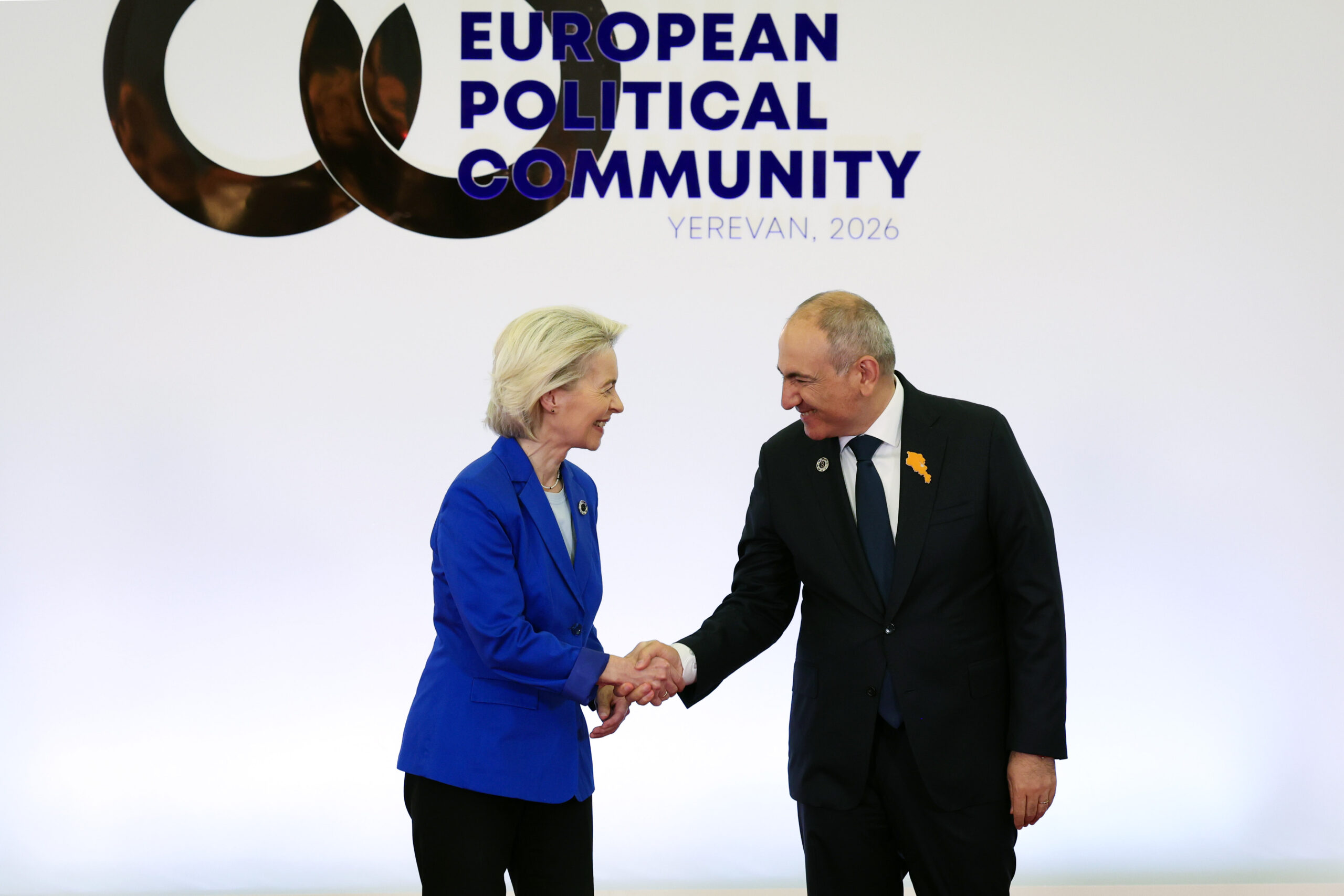
Brussels – War, energy instability and global competition are reshaping the international balance of power. Against this backdrop, Europe has chosen Yerevan, the capital of Armenia, to meet in an expanded format and take stock of the situation at the Eighth summit of the European Political Community (EPC). Established in 2022 on the initiative of French President Emmanuel Macron and the then President of the European Council, Charles Michel, the CEP is an informal platform that meets every six months to allow the leaders of the main European countries (not necessarily members of the European Union) to discuss the most pressing issues with a flexibility that traditional EU summits do not allow.
Energy, defence, supply chains: Europe’s strategic autonomy at the heart of the summit
The central theme of the summit was the strengthening of Europe’s strategic autonomy. This objective is to be achieved by reducing the dependencies that weigh down the Old Continent in three specific areas, as outlined in a press briefing prior to the meeting by the President of the European Commission, Ursula von der Leyen. “The first is energy: we are too dependent on fossil fuel imports and on the volatility of their prices, which severely affects our competitiveness,” emphasised the head of the European Commission. With the Israeli-US attack on Iran and the worsening of the Middle East crisis, the issue has become even more critical and, according to von der Leyen, the only possible solution lies in “strengthening our domestic assets, namely renewables and nuclear power.” “Only in this way,” she summarised, “will Europe truly be able to rely on a stable, clean, and affordable energy supply.”
The second area of focus addressed by the German politician is defence and security. “Building up our military capabilities so that we can stand on our own two feet” is the objective von der Leyen has had in mind for some time, which she reiterated today. In this regard, she drew attention to the €800 billion Rearm Europe plan, “enabling European states to bridge the current gaps in security and defence.” “Having a credible deterrent,” she remarked, “is the best form of prevention against potential military aggression.”
Finally, the third area of action: strengthening European supply chains, because, as von der Leyen explains, “our weaknesses cannot be resolved by turning in on ourselves, but by diversifying our partners and strengthening relations with like-minded allies.” According to the head of the European Commission, the recent free trade agreements signed with the Australia, the India and the Mercosur (von der Leyen also opened the door to new developments in trade relations with Mexico, where she will pay an official visit on 22 May alongside the President of the European Council, Antonio Costa).
The choice of Yerevan and the Caucasus as a strategic corridor
Europe’s desire to do more to strengthen its supply chains is also demonstrated by the decision—by no means coincidental—to hold today’s summit in Yerevan. Armenia occupies a perfectly central position in the so-called Middle Corridor, the trade route linking Asia and Europe via the Caucasus, thereby allowing trade to bypass both Russia to the north and the Middle East to the south. “With the wars currently underway, this is a very important alternative for diversifying trade routes,” explained the EU’s High Representative for Foreign Affairs, Kaja Kallas, emphasising precisely how the decision to hold the summit in Armenia “demonstrates the importance of the Caucasus for European connectivity and resilience in the face of the threats we are facing.”
Economic interconnections, however, often also strengthen more strictly political ties, and the EU seems to want to focus specifically on Armenia as a player in its diplomatic operations aimed at countering Russia’s influence in Eastern Europe. This was made clear by Antonio Costa during the press conference at the end of the summit: “Interconnected strategic industries, transport corridors, and digital networks build trust, create jobs, and bind neighbouring countries together through concrete cooperation and shared growth.” To this end, tomorrow (5 May)—almost a year and a half after the approval of the bill submitted by Prime Minister Nikol Pashinyan’s government to join the EU—Costa will remain in Yerevan to attend the first EU-Armenia summit. The aim is to strengthen bilateral relations and, above all, to take stock ahead of the crucial parliamentary elections that the Caucasian country will hold on 7 June, amid rumours of possible Russian interference. “The fight against foreign interference in democratic processes was also at the heart of today’s summit,” was the message the former Portuguese prime minister delivered in Moscow.
Starmer and Carney: non-EU allies take centre stage
If Armenia is to be ‘fortified’ against Russia, strengthening ties with the United Kingdom and Canada is necessary to counter Donald Trump’s unpredictability and the US ally’s declining reliability. For this reason, among the non-EU guests present in Yerevan were the Canadian Prime Minister, Mark Carney, and the British Prime Minister, Keir Starmer.
“One of the reasons why today’s summit is historic is precisely the fact that for the first time we have invited a non-European country,” Costa emphasised, in a clear reference to Canada. The reason is simple: the current geopolitical context requires “a 360-degree approach to security” and “the development of multipolar partnerships to promote sustainable peace and ensure shared prosperity.” And “on all these levels,” explained Costa, “Canada is a close ally and wants to build with us an international order based on principles, anchored in respect for international law and humanitarian law, and with the United Nations at its centre.” Carney reciprocated this warmth, claiming for his country the title of “the most European of the non-Europeans” and, echoing von der Leyen’s words on strengthening strategic autonomy, emphasised how Europe and Canada can make this effort together. The cooperation called for by the Labour leader covers crucial sectors such as “space communications, semiconductors, digital sovereignty, critical minerals, and clean energy.”
Keir Starmer also attended the summit as part of the “reset” of relations with the EU announced following his election. The “Trump factor” undoubtedly played a part in this decision, and the Prime Minister himself acknowledged this today when he explained that “it is undeniable that some of the alliances we have relied on are not in the best of shape and the level of tension is higher than we would like.” So London and Brussels appear closer than ever: among the numerous bilateral meetings organised today, Starmer and von der Leyen found time to discuss, face-to-face, the possibility of the UK contributing to the €90 billion package of EU aid for Ukraine,approved on 23 April. Furthermore, the two have also agreed to begin negotiations on the UK’s accession to the European Innovation Council Fund, the EU investment fund dedicated to innovative technologies. With the aim of “keeping Europe’s most promising innovators of the future,” the initiative appears to signal that Brexit, at least on a strategic level, may be becoming less of an obstacle.
English version by the Translation Service of Withub![Il presidente del Consiglio europeo, Antonio Costa (sinistra), con il primo ministro armeno, Nikol Pashinyan [Yerevan, 4 maggio 2026. Foto: European Council]](https://www.eunews.it/wp-content/uploads/2026/05/armenia-europa-350x250.jpg)