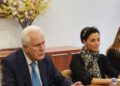
![Kyriakos Pierrakakis [foto: European Council]](https://www.eunews.it/wp-content/uploads/2025/12/pierrakakis-scaled.jpg)
Brussels – The key lies in courage. The European Union can overcome the challenges it faces, both at the level of individual states and as a Union, only if it has the courage to act. The President of the Eurogroup, Kyriakos Pierrakakis, offers what appears to be a simple, almost obvious solution, yet it is anything but. Inaction is the main obstacle to growth and competitiveness. He takes the banking sector as an example to illustrate where the Europe of nation states is going wrong: “We need European champions in the banking sector,” large national groups that merge to create even larger entities, he emphasised during the hearing before the Committee on Economic Affairs of the European Parliament.
“If we do not understand this—that we need European champions—we will not be able to compete with the major banks in the United States and China,” continues the President of the Eurogroup, in what appears to be a not-so-veiled criticism of the German government, which blocked UniCredit’s takeover of Commerzbank. The example cited by Pierrakakis serves to highlight a more general principle: “If we do not understand that the cost of inaction is greater than the status quo, then we lose opportunities” and time. We must therefore act, and to do so we need courage, such as that shown by Greece in emerging from the economic crisis that hit the country first in 2008, and even more so in 2015.
The current Greek Minister of Finance and President of the Eurogroup embodies the story of a country that was once on the brink of leaving the eurozone, yet now holds the presidency of that very eurozone—albeit only after a gruelling process of fiscal consolidation. Why does Greece hold the Eurogroup presidency today? Because the “blood, sweat, and tears” approach imposed by the EPP-led EU has thus proved effective in resolving the problem. But there is more to it than just a symbolic aspect; there is much more.
“The lesson we have learnt is that political stability is needed,” explains Pierrakakis as he looks back on the Greek “miracle”. “Stability is needed to build fiscal stability and implement reforms, reforms, and more reforms,” he states. He is keen to point out that it is not his place to point the finger at anyone, and so he makes no references of any kind. There are countries with accounts in even greater disarray than Greece’s, but for all of them, without exception, the advice is the same: what Greece has done—political stability, financial stability, and reforms—“requires political courage, but that is precisely what is needed.”
English version by the Translation Service of Withub


![[Copyright: European Union]](https://www.eunews.it/wp-content/uploads/2026/10/euco-261015-120x86.png)