Brussels – China’s trade surplus with the European Union has grown by 24 per cent in a year. In the first four months of 2026, Beijing accumulated a surplus of $113 billion with the EU-27, compared to $91 billion in the same period of 2025: an increase of $22 billion over twelve months, equivalent to approximately $180 million a day. We are talking about the difference between exports and imports. The trend was reported by the Soapbox Newsletter. An analysis by the Eunews editorial team of data from the Chinese Customs Administration (the most up-to-date source on Chinese trade) also reveals that the European Union is the region where China achieves the largest trade surplus. In other words, it exports a great deal to the EU and imports very little, proportionally.
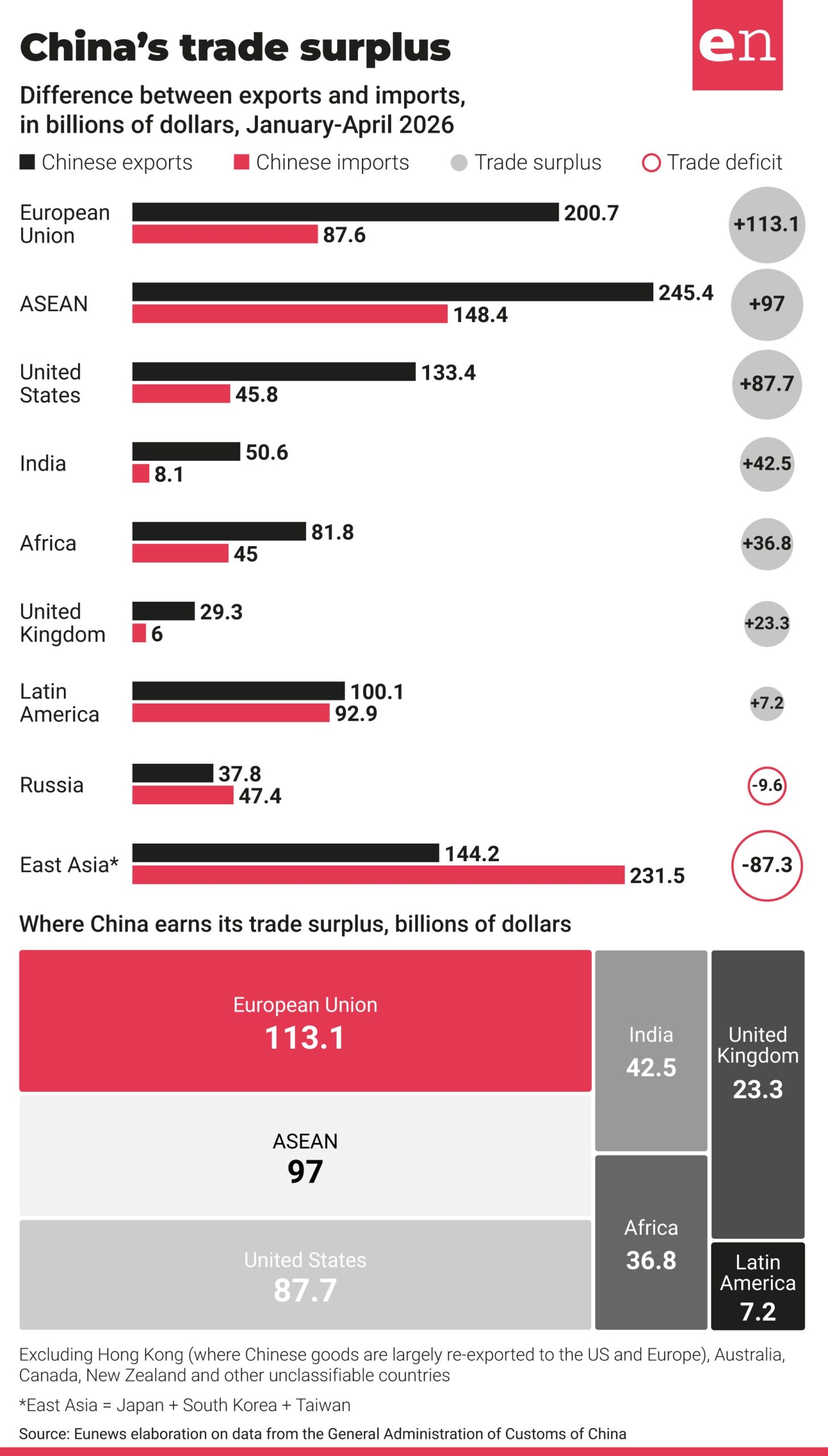
Chinese exports to the 27 EU member states reached $200.7 billion in the January–April period, up 19 per cent on the previous year, while European imports rose to $87.6 billion. Apart from Europe, the other regions contributing most to Beijing’s trade surplus are ASEAN (11 countries in South-East Asia), with $97 billion, and the United States, with $87.7 billion. Washington, despite the tariffs imposed by the US administration, remains a significant source of surplus for China: Beijing exported $133.4 billion to the United States while importing only $45.8 billion.
An analysis of Eurostat data for 2025 shows that the EU’s trade deficit with China is, in fact, increasing. Compared with 2024, European exports fell by 6.5 per cent while imports rose by 6.4 per cent. Looking at 2015, exports grew by 37.1 per cent compared to the 145.6 billion recorded at that time, while imports rose by 89 per cent from the 295.9 billion euros of ten years ago. If European imports are rising faster than exports, it is clear that the trade deficit gap is widening. Moreover, as the interactive chart below shows, EU countries generally export more to the United States than they import from it, whereas, as we have seen, the exact opposite is true for China. Germany is by far the leading trader with both superpowers, while the figures for the Netherlands are distorted by re-exports, given the importance of Dutch commercial ports.
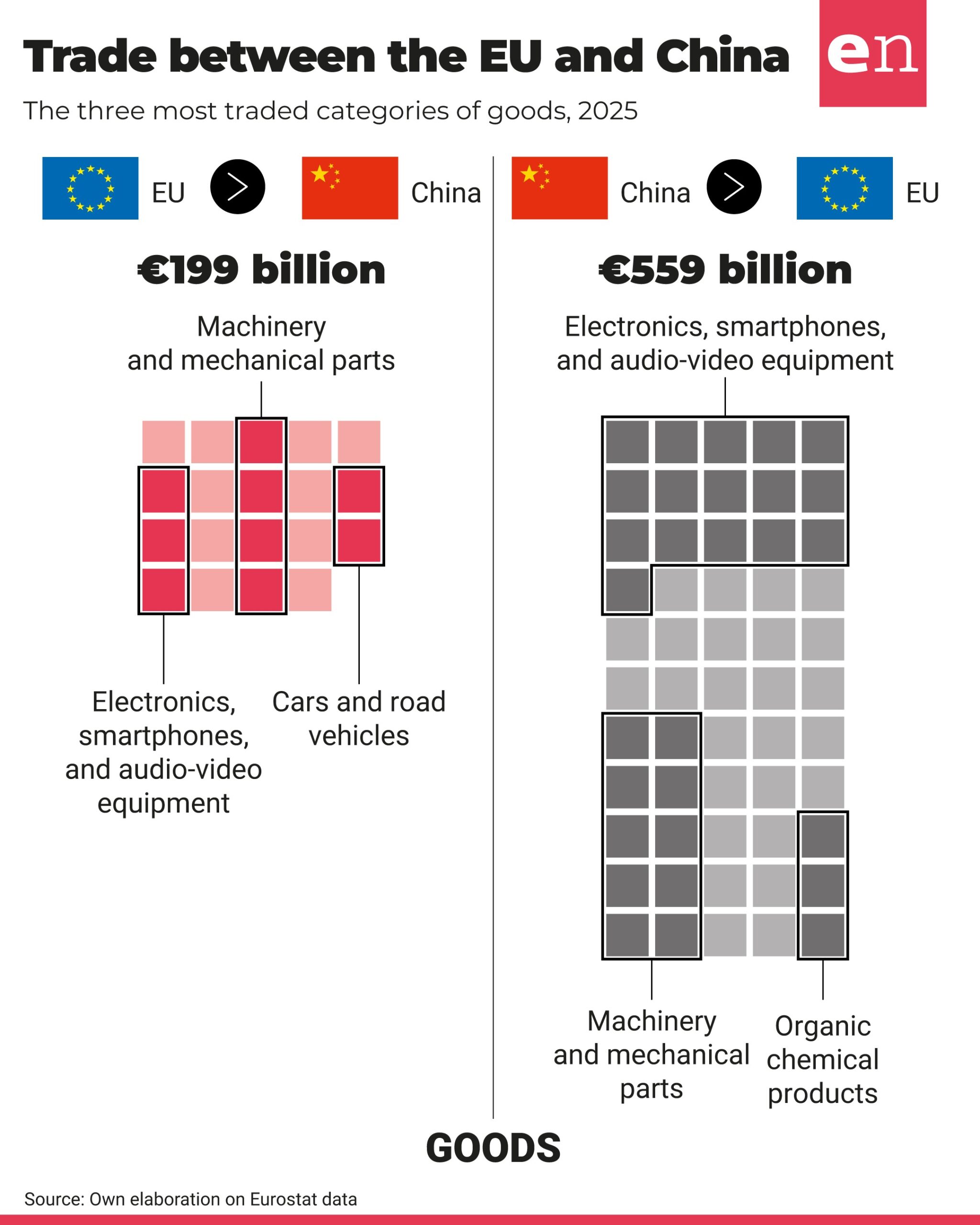
But what are the most commonly traded goods with China? Let’s look at the categories of goods. The EU exports machinery in particular, as shown in the chart below. From China, on the other hand, come electronic goods, audio-visual equipment and smartphones, machinery and spare parts, and organic chemicals: these are the three categories of goods most heavily represented in the trade figures for 2025.