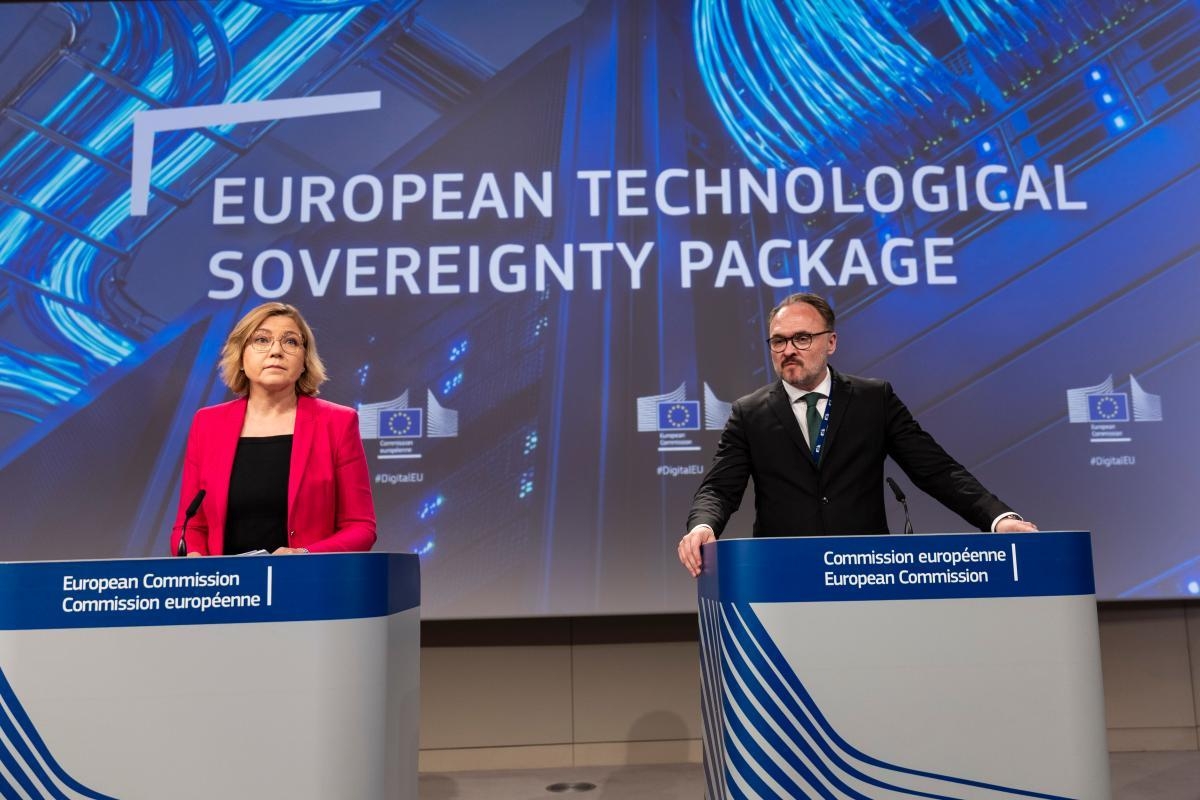
Brussels – The European Union is stepping up its efforts on technological sovereignty, making it the cornerstone of its strategy to strengthen the Old Continent’s industrial competitiveness. Today (3 June), the EU Commission presented the new Technological Sovereignty Package, a set of measures through which Brussels aims to strengthen its digital autonomy and reduce dependence on foreign suppliers in the most strategic technology sectors: the official press release does not name names, but it is clear that the main “suspects” are the United States and China.
The package addresses four key areas: semiconductors, i.e. the microchips that power computers, smartphones, and much of modern technology; artificial intelligence (AI); the cloud, i.e. the digital infrastructure that enables data to be stored and processed; and open-source software that forms the basis of many digital services and infrastructure.
Welcoming the initiative, the President of the European Commission, Ursula von der Leyen, reiterated the need for “autonomy” on which the package is based. “We cannot afford to depend on others for the technologies that keep our hospitals running, our energy networks stable, and our services secure,” she emphasised, adding that “it is about protecting our citizens, defending our interests, and preserving our freedom of choice.”
The Commissioner for Technological Sovereignty and champion of the initiative, Henna Virkkunen, takes a similar view. According to the Finnish politician, “we live in a world where geopolitics and technology are inseparable. Those who drive technological innovation will shape the future, and we must ensure that Europe plays a leading role in this process.” For this reason, “it is time for Europe to take control of its own data, its own supply chains, and its own future in a clean and sustainable way,” she explained.
The core of the package: semiconductors and data centres
At the heart of the package are two legislative proposals: the Chips Act 2.0 and the Cloud and AI Development Act. The first represents an evolution of the 2023 Chips Act, with which Brussels had attempted to reduce Europe’s dependence on semiconductor supply chains that are often overly vulnerable. In particular, the EU purchases most of the microchips required by its technology industry from Taiwan, followed by South Korea and China. Relying so heavily on a geopolitically unstable region such as Taiwan is a risk: should a conflict break out between the island and China—which has always claimed control over it—semiconductor supplies would be cut off, and the consequences could be similar to those caused by the disruption of Russian gas supplies following the start of the war in Ukraine.
The original version of the Chips Act, however, proved insufficient to address these critical issues. The Commission itself acknowledges this, stating that “Europe continues to rely heavily on third countries for advanced chip manufacturing and design.” For this reason, the new measure aims to do more to “build on Europe’s strengths.”
How exactly? By speeding up approvals for the construction of manufacturing facilities, by strengthening cooperation with trusted partners, and by supporting investment in the most advanced semiconductors—particularly those intended for AI systems—which, according to Brussels, will account for over 70 per cent of the market by 2030. The aim is also to create a genuine European semiconductor ecosystem, strengthening links between manufacturers and customers and supporting both domestic supply and demand.
The second pillar of the package is the Cloud and AI Development Act, described by the Commission as a central element of its AI Continent Action Plan (presented in April 2025 to make the EU “the continent of AI”). The measure aims, first and foremost, to triple the capacity of data centres in Europe over the next five to seven years, i.e., the physical infrastructure that houses servers and cloud services. This is because, according to Brussels’ analysis, Europe’s current capacity is insufficient to support the development and large-scale use of artificial intelligence, which requires enormous amounts of computing power.
The proposal also aims to strengthen the Apply AI strategy to accelerate the adoption of artificial intelligence in the public and industrial sectors and support research into the most advanced technologies, “reconciling—as stated in the official press release from the Berlaymont Building—ambitions in the field of AI with European climate commitments.” Another key element is the introduction of common criteria at the European level to assess the degree of autonomy and security of cloud and artificial intelligence services, establishing when they can be considered sufficiently “sovereign” from a European perspective. The Commission points out, however, that the market will remain largely open to providers from countries considered reliable.
The other two pillars of the EU strategy: open source software and the digitalisation of the energy sector
In addition to the two legislative proposals, the package includes an Open Source Strategy and a Roadmap for digitalisation and artificial intelligence in the energy sector.
On the first front, Brussels intends to capitalise on what it describes as a genuine “European strategic asset”: over three million active developers and contributors to open-source software. The strategy involves strengthening open-source alternatives in the aforementioned sectors of cloud computing, AI, and semiconductors, as well as investments in digital skills, support for start-ups in these sectors, and the long-term maintenance of software infrastructure. The aim is also to encourage greater use of these solutions within public administrations.
The energy roadmap, on the other hand, aims to integrate digital infrastructure more efficiently into the European energy system, accelerating the use of digital tools and AI to modernise the electricity grid, promote the roll-out of smart meters and help, at least in the Commission’s view, to reduce energy costs for citizens and businesses.
At this stage, the final text of all four proposals will need to be negotiated with the European Parliament and the Council of the EU in the so-called “trilogues”.
Technological sovereignty as a key element of the Buy European
Every element of the package presented today is based on the same leitmotif: reducing dependence on third countries and strengthening domestic industrial capacity. This is the same “mantra” that characterises other measures recently presented by the EU, such as the Satellite strategy and, to move away from the tech world, the Industrial Accelerator Act, the major industrial recovery plan drawn up by Brussels in March.
These similarities can be explained by the fact that the common thread running through all the latest initiatives developed by the European Commission in the economic and industrial sphere is based on the principle of Buy European: a policy aimed at promoting local businesses and production, thereby reducing economic and technological dependence on non-EU powers such as China and the US.
The technology sector appears to be the ideal area of application for this strategy, as Brussels believes that Europe has become overly dependent on foreign suppliers for a range of technologies deemed critical: from email systems to cloud platforms hosting public and private data, right through to the tools that power many government digital services. Although the issue of technological dependence has been part of the European debate for years, the deterioration of transatlantic relations and Donald Trump’s return to the White House have helped to accelerate the debate on the need to build European alternatives.
The so-called “Trump effect”, therefore, has had the merit of prompting a rethink among all those Member States that, until recently, viewed the Buy European initiative with some scepticism. This is demonstrated by the trajectory of one of the most historically hostile governments to this strategy: the Netherlands. As journalist Oliver Grimm pointed out in today’s issue of the newsletter Il Mattinale Europeo, Amsterdam has shifted from being a staunch ally of the United States and the interests of its tech giants in Europe to playing a leading role in challenging the hegemony of these giants in the European market.
The most recent case dates back a week: The Dutch government has blocked the sale of Solvinity, a cloud services company, to the American Kyndryl. “The Netherlands applies an investment control system in the telecommunications sector that is designed exclusively to safeguard the public interest and is applied to all investors without distinction of nationality,” said the State Secretary for Digital Sovereignty, Willemijn Aerdts, rejecting the US protests.
Will Brussels be able to show the same assertiveness?
English version by the Translation Service of Withub