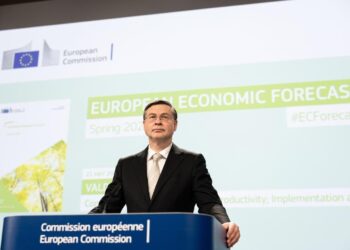
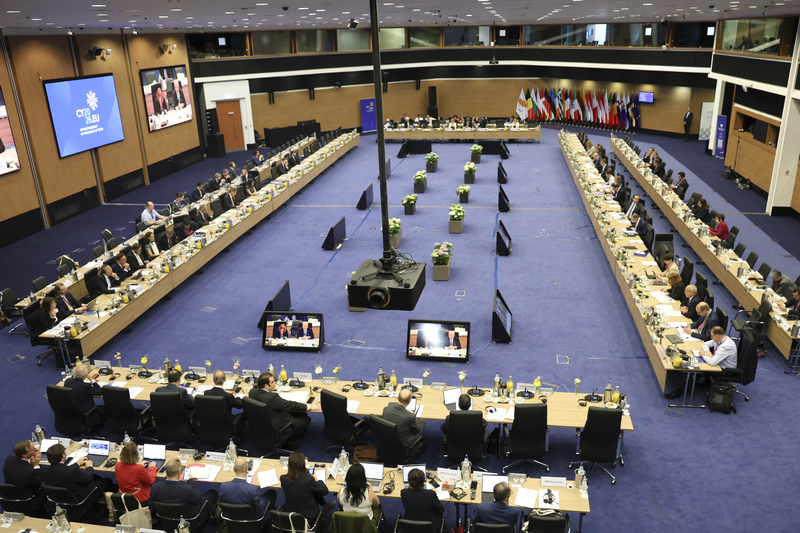
Brussels –Cautious optimism. Europe, grappling with the crisis triggered by the war in Iran — marked by soaring energy costs and economic fallout — is a worried continent. The Eurogroup meeting in Cyprus becomes an opportunity to showcase this conflicted mood, with the European Union and the eurozone caught between discouraging, though not catastrophic, numbers and the spectre of what may yet unfold. Discussions begin with the European Commission’s economic forecasts, which show reduced but still present growth. Yet, Kristupas Vaitiekunas, Lithuania’s Minister of Finance, admits, “I am concerned” about the situation.
On the one hand, there is the national perspective: “In April, inflation in Lithuania reached 5.1 per cent,” the Lithuanian minister explains. On the other hand, more generally, “low growth and high inflation is the worst economic situation one can have.” In this context, “we must choose between helping the economy grow or helping to keep prices stable.”
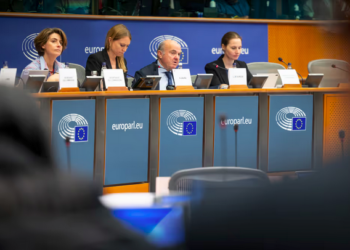
The Eurogroup meeting in Cyprus provides an opportunity for the finance ministers of the EU countries using the single currency to discuss matters with the President of the European Central Bank, Christine Lagarde, who shares their concerns: even though at present “long-term inflation forecasts are well anchored” around the stability target of around 2 per cent, there is no denying that “the energy shock is serious, because it has direct and indirect effects on our economy,” she explained during the post-meeting press conference. Furthermore, “even if the war [in Iran] were to end today, the effects would continue because we need to restore the pre-war conditions;” that is to say, rebuild what has been destroyed in terms of infrastructure.
Lagarde, however, is not giving any hint about the ECB Governing Council‘s moves on 11 June, when it will have to decide on whether to raise interest rates: “We are continuing to monitor the data,” she reiterates.
The comments from Eurogroup President Kyriakos Pierrakakis are also not particularly reassuring. Admittedly, he admits that a stagflationary situation is emerging, even though, for now, the EU and the eurozone know how to respond. Nevertheless, “pressure is mounting on energy and fertilisers, which are essential for agricultural production and the economy.” In this climate of widespread concern, it falls to the Executive Director of the ESM, Pierre Gramegna, to try to reassure: “We cannot speak of either stagflation or recession.” It is this assessment of the situation that, more than any other, helps us to look with a little confidence – or hope? – at a time when there is no shortage of concerns.
English version by the Translation Service of Withub