Brussels – No downward revision: the final figures confirm that in May, inflation in the eurozone stood at 3.2 per cent, up compared with April (3 per cent). This marks the fourth consecutive month of rising living costs, fuelled by the war in Iran and its repercussions. The main drivers of the rise in the inflation index between April and May were services (+0.5 percentage points, to 3.5 per cent) and non-energy industrial goods (+0.1 pp, to 0.9 per cent). Energy prices remained stable (10.8 per cent), while food, alcoholic drinks, and tobacco recorded a fall (-0.5 pp, to 1.9 per cent).
Among the major economies of the eurozone, Spain recorded a modest increase (+0.1 pp, to 3.6 per cent), while increases were sharper in France (+0.3 pp, to 2.8 per cent) and Italy (+0.4 pp, to 3.2 per cent). For Italy, according to data from the European Statistical Office, inflation rose from 1 per cent in January to 3.2 per cent in May. Germany bucked the trend, with inflation falling (-0.2 pp, to 2.7 per cent).
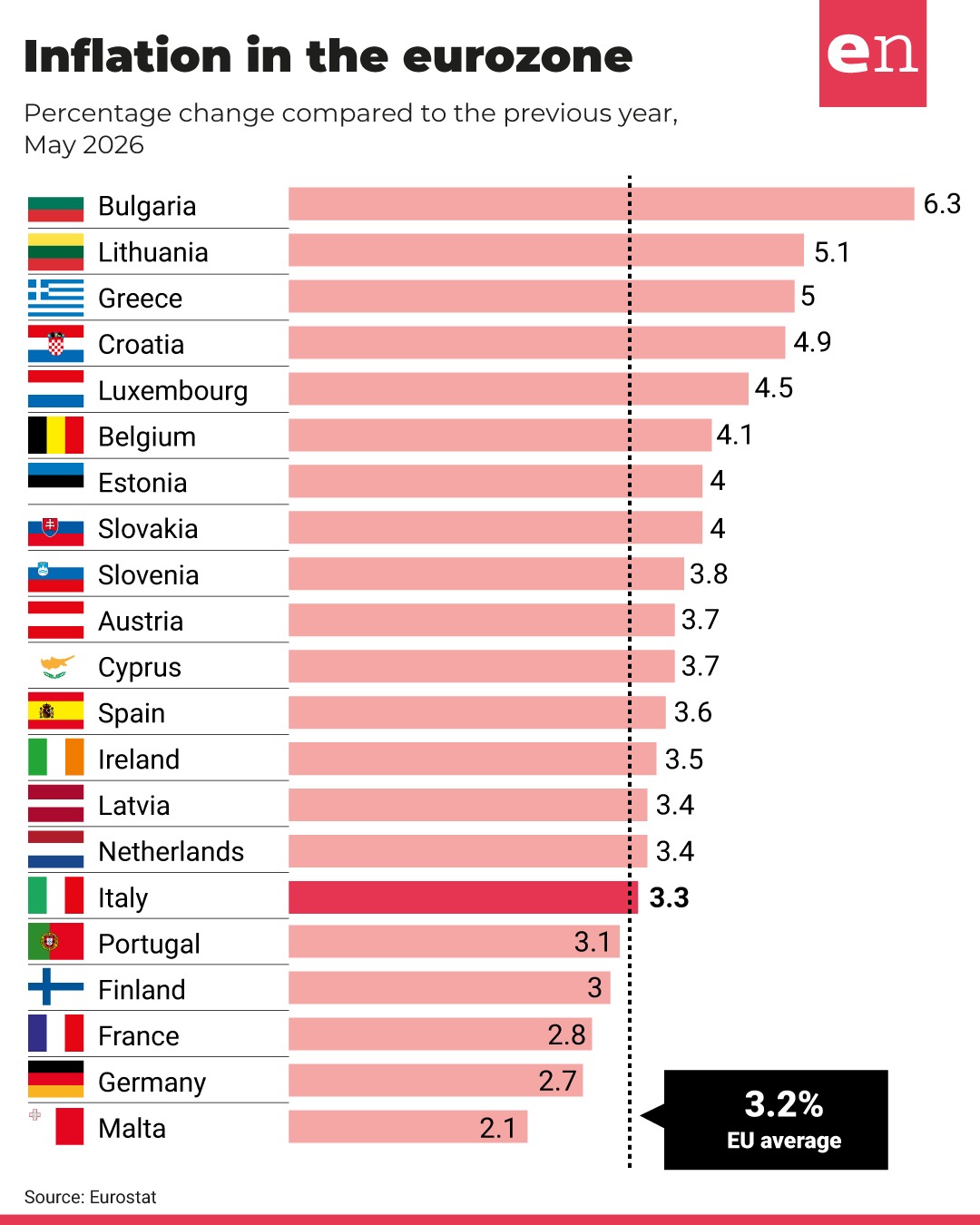
The German data highlight the uneven nature of inflation trends, not only among EU countries using the single currency, but also across the European Union as a whole. Compared with April 2026, inflation fell in eleven Member States (Belgium, Croatia, Germany, Ireland, Luxembourg, Malta, Poland, Portugal, the Czech Republic, Slovakia, and Hungary) and rose in sixteen (Austria, Bulgaria, Cyprus, Denmark, Estonia, Finland, France, Greece, Italy, Latvia, Lithuania, the Netherlands, Romania, Slovenia, Spain, and Sweden).
Preliminary inflation figures for June are due on 1 July. These will help determine whether the EU and the eurozone are still feeling the effects of geopolitical tensions or, on the contrary, are set to see an easing in the cost of living.
English version by the Translation Service of Withub

![Da sinistra: il presidente del Consiglio europeo, Antonio Costa; il presidente dell'Ucraina, Volodymir Zelensky: la presidente della Commissione europea, Ursula von der Leyen [Bruxelles, 18 giugno 2024. Foto: European Council]](https://www.eunews.it/wp-content/uploads/2026/06/euco_ua260618-120x86.jpg)
![[foto: Saverio De Giglio/imagoeconomica]](https://www.eunews.it/wp-content/uploads/2026/10/cpt-120x86.png)