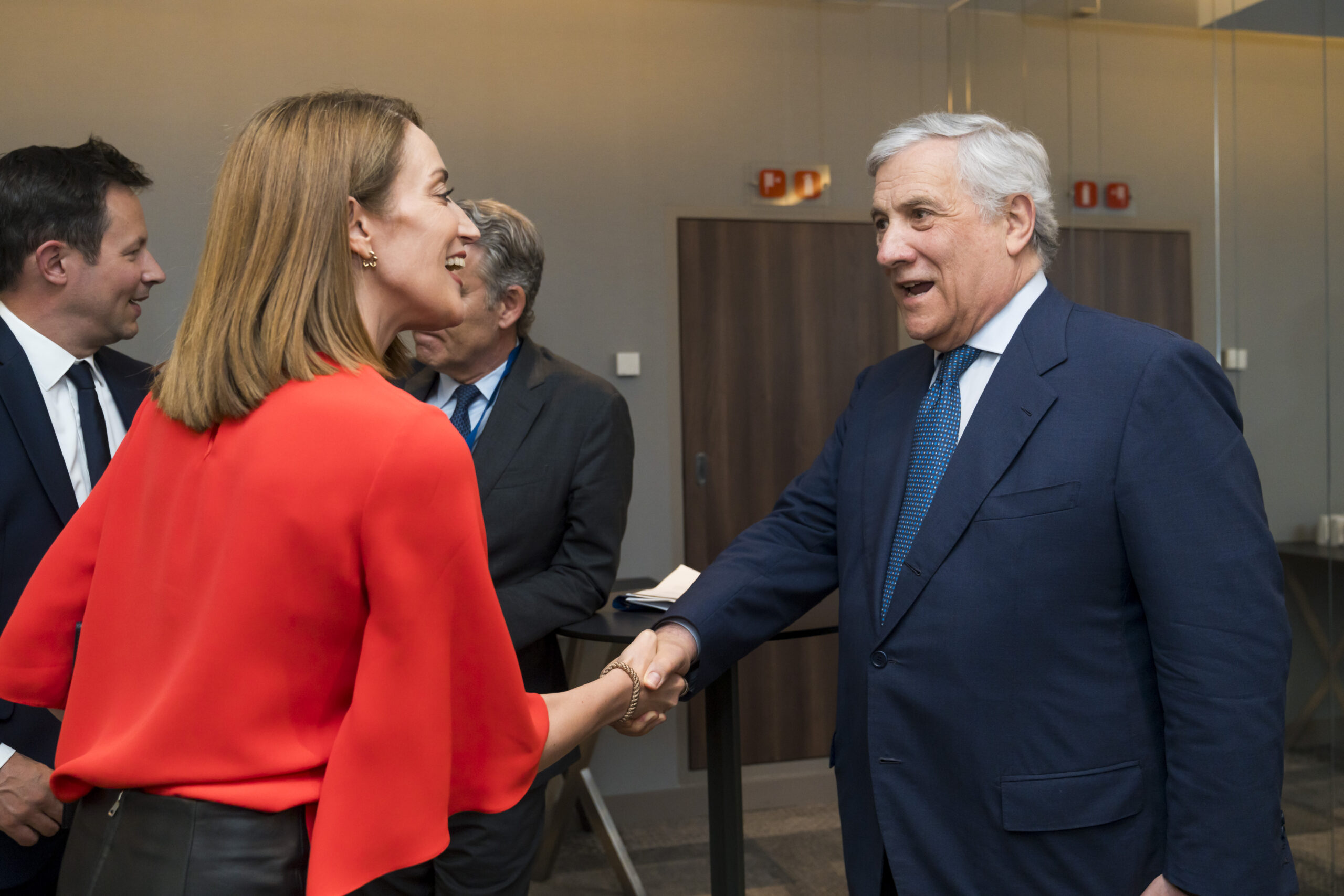
Brussels – Adopting a unified stance in dialogue with Russia, assessing the possibility of imposing sanctions on Israeli ministers and goods from the West Bank, and ensuring the passage of Italian ships through the Strait of Hormuz. These are the guidelines presented today (18 June) by the Deputy Prime Minister of Italy and Minister for Foreign Affairs, Antonio Tajani, on the sidelines of the pre-summit of the European People’s Party (EPP) – that is, the meeting of heads of state and key political leaders of the EPP family ahead of the European Council. “I believe one thing must be decided: we need a special envoy to speak to Russia with a single European voice,” the minister reiterated, adding that it is necessary to reduce “the number of meetings and express the position of all twenty-seven Member States in relations with the Russian Federation.” According to Tajani, “the name must be chosen by all Member States” to avoid “formats comprising only three or five countries.” It will therefore be necessary to “speed up the process of identifying a spokesperson who can make a difference.” When asked whether the President of the European Council could fulfil this role, the minister replied that it is “an institutional role outside the EU’s borders.” In other words, “within the Union, the highest authority is the President of the European Parliament, while outside, it is the President of the European Council,” he explained. Therefore, it could “be him, but also other people.” What is important, he stressed, “is that there is a voice expressing the Union’s position at a time when it seems that Russia is unwilling to see reason.” In this regard, the EPP vice-president expressed his satisfaction with the outcome of the G7 summit that ended yesterday in Evian, describing it as “positive,” adding that “relations between all countries have been mended.” Following the meeting in France, “the G7 emerges stronger and more united, with an identity recognised even by Russia”, he emphasised, because “the United States has realised that it is essential to continue putting pressure on Putin, who continues to seek war rather than peace.”
Regarding the Middle East, on the question of imposing sanctions on goods from Israeli settlements in the West Bank, “Italy is not opposed in principle to sanctioning goods,” Tajani said, but “we are awaiting the European Commission’s proposal.” The Foreign Minister clarified, however, that “at present, Rome is not in favour of terminating the trade agreement with Israel,” as “it would be a mistake to isolate the country.” According to the minister, “it would be a gift to the extremists, and I do not think that is right” because “there is an election campaign underway in Israel too, and I hope that matters can be smoothed over.” Regarding the hypothetical sanctions against the Israeli Minister of the Interior, Itamar Ben Gvir, on the other hand “Italy is the main proponent of this request”, due to what happened “during the unlawful arrest of several Italian citizens who were part of the Flotilla and because of the statements made against Italy itself”. In this context, “we are trying to persuade EU countries to sanction this minister,” he announced.
Finally, according to Tajani, the G7 summit also proved positive in relation to the issues arising from Israel’s war against Iran. The minister believes it is now essential to “consider alternative routes” to avoid the economic tensions caused by the closure of the Strait of Hormuz. Speaking of trade routes, the Deputy Prime Minister took the opportunity to mention that the “Italian merchant ship Grande Torino, owned by the Grimaldi Group, was one of the first ships to pass through after the Strait of Hormuz reopened.” Now, “the aim is to get two MSC ships through as well,” he concluded.
English version by the Translation Service of Withub
![VERTICE UE-CINA Luglio 2025 [Fonte: Imagoeconomica]](https://www.eunews.it/wp-content/uploads/2026/06/Imagoeconomica_2513581-350x250.jpg)
![Un momento del summit UE-Russia del 2013 [foto: European Council]](https://www.eunews.it/wp-content/uploads/2026/06/ue-russia-350x250.png)

![Da sinistra: il presidente del Consiglio europeo, Antonio Costa; il presidente dell'Ucraina, Volodymir Zelensky: la presidente della Commissione europea, Ursula von der Leyen [Bruxelles, 18 giugno 2024. Foto: European Council]](https://www.eunews.it/wp-content/uploads/2026/06/euco_ua260618-120x86.jpg)
![[foto: Saverio De Giglio/imagoeconomica]](https://www.eunews.it/wp-content/uploads/2026/10/cpt-120x86.png)