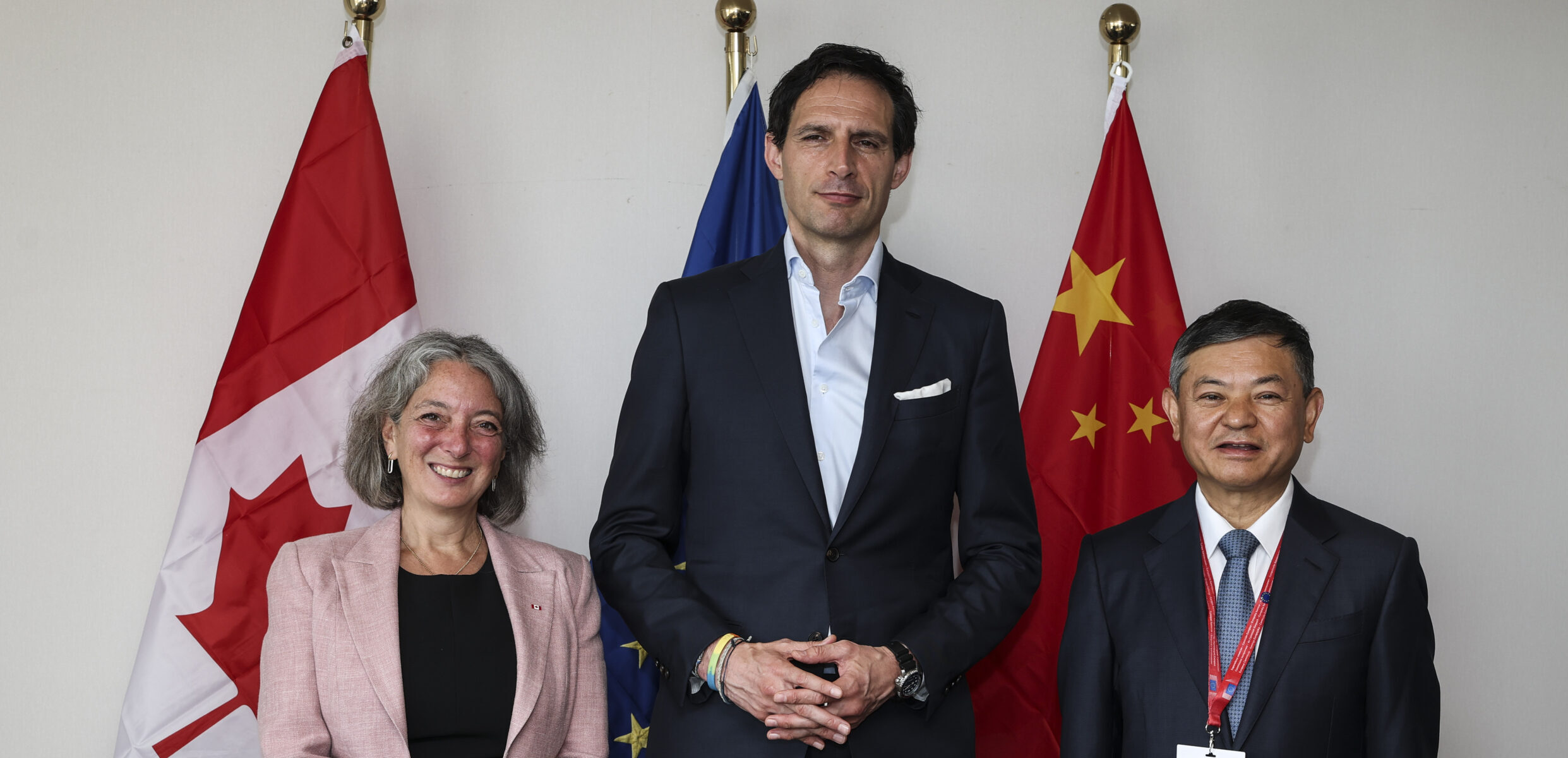
Brussels – Faced with climate change, whose impacts are becoming increasingly frequent and severe, as well as economic and geopolitical shocks, the answer is not to slow down the energy transition but rather to focus on electrification as a solution that addresses climate change, security, competitiveness, and cost reduction. This is the message delivered by the European Commissioner for Climate Action, Net-Zero Emissions and Clean Growth, Wopke Hoekstra at the 10th Ministerial on Climate Action, which opened today (22 June) in Brussels. The forum, which brought together the European Union, Canada, and China around the same table, gathered ministers and representatives from 30 governments alongside officials from international organisations.
This platform for dialogue was established ten years ago “to help build political momentum for the implementation of the Paris Agreement,” Hoekstra recalled. And, over the course of the decade, “it has provided a valuable space for dialogue, to uphold multilateralism, and help maintain international cooperation and support progress on climate action.” Today, however, the situation is “different”, and “the geopolitical landscape is extremely volatile and challenging.” The world, the Commissioner noted, has changed profoundly in terms of “the rule of law, legal battles, cyber-attacks and trade. Yet we must take action on climate change. The science is clear.” The main challenge now is implementation.
“Recent years have shown us, unfortunately with increasing urgency, the consequences of a changing climate,” Hoekstra pointed out, emphasising that communities across the globe are “experiencing increasingly frequent and severe impacts.” Added to this is the pressure from economic and geopolitical shocks, which have highlighted just how high “the costs and vulnerabilities associated with dependence on fossil fuels” are. Faced with this dual emergency, the Commissioner’s message was clear: “The answer cannot be to slow down the transition” because electrification from clean sources “is not only a response to the climate crisis, but a lever for energy security, industrial competitiveness, and long-term cost reduction.”
The Canadian Minister of Environment, Climate, Net-Zero and Clean Growth, Julie Dabrusin, has focused on the climate transition, which “must be rooted in the everyday realities of people’s lives.” For Canada, she said, climate action and economic strategy are inseparable. Since 2005, Canadian emissions have fallen by 10 per cent, while the economy has grown by 42 per cent and the population by 28 per cent. Dabrusin outlined the main measures adopted by the country, from the decarbonisation of transport and heavy industry to new methane regulations, right through to the ‘Powering Canada Strong’ electricity strategy, and announced a commitment to mobilise over $13 billion in international climate finance over the next five years, of which nearly 8 billion will come from public funds.
Hoekstra reiterated the EU’s full support for the IPCC (Intergovernmental Panel on Climate Change) and to international scientific cooperation, describing nationally determined contributions (non-binding national climate plans, NDCs) as “among the most important tools at our disposal” for keeping the 1.5-degree target within reach. An explicit appeal was also made to those countries that have not yet submitted their NDCs. Doing so “as soon as possible,” he said, is a priority shared by all those present.
Confidence in the resilience of the global process was expressed by the Chinese Minister of Ecology and Environment, Huang Runqiu, who pointed out that more than 160 countries have set carbon neutrality targets and over 130 have already submitted their NDCs for 2035, confirming that “the multilateral process will not come to a halt due to the absence of individual states.” Huang also outlined China’s progress over the last decade: coal consumption has fallen from 67.4 per cent to 51.4 per cent of the energy mix, CO₂ emissions per unit of GDP have fallen by over 35 per cent, while economic growth has exceeded 6 per cent annually alongside an increase in energy consumption of just 3.3 per cent. China has built “the world’s largest and fastest-growing renewable energy system,” the minister emphasised, before going on to praise the trilateral mechanism between China, the EU, and Canada, which has helped to stem the risk of the multilateral front falling apart. A role which, the minister said, “Beijing intends to continue to play.”
Finally, European Commissioner Hoekstra outlined the agenda and highlighted the issues that will shape COP31: the review of the Mitigation Work Programme, the 1.5°C Mission and the Global Implementation Accelerator. Particular attention was paid to the Mechanism for a just transition, which the Commissioner hopes will become fully operational to ensure a transition that is “fair, inclusive, and responsive to national circumstances.”
English version by the Translation Service of Withub