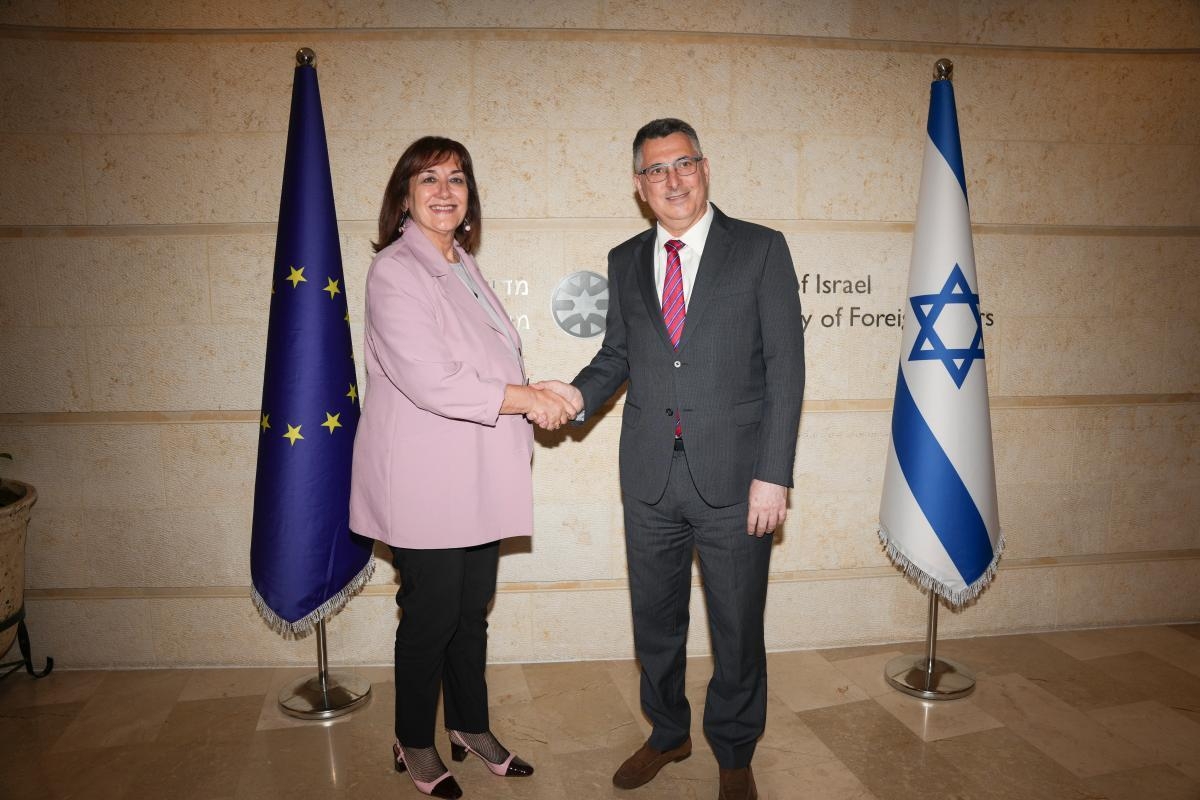
Brussels – The European Commission’s mission to Israel and the occupied Palestinian territories is proceeding as planned, despite the climate of high tension between Brussels and the Israeli government. The Israeli Foreign Minister, Gideon Sa’ar recently stated that he wished to sever ties with the High Representative of the Union for Foreign Affairs and Security Policy, Kaia Kallas, accusing her of having compared Israeli policies to the South African apartheid system, without subsequently denying it. In the last few hours, the Berlaymont spokesperson for enlargement, international partnerships and the Mediterranean, Guillaume Mercier, has clarified the EU executive’s position, emphasising that the visit by the European Commissioner for the Mediterranean, Dubravka Šuica, had been planned for some time and coordinated with the European External Action Service.
According to Mercier, it was precisely last weekend’s developments that provided an opportunity to initiate a “frank, open, and respectful” dialogue with the authorities involved, while emphasising the EU’s position on Israel’s security and, at the same time, its concerns regarding illegal settlements in the West Bank. “What a fine demonstration of solidarity and coordination within the EU,” said Kallas’s predecessor, Josep Borrell Fontelles, on social media.The Spanish politician, who served as High Representative for Foreign Affairs until December 2024, emphasised that “Israel has declared Kallas persona non grata for alleged anti-Semitic behaviour, and the very next day her colleague, Commissioner Šuica, turns up in Tel Aviv and exchanges smiles and no reproaches with Minister Sa’ar.”
The Commissioner’s visit also took her to the Occupied Territories. Yesterday, Šuica visited the Yad Vashem World Holocaust Remembrance Centre, on the outskirts of West Jerusalem, Israeli territory, while today she visited the Augusta Victoria Hospital in East Jerusalem, run by the Lutheran World Federation, which, in partnership with UNRWA, provides specialist care to refugees and patients from across the West Bank and the Gaza Strip. During today’s visit to the Occupied Territories, the Commissioner met the Prime Minister of the State of Palestine, Mohammad Mustafa who highlighted the (all too) familiar dramatic situation facing the Palestinian population and its economy, which has long been “on the brink of collapse.” Mustafa denounced a systematic campaign aimed at “dismantling the Palestinian people and the two-state solution” through the expansion of settlements and settler violence. On the economic front, the Palestinian Prime Minister presented alarming figures: Palestine’s economy is reportedly losing around 11 billion dollars a year due to Israeli policies. Specifically, he pointed out that Israel is illegally withholding $6 billion in customs revenues, which account for over two-thirds of general public revenue, and has frozen approximately $5 billion deposited in Palestinian banks. “Despite these exceptional circumstances, the government is pressing ahead with its reform programmes, guided by the best interests of the Palestinian people and the State of Palestine,” the Palestinian Prime Minister emphasised, “and we continue to coordinate with the European Union and our international partners in this regard.” At the same time, Mustafa made it clear that “stability, security, and peace in the region can never be achieved unless the Israeli occupation is brought to an end in favour of the State of Palestine, in accordance with international law and the resolutions and decisions of the United Nations.”
Just a few words—and ones we have heard before—from Commissioner Šuica, who wished to point out that the European Union remains the Palestinian Authority’s main source of funding. She urged the Ramallah government to continue on its path of reform, particularly in education and social security, describing strong and effective institutions as “essential for resilience.” Šuica also described the humanitarian suffering in Gaza as “unacceptable” and condemned the expansion of settlements in the West Bank, calling them an obstacle to peace.
On 13 July, the Palestinian Donors’ Group will meet in Brussels to review the implementation of reforms and mobilise further international support: Šuica’s stated objective remains the two-state solution, under which Israelis and Palestinians should strive to live side by side “in peace, security, and dignity.”
Meanwhile, at the same time as the visit, from Geneva, the United Nations Independent International Commission of Inquiry on the Occupied Palestinian Territories, including East Jerusalem, and Israel, presented its new report which alleges that “Israeli authorities and security forces have deliberately targeted Palestinian children, committing genocide, crimes against humanity, and war crimes in the Gaza Strip, and war crimes in the West Bank.” The Commission, which last year concluded that Israel had committed genocide against the Palestinian population in the Gaza Strip, noted that “the intensity and systematic nature of Israeli military operations have continued, causing an unprecedented number of deaths, injuries and trauma among Palestinian children.” In particular, the Commission reiterated that “the deliberate targeting of children is one of the key elements demonstrating the genocidal intent of the Israeli authorities and security forces to destroy, in whole or in part, the Palestinian population in Gaza.”
“Evidence shows that Palestinian children have been deliberately targeted and killed by Israeli security forces,” said Srinivasan Muralidhar, Chair of the Commission. “Even after the October 2025 ceasefire, children continue to be killed and seriously injured, with Israel continuing to fail to respect the ceasefire and the protection afforded to Palestinian children under international law,” he added.
English version by the Translation Service of Withub
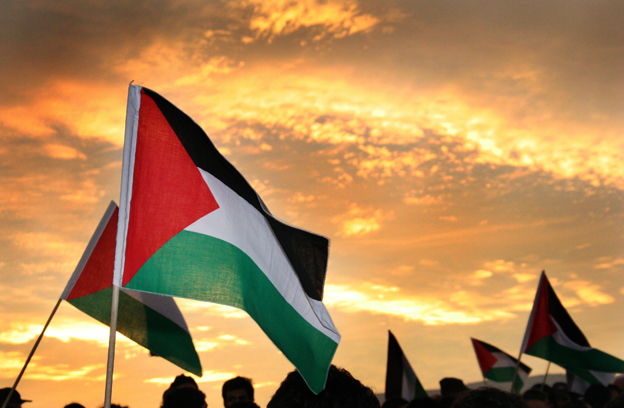
![Manifestazioni per la Flottilla e la Palestina [foto: unsplash]](https://www.eunews.it/wp-content/uploads/2026/06/nikolas-gannon-DNN_008JieA-unsplash-350x250.jpg)