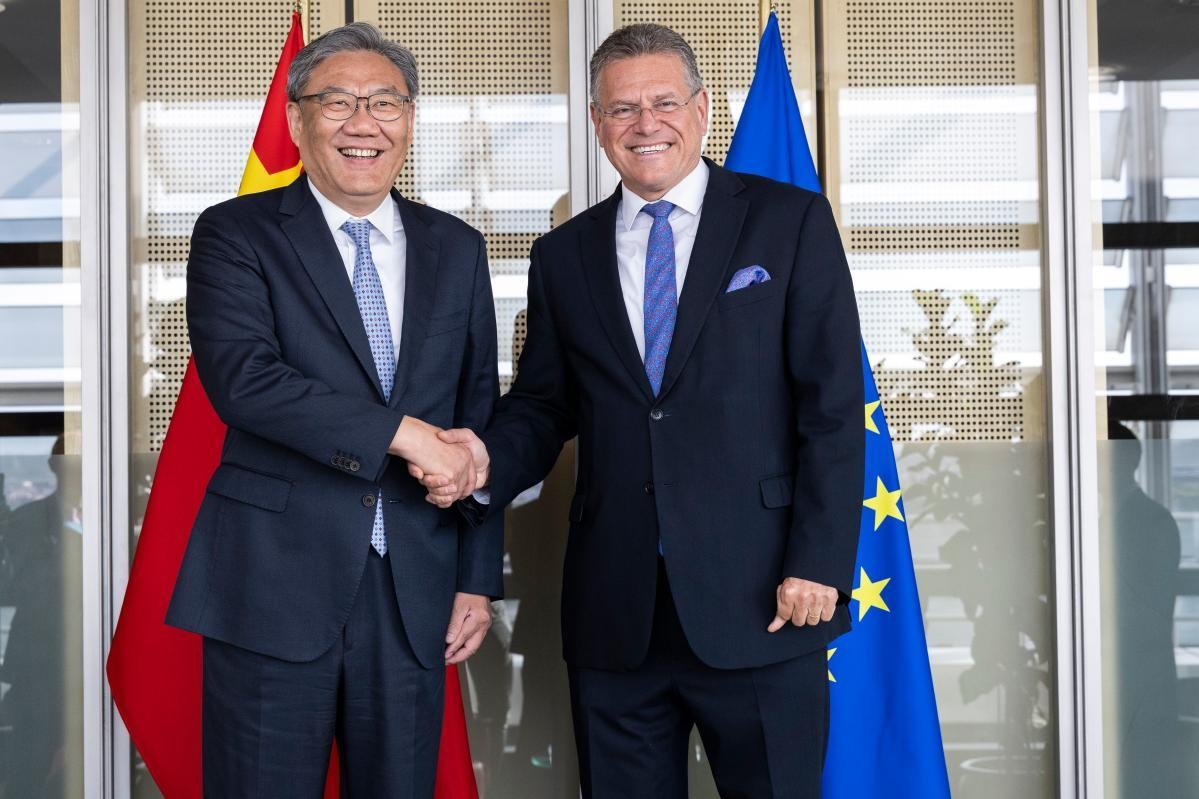
Brussels – The European Union and China are launching a consultation platform on trade and investment, aiming to deliver results by October. The announcement was made by the European Commissioner for Trade, Maroš Šefčovič, following his discussions—described as “intense, focused, and constructive”—with the Chinese Minister for Trade, Wang Wentao. Specifically, as explained in the final joint statement, this was the first meeting of the EU-China Trade and Investment Consultations (TIC), and the first on trade in the last seven years. During the meeting, “the EU and China emphasised the importance of addressing the challenges affecting bilateral trade relations and agreed to seek concrete solutions. Four initial areas of work were identified within the TIC: the balance between trade and investment; export controls; intellectual property; and reform of the WTO,” the World Trade Organisation. Šefčovič and Wang also instructed officials to work on the four areas of focus and agreed to meet again at ministerial level in the autumn of 2026.
In the following press briefing, Šefčovič pointed out that his objective has been “clear” from the outset, namely “to begin rebalancing trade relations between the European Union and China” because “the gap is widening; Chinese exports to the EU continue to rise, while our market share in China continues to fall,” and “this trend is unsustainable: the status quo is not an option.” The EU is therefore seeking dialogue with Beijing to establish a level playing field and “avoid unnecessary tensions.” And, in this context, the outlook is positive: “I believe we are beginning to understand each other better on the structural issues that need to be resolved in our trade relations,” said the Commissioner, referring to the joint statement issued with Wentao.
“Therefore,” explained Šefčovič, “today we are launching the Trade and Investment Consultations, a platform dedicated to addressing, in a structured manner, the issues we have identified together, organised into four main areas: the balance between trade and investment, export controls, intellectual property rights, and reform of the WTO,” the World Trade Organisation.
More specifically, with regard to the work on the balance between trade and investment, “we have agreed to immediately establish a joint mechanism for monitoring trade flows, as a means of helping to balance our trade.” With regard to export controls, “I welcome the Minister’s reassurance that the current export controls on rare earths and permanent magnets will not disrupt the EU’s supply chains” and “I have also proposed ways to further simplify the licensing process for EU companies.”
Šefčovič views these steps forward favourably, well aware that “progress is built one dialogue at a time.” The teams will therefore “now step up their work,” and Šefčovič will travel to Beijing next autumn to assess progress. “They have a clear mandate and an ambitious timetable to deliver concrete results by October,” the EU Commissioner explained.
Furthermore, the statement sets out that, during the meeting, Šefčovič and Wentao agreed “to establish a joint monitoring mechanism for the exchange of relevant data, the monitoring of trade flows and support for technical work with a view to improving transparency, enhancing mutual trust, and managing trade frictions.” It also states that both sides agreed that “the adoption of measures and initiatives to enhance market access can contribute to balanced trade relations.” With regard to possible tariff and non-tariff initiatives, “lists of issues relating to market access were exchanged, and it was agreed to continue consultations within the working track on the balance between trade and investment in order to make progress on specific issues.”
Finally, the two sides discussed the importance of a continuous exchange of information on their respective regulatory frameworks and licensing policies; they recognised the need to strengthen the EU-China dialogue on export controls and agreed on the need for further facilitation efforts to maintain the stability of global industrial supply chains. “The EU and China underline the necessity of strengthening bilateral cooperation in the WTO, advancing substantive progress on WTO reform, and improving the authority and effectiveness of the WTO.
Both sides agree to further intensify communication and cooperation within the WTO moving forward,” the statement adds.
English version by the Translation Service of Withub
![[Foto: European Council]](https://www.eunews.it/wp-content/uploads/2026/06/ue-china-350x250.jpg)
![VERTICE UE-CINA Luglio 2025 [Fonte: Imagoeconomica]](https://www.eunews.it/wp-content/uploads/2026/06/Imagoeconomica_2513581-350x250.jpg)

![[foto: European Council]](https://www.eunews.it/wp-content/uploads/2026/03/euco-260319-120x86.jpg)