- Europe, like you've never read before -
Friday, 30 October 2026
No Result
View All Result
  • en ENG
  • it ITA
Eunews
  • Politics
  • World
  • Business
  • News
  • Defence
  • Health
  • Agrifood
  • Other sections
    • Culture
    • Rights
    • Energy
    • Green Economy
    • Finance & Insurance
    • Industry & Markets
    • Media
    • Mobility & Logistics
    • Net & Tech
    • Sports
  • European 2024
    Eunews
    • Politics
    • World
    • Business
    • News
    • Defence
    • Health
    • Agrifood
    • Other sections
      • Culture
      • Rights
      • Energy
      • Green Economy
      • Finance & Insurance
      • Industry & Markets
      • Media
      • Mobility & Logistics
      • Net & Tech
      • Sports
    No Result
    View All Result
    Eunews
    No Result
    View All Result

    Home » Business » Renewables and natural gas set to rise in 2025, while coal hits its lowest level since 1990

    Renewables and natural gas set to rise in 2025, while coal hits its lowest level since 1990

    According to Eurostat figures, the supply of natural gas grew for the second consecutive year, rising by 2.3 per cent to reach approximately 13.1 million terajoules. The supply of renewable energy rose by 1.4 per cent compared with 2024

    Valeria Schröter by Valeria Schröter
    29 June 2026
    in Business
    [Foto: Unsplash]

    [Foto: Unsplash]

    Brussels – In 2025, according to data from the EU Statistical Office (Eurostat), the supply of natural gas and renewable energy in the European Union increased compared with 2024, while the supply of coal and petroleum products decreased. Eurostat noted that the supply of natural gas increased for the second consecutive year—following a sharp decline in 2023—rising by 2.3 per cent to approximately 13.1 million terajoules. The supply of renewable energy, on the other hand, grew by 1.4 per cent compared with 2024, totalling 11.5 million terajoules. 

    This positive figure is partly overshadowed by the decline in hydroelectric power, which has dragged down overall electricity generation from clean sources. Nuclear power is also growing, albeit slightly: +0.2 per cent, totalling over 650,000 gigawatt-hours. On the other hand, coal continues its decline. Lignite fell by 7.7 per cent and hard coal by 3.2 per cent, reaching their lowest levels since 1990. Petroleum products also declined, with supply reaching almost 449 million tonnes, a 2.8 per cent fall from the previous year. 
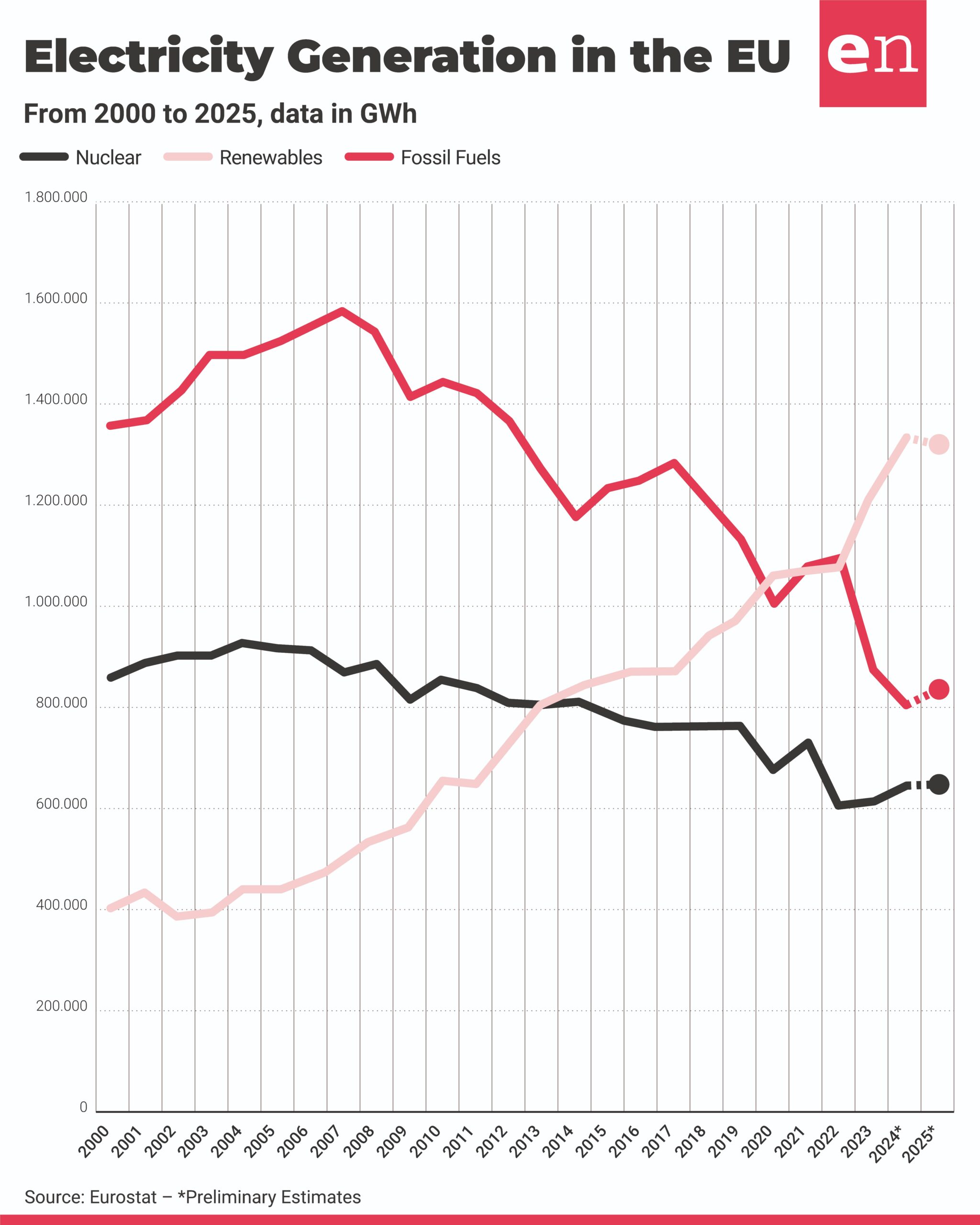
    Renewables remain the leading source of electricity in the EU in 2025, accounting for 47.2 per cent of total generation, though this represents a slight 0.5 per cent decline compared with 2024. The share of fossil fuels, on the other hand, rose to 29.6 per cent of the total, up 3.2 per cent. Finally, the contribution of nuclear power remained stable, standing at 23.2 per cent of European electricity generation. 

    However, the production figures must be considered alongside those for imports. Nel 2024 l’UE produced only 43 per cent of its own energy, importing the remaining 57 per cent from abroad. This figure illustrates just how strategic the progress made in gas and renewables is. For natural gas, the main suppliers were Norway (30 per cent), the United States (17 per cent), Algeria and Russia (both 14 per cent), which together accounted for 75 per cent of non-EU imports. For oil, on the other hand, the main suppliers were the United States (16 per cent), Norway (12 per cent), Kazakhstan (9 per cent), and Saudi Arabia (8 per cent). 

    Against this backdrop, Italy stands out for its heavy reliance on gas. In 2024, natural gas accounted for 36 per cent of Italy’s energy mix, the highest share of any EU Member State. Italy also had the highest share of gas in its total energy imports, at 37 per cent. This dual exposure makes the diversification of supply a strategic priority. 

    In addition to the figures, there are the EU’s climate targets. In 2024, the share of renewables in gross final energy consumption stood at 25 per cent, up from 10 per cent in 2004, but still a long way from the 42.5 per cent target set for 2030.

    English version by the Translation Service of Withub

    Tags: energiaeurostatfossil fuelsgas naturalerenewable

    Related Posts

    Fabbrica di automobili elettriche Rivian. Crediti: Imagoeconomica via Rivian X
    In Brief

    The 27 Member States remain divided over zero-emission cars

    26 June 2026
    Società metanodotti Snam. Crediti: Imagoeconomica via Snam.it
    Energy

    Italy and 11 other countries call to delay methane‑import obligations

    26 June 2026
    GAS AUMENTI SOLDI ECONOMIA  CARO ENERGIA METANO GRAFICO FORNELLI BOLLETTA
    Business

    ECB flags high energy prices this summer and inflation above target through mid-2027

    25 June 2026
    Julie Dabrusin, Wopke Hoekstra, Huang Runqiu
    Energy

    Climate change and geopolitical instability. Hoekstra: “The answer cannot be to slow down the transition”

    22 June 2026
    map visualization
    Decreto bollette: nel punto stampa al termine del Consiglio europeo di ottobre 2026, la presidente del Consiglio, Giorgia Meloni, spiega che

    The utility bills decree: between subsidies and actual savings

    by Carlo Cambini - Luca Lo Schiavo *
    30 October 2026

    The government announced that it has reached an agreement with the European Commission on the energy bills decree. The effects...

    Mercato Elettrico Elettricità - Luce gas bollette energia Eurostat

    Electricity and gas bills fall across the EU; but Italy remains one of the most expensive countries for power

    by Annachiara Magenta annacmag
    30 October 2026

    The issue is at the heart of European political concerns, not least in light of market tensions and uncertainties over...

    Soldi. Crediti: 
Towfiqu barbhuiya via Unsplash

    Eurozone Q3 GDP up 0.4 per cent, EU GDP up 0.5 per cent

    by Iolanda Cuomo
    30 October 2026

    In Italy, there was no change. Compared with last year, unemployment has also risen

    Treni. Source: Imagoeconomica via Ermes Beltrami

    Trains are winning over Europeans: rail travel reaches a 21-year high in 2025

    by Redazione eunewsit
    30 October 2026

    Brussels – Rail is winning over EU citizens. In 2025, 457 billion passenger-kilometres (pkm) were travelled by rail in the EU,...

    • Director’s Point of View
    • Opinions
    • About us
    • Contacts
    • Privacy Policy
    • Cookie policy

    Eunews is a registered newspaper
    Press Register of the Court of Turin n° 27

    Copyright © 2025 - WITHUB S.p.a., Via Savona 127/B, 20144 Milano
    VAT number: 10067080969 - ROC registration number n.30628
    Fully paid-up share capital 50.000,00€


    No Result
    View All Result
    • en ENG
    • it ITA
    • Politics
    • Newsletter
    • World politics
    • Business
    • General News
    • Defence & Security
    • Health
    • Agrifood
    • Altre sezioni
      • Culture
      • Rights
      • Energy
      • Green Economy
      • Gallery
      • Finance & Insurance
      • Industry & Markets
      • Media
      • Mobility & Logistics
      • Net & Tech
      • News
      • Opinions
      • Sports
    • Director’s Point of View
    • Draghi Report
    • Eunews Newsletter

    Attention