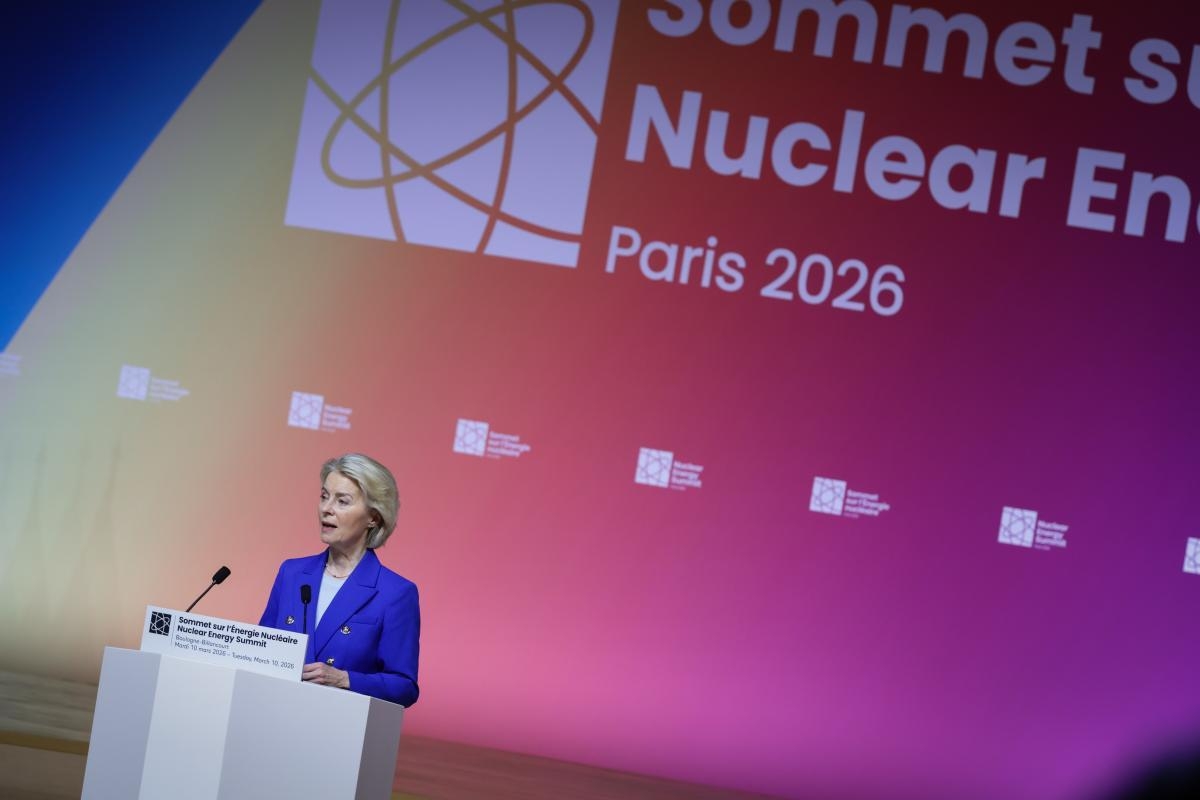
Paris, 10 March 2026, but it feels like yesterday… In the hall of the Nuclear Energy Summit convened by the French government, Ursula von der Leyen delivers a line she would hardly have used fifteen years ago. Turning one’s back on nuclear power, she told the assembled delegates, was a strategic mistake for Europe, which gave up a reliable, low-emissions source of energy just as the rest of the world was rediscovering it. Nobody in the room reminds her that she was a minister in the German government that, in 2011, in the wake of the Fukushima accident, decided on Berlin’s definitive exit from the atom.
Fukushima struck on a Friday. Günther Oettinger, long-serving Ministerpräsident of Baden-Württemberg, the Land that serves as Germany’s industrial efficiency showcase and still draws, by his account, on 90 million tonnes of domestic coal, and by then European Commissioner for Energy, drove his cabinet hard to stage a theatrical press conference the following Monday. A packed room, Brussels’ most relevant energy stakeholders, an institutional venue, environmental and anti-nuclear NGOs out in force and voiced by their most authoritative names, and Oettinger announced Germany’s retreat in language, tone and inflection that hinted at a powerful brake on the atom across the rest of Europe too. Italy would vote three months later; the result was effectively written that weekend, and for the second time mass psychology overrode pragmatic, far-sighted thinking on energy. I admit it. I am pro-nuclear, and a well-read one at that. But the detail stands. It is on the record regardless, and it says more about the state of today’s European Green Deal than most analyses manage to.
The Paris scene remains the one that implicitly opens the nineteenth issue of the Green Deal Watch, the quarterly report published by the Istituto Affari Internazionali with the support of Edison. The title chosen by the authors, Alessio Sangiorgio and Lorenzo Colantoni, is Uncertain Waters Ahead, and the maritime metaphor is no accident. It describes a Commission that, after years spent charting binding courses for member states and businesses alike, now finds itself navigating by sight, chasing events it no longer controls.
The second energy shock in under five years, triggered by the March attack on Hormuz and the closure of the strait that followed, set the same script as 2022 back in motion: gas prices spiking, the European bill for fossil fuel imports rising by more than 22 billion euros in the first 44 days of the crisis according to the figures cited by von der Leyen herself, governments forced into emergency relief measures. This time, the difference lies in the scale of the response. Between 2022 and 2023 the Union spent around 540 billion euros cushioning the Russian shock. In the first months of the current crisis the twenty seven stopped at roughly 12 billion. That is not prudence learnt the hard way. It is a sign of fiscal space that has shrunk, and of governments that have learnt to shield consumers from prices rather than to act on demand itself.
Here lies the fracture the report describes honestly, even if perhaps not fully. Brussels recommends electrification and energy savings, alongside a structural reform of the system that struggles to translate into action. National governments, Italy and Germany foremost among them, prefer to cut excise duties and VAT, and meanwhile raise their voices over a dossier the Green Deal Watch treats with almost excessive caution: the revision of the Emission Trading System.
The report concentrates on the so-called benchmark within ETS1, the fight between Brussels and heavy industry, chemicals and paper in particular, over the share of free permits still granted after two decades of the system’s operation. Italy and Germany are calling for a more limited application, especially regarding electricity generation; Spain is pushing for tightening; the Commission, through DG Clima, points out that the demands made by Rome and Warsaw on chemicals could land the cement industry with an additional cost of two billion euros. It is a war of transfers between sectors, not a battle over principles.
What the report mentions only in passing, in a single line of the closing timeline, is the other front of the ETS: the second system, the one that from 2028 will put a price on the carbon in the fuel that goes into cars and the energy that heats homes. The launch was originally set for 2027; it was pushed back a year in the same March agreement that fixed the legally binding target of a 90 per cent cut in net emissions by 2040, with a flexibility window allowing up to 5 per cent of the target to be met with international credits from 2036 onwards. The allowance auctions will still go ahead in 2027, a year before the deadline itself actually bites, a sign that even the Commission’s own technicians have less than full confidence the timetable will hold.
This postponement is not an administrative detail. To many, it already looks like an early demonstration of its political fragility. The sectors covered by ETS2, road transport and buildings, have cut emissions by only 4.4 per cent since 2005, against a halving achieved over the same period by heavy industry and electricity already under ETS1. These are diffuse sources, millions of motorists and boilers, hard to discipline with a market instrument designed for large, centralised plants. The price ceiling meant to cushion shocks sits at around 45 euros a tonne in 2020 values; futures contracts have already touched 84. If the complementary measures, building efficiency, support for clean mobility, fail to arrive in time, that ceiling risks becoming a dead letter just as the European citizen’s bill starts to feel the weight of it.
This is where the gap between Brussels and the capitals, today measurable in free permits for heavy industry, risks turning into an open social fracture. The IAI report notes that nearly one European in ten cannot adequately heat their home, and that more than 30 million citizens report difficulty paying their energy bills. The Social Climate Fund, financed by ETS2 auctions and intended to mobilise at least 86.7 billion euros between 2026 and 2032, is the political insurance policy designed to stop 2028 becoming the year of a continent-wide yellow-vest revolt. Whether it will be enough remains to be seen.
On the industrial front, the most revealing document of the half-year is the Industrial Accelerator Act, presented in March after months of delay and squabbling between Directorates-General, to the point of changing its original name, which contained the word decarbonisation, to make it more palatable as an industrial policy tool tout court. The stated goal, lifting European manufacturing to 20 per cent of EU GDP by 2035 from today’s 14.3, comes with no explanation of how that figure was arrived at, nor any quantitative model justifying it as an optimal target. It is a political number dressed up as a technical one, and on this point the Green Deal Watch, which does flag it, might have pressed harder.
The real battle is fought over the definition of Made in EU for public procurement, a market the Commission itself estimates at around 2,000 billion euros. The final choice to treat goods from countries with free trade agreements as equivalent to EU content reassures the Nordic and Baltic states, worried about distortions in the internal market, but it also hollows out much of the measure’s capacity to favour European companies exclusively. China remains formally excluded; it nonetheless enters through the side door of third countries with which Brussels has just signed new treaties, Morocco included, courtesy of its Euro-Mediterranean association agreements. This is protectionism with wide gaps in the net, built more to placate trade diplomacy than to seal off supply chains.
The Carbon Border Adjustment Mechanism, which entered its definitive regime in January, with certificate prices now above 75 euros a tonne, shows the same limitation, only from another angle. It covers a narrow range of products, remains open to circumvention through finished or semi-finished goods that incorporate the same taxed materials, and runs up against China’s ability to differentiate its supply chains: lower-carbon steel directed towards Europe, dirtier production diverted to third markets with weaker standards. CBAM, in other words, is ETS1’s border. ETS2, once it arrives, will have no equivalent at the border, because its target is not the importer but the end consumer. It is an asymmetry, and nobody in Brussels yet seems to be taking it seriously.
Within this picture, the positions defended by the Italian government acquire a coherence the report, without saying so outright, ends up confirming. The letter of 4 December 2025, signed by Giorgia Meloni together with the governments of Bulgaria, Poland, the Czech Republic, Slovakia and Hungary, called for shelving what the signatories branded as ideological prejudice, accused of having crippled entire productive sectors without delivering measurable results on global emissions. Within days the Commission recalibrated the ban on combustion engines due from 2035, moving from a target of total elimination to a 90 per cent cut, reopening space for hybrids, biofuels and e-fuels in the name of technological neutrality. The same dynamic is now repeating itself on ETS1, on nuclear power, on the flexibility over CBAM for fertilisers that Italy had already been requesting before the Hormuz crisis. Industrial and energy reality is rewriting Brussels’ agenda one item at a time, and Rome finds itself, for once, on the side that anticipates the change of course rather than suffering it.
There is, however, a point that deserves a moment’s pause, because it risks turning a defensible position into an alibi. Technological neutrality, unless disciplined by the actual cost of abatement, becomes an ideology in its own right, merely dressed up as pragmatism. Biofuels cost, according to estimates circulating in recent months, around 290 euros per tonne of CO2 saved, against an average of 73 euros under ETS1 in 2025 and the 45 euros set as the ceiling for ETS2. Defending a technology because it already exists, because it protects an established supply chain, is no less ideological than mandating electric vehicles alone by decree. The pragmatism industrial change genuinely requires does not lie in preferring one technical solution over another. It lies in the willingness to measure them all by the same yardstick, euros per tonne, before choosing between them.
Ideology is no less present on the side that presents itself as the guardian of green orthodoxy. In the interview that closes the IAI report, Environment Commissioner Jessika Roswall states that she sees no contradiction between circularity and competitiveness, and insists that the forthcoming Circular Economy Act is no longer merely an environmental issue but an economic necessity. It is the language of someone on the defensive, confirmed a few lines later when, asked about the failure of the Green Claims Directive, sunk by opposition from the micro and small enterprises that make up 96 per cent of Europe’s productive fabric, she answers by talking about reducing administrative burdens rather than admitting a retreat. The same applies to the emphasis on nature-based solutions in water and electricity management, which sits uneasily alongside Roswall’s own call, a few lines further on, to speed up permitting procedures for sectors strategic to the transition.
What remains is the backdrop we started from: the Strait of Hormuz, reopened by a fragile, and as is now becoming clear, improbable agreement between Washington and Tehran that nobody in Brussels regards as final. Mines still lie in the strait, infrastructure still needs rebuilding, and the trust of those who insure oil tankers will return more slowly than a pipeline can be repaired. It could take months before the crisis truly starts to feel behind us, perhaps years before its effects fully fade. The uncertain waters of the title are not only those of the Gulf. They are the waters in which the Green Deal itself is now sailing, between a 2028 that will carry the carbon price straight into the homes of Europeans still unaware of what is coming, and a Union that, for the first time since 2019, appears willing to admit that the course it set back then needed correcting. What remains to be seen is whether that correction will be steered by the compass of pragmatism or simply by that of fear. Too late, in any case, to make up another fifteen years lost on nuclear.
English version by the Translation Service of Withub![[Foto: Unsplash]](https://www.eunews.it/wp-content/uploads/2026/06/andreas-gucklhorn-Ilpf2eUPpUE-unsplash-350x250.jpg)