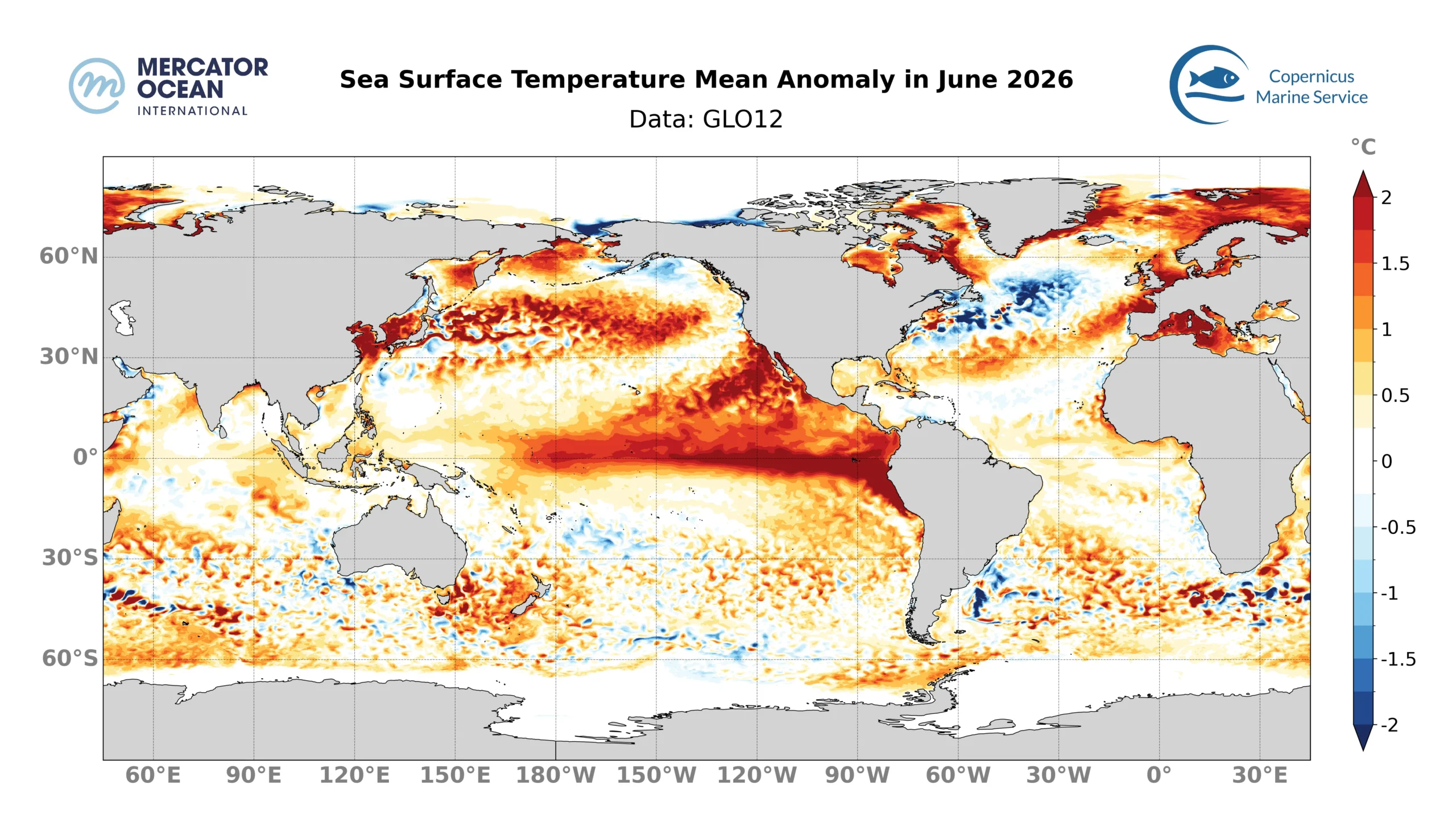
Brussels – Ocean warming in June has reached record levels: daily global sea surface temperatures for this time of year have exceeded the records observed in 2023 and 2024. This has been confirmed by Copernicus Climate Change Service and Copernicus Marine, which report “the highest ocean warmth ever recorded for this period.” According to forecasts, “this record is expected to have consequences for both weather patterns, global climate, and marine ecosystems,” said the Copernicus Earth Observation Services of the European Union’s space programme, noting that forecasts point to a likely strong El Niño.
More specifically, daily data on sea surface temperatures (SST) “exceeded the 2024 levels on 21 June at 20.86ºC, marginally above the 20.83ºC observed in 2023 and 2024. Copernicus Marine daily SST data also indicate record-high temperatures on 21 June, reaching 21.0 °C and beating the previous records from 2023 and 2024 by 0.1 °C.”
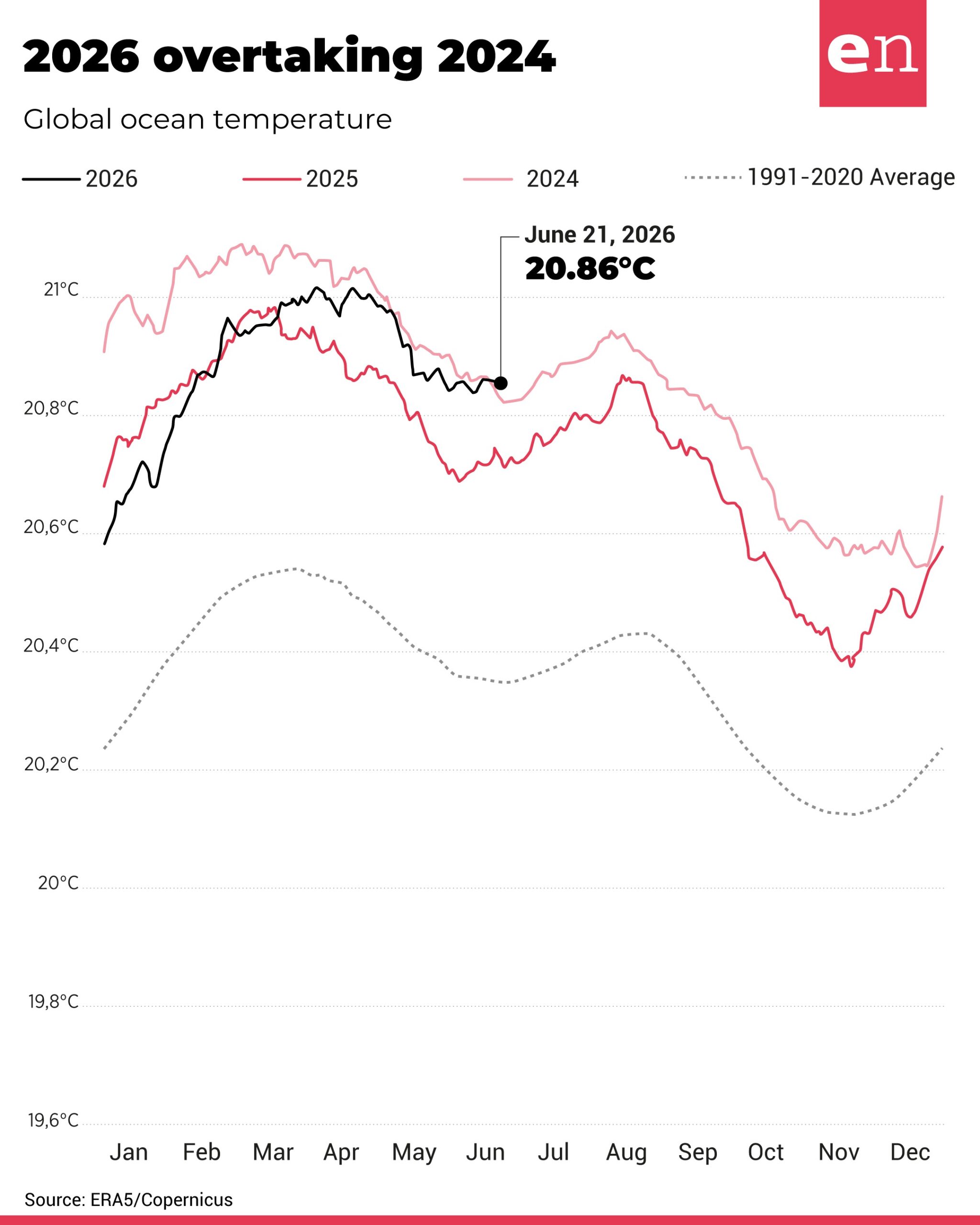
This new global sea surface temperature record for the time of year “was expected with the onset of El Niño conditions in the Equatorial Pacific,” namely the abnormal warming of the ocean surface, “announced by the World Meteorological Organisation (WMO) on 2 June, in addition to unusually high SST observed in several ocean regions over recent months.” This record-breaking warming reflects “both our changing climate and the onset of an El Niño event whose strength, according to the C3S ensemble of seasonal forecast models, is likely to reach levels not seen in decades,” the organisation said.
A warmer ocean, Copernicus explains, “has wide-ranging impacts. Higher ocean temperatures keep the atmosphere warm for longer, provide extra energy to storms and increase evaporation, thus enhancing the potential for extreme precipitation and flooding. Ocean warming also contributes to sea-level rise and ice melt and stresses marine ecosystems. Higher SSTs are also associated with more frequent and intense marine heatwaves—periods of unusually high ocean temperatures that disrupt ecosystems and fisheries, affect coastal economies, which can also intensify heat extremes over nearby land areas. Additionally, an El Niño event is a source of heat for the atmosphere, increasing global temperature and shifting weather patterns across the globe.”
Carlo Buontempo, director of the Copernicus Climate Change Service, pointed out that “Current conditions could indicate the beginning of a new phase, leading, once more, to uncharted territory. With ocean temperatures at these levels and El Niño on the horizon, we are likely to see more temperature records fall in the coming months.”
In collaboration with Agenzia Gea: https://geagency.it/clima-e-ambiente/mari-bollenti-e-record-riscaldamento-oceanico-a-giugno-a-2098c/
English version by the Translation Service of Withub

![ALLARME CALDO VENTILATORI NEI BAR. [Foto: Imago economica]](https://www.eunews.it/wp-content/uploads/2026/05/Imagoeconomica_1781593-350x250.jpg)