Brussels – The European Parliament’s plenary session today (8 July) approved two agreements aimed at forging closer political ties and expanding trade between the EU and Mexico. The first is the EU-Mexico Modernised Global Agreement (MGA), which – approved by 479 votes in favour, 119 against, and 65 abstentions – will replace the current framework, in force since 2000, and aims to promote new opportunities for businesses, sustainable development and the fight against corruption. The second is the Interim Trade Agreement (iTA), which, approved by 474 votes in favour, 131 against, and 60 abstentions, covers the trade-related parts of the MGA falling within the EU’s exclusive competence (such as customs duties, the protection of EU innovations and traditional products, and access to Mexican public procurement). The agreement “will allow for the updated trade arrangements to apply earlier, without waiting for all EU member states to ratify the MGA. The interim trade deal will expire and be replaced by the MGA once it enters fully into force,” the European Parliament said in a statement.
MEPs stress that “under the most ambitious scenario, total EU exports of goods and services could increase by 75 per cent, while EU companies could save up to 100 million euros annually in customs duties.” They note that “the agreement would remove almost all remaining tariffs, benefitting EU farmers and agri-food exporters, as Mexican tariffs imposed on products such as cheese and pork currently reach up to 45 per cent.” MEPs “welcome the fact that 568 EU geographical indications for traditional agri-food products will be protected in Mexico, making it illegal to sell imitations of distinctive EU regional food and drink specialities.”
According to the House, in an increasingly fragmented geopolitical landscape, “the strategic partnership between the EU and Mexico is vital to defend the rules-based international order and promote multilateralism.”
Furthermore, MEPs underline that the Modernised Global Agreement (MGA) “i includes a binding commitment to democratic principles, the rule of law, and fundamental human rights;” “strengthens institutional dialogue on the protection of civil society actors, journalists and human rights defenders”; “enhances cooperation to strengthen judicial independence, promote good governance, and increase transparency;” and “establishes joint actions against corruption, money laundering, and organised crime.”
Finally, MEPs point out that the agreement offers EU companies “unprecedented access to procurement markets in 14 Mexican states and to a broader range of public contracts.” They demand “further effort to promote access for European companies to public procurement markets in all Mexican states and welcome the fact that procuring entities will be able to take environmental and social considerations into account throughout procurement procedures.”
Now that Parliament has given its consent, the Council will be able to formally conclude the MGA, after which the agreement will need to be ratified by all EU member states and Mexico before entering fully into force. The Council will also be able to conclude the iTA, which will enter into force on the first day of the second month following the date on which the EU and Mexico notify each other of the completion of their internal procedures.
English version by the Translation Service of Withub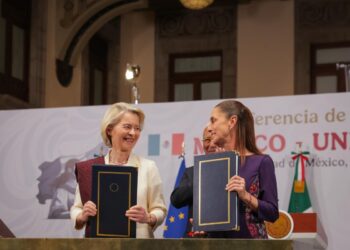
![Ursula von der Leyen alla plenaria di Strasburgo, 20 maggio [Foto: EC - Audiovisual Service]](https://www.eunews.it/wp-content/uploads/2026/05/P-069763_00-01_02-HIGH-732475-350x250.jpg)


![Da sinistra: il presidente del Consiglio europeo, Antonio Costa; il presidente dell'Ucraina, Volodymir Zelensky: la presidente della Commissione europea, Ursula von der Leyen [Bruxelles, 18 giugno 2024. Foto: European Council]](https://www.eunews.it/wp-content/uploads/2026/06/euco_ua260618-120x86.jpg)
![[foto: Saverio De Giglio/imagoeconomica]](https://www.eunews.it/wp-content/uploads/2026/10/cpt-120x86.png)