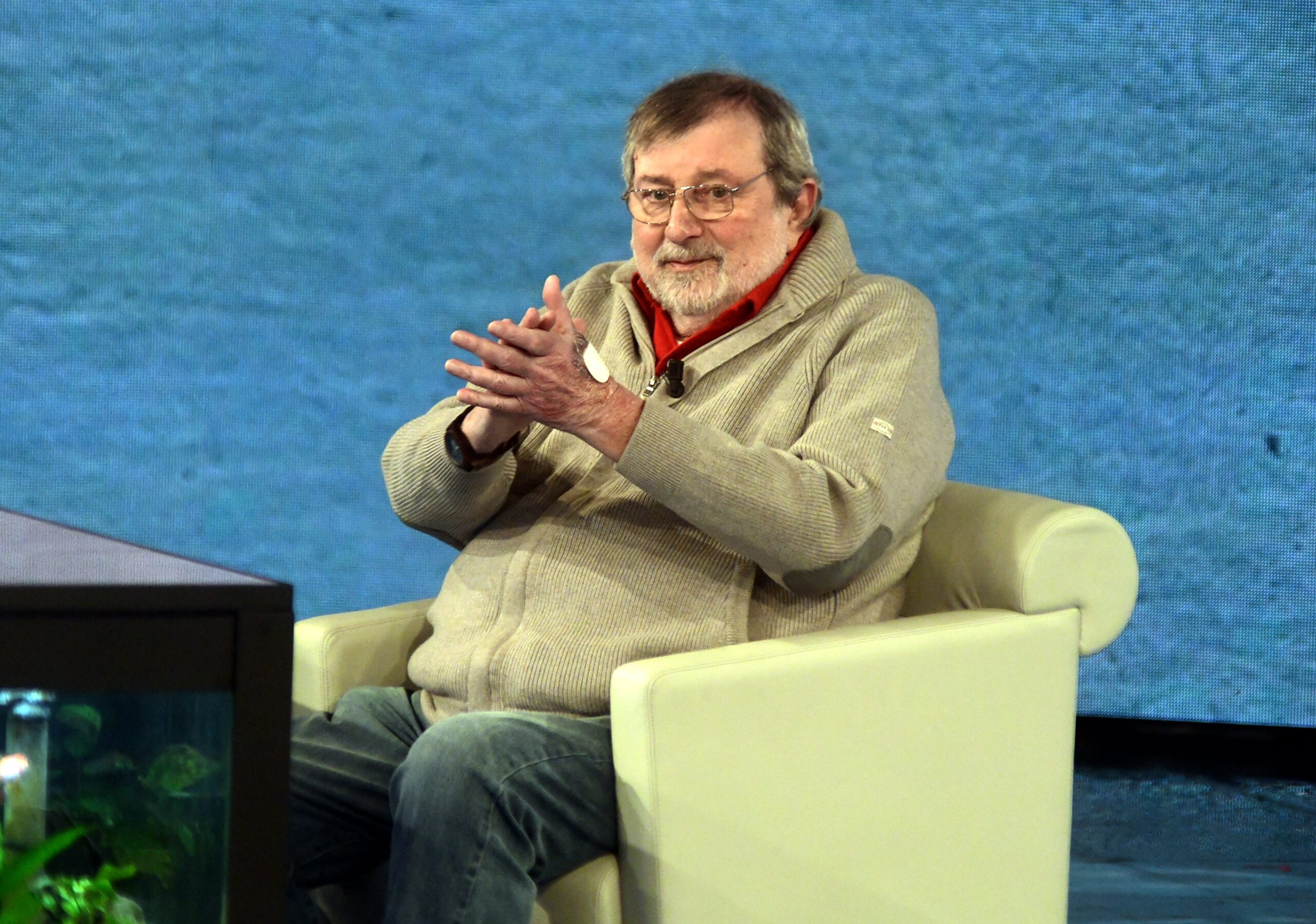
Brussels – Time has been the recurring theme in Francesco Guccini’s work. Time that passes, that changes people, that fades memories without ever erasing them completely. “And one day you realise that you are no longer the master of time, but that time is the master of you,” said Guccini, a phrase that does not appear in his songs but which captures the spirit of his writing perfectly. And today, it is precisely that time—the very time the singer-songwriter observed and transformed into poetry throughout his entire life—that has taken him from us.
Today, Italy mourns the death of Francesco Guccini, one of the great figures of Italian music, the voice of a generation and the chronicler of a country in the midst of change. Born in Modena in 1940 and raised between Emilia and Tuscany, Guccini took everyday life—the town squares, friendships, childhood memories, hopes and disappointments—and transformed it into words that stand the test of time. In his songs, he has portrayed humanity confronting its own frailties, society facing its own contradictions, and the past grappling with the need not to be forgotten.
Nicknamed “il Maestrone” for his rough, unmistakable voice, his boundless erudition and his ability to blend poetry with street life (and, to some extent, for his imposing physique), Guccini has left behind a musical legacy that belongs to entire generations. From “La locomotiva” to “Auschwitz”, from “L’avvelenata” to “Canzone per un’amica”, his songs have become more than just tunes: they have become places of memory, refuges for those seeking in his words an answer, a memory or even just a part of themselves.
Guccini was not merely a singer-songwriter, but a chronicler of the human spirit. His lyrics gave voice to the marginalised, the dreamers, the restless, and those who look back with nostalgia and forward with a touch of melancholy. He chronicled the passing of time, the seasons that come to an end, and the people who remain within us even when they are no longer here. His writing, poised between literature and lived experience, transformed a personal story into a collective one.
His Emilia—that region “between the Via Emilia and the West”—has never been merely a geographical area. It has become a landscape of the soul: made up of mists, roads, taverns, distant friends and memories that endure the passing of the years. An imaginary place where millions of Italians have rediscovered a fragment of their own history.
His lyrics and settings have travelled far beyond the country’s geographical borders, reaching Brussels in 2013, when the bookshop Piola Libri organised an evening of pure poetry to mark the launch of his album L’ultima Thule, one of the final releases of his career as a singer-songwriter.
Among the first messages of condolence was one from Stefano Bonaccini, MEP for the Democratic Party and former president of Emilia-Romagna, who wrote on social media: “Francesco Guccini has left us. A lyricist, singer-songwriter and poet born ‘between the Via Emilia and the West’. Farewell, Maestro, you will be sorely missed.”
With Guccini’s passing, we lose one of the last great voices capable of portraying Italy while never ceasing to question the meaning of time. That time which he himself had described as a silent master, capable one day of reminding us that nothing truly belongs to us. But his words—they will not: they will continue to live on, from generation to generation, like a song that has never finished its journey. And today his words resonate in the hearts of those who are open to them. Thank you, Maestrone, for giving us the courage to listen to those words.
English version by the Translation Service of Withub“Fear and the courage to live like a burden that everyone has borne,
the fear and the courage to say: ‘I’ve always tried,
I’ve always tried… “