
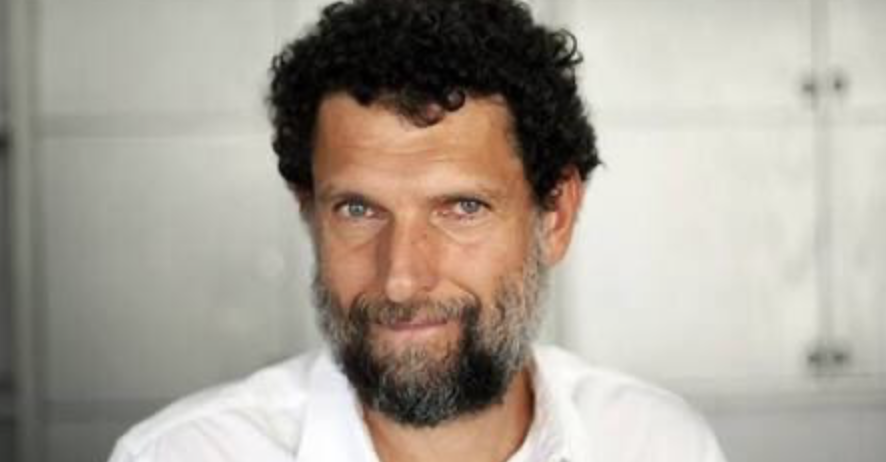
Brussels – “Kavala’s detention and conviction are in breach of the European Convention on Human Rights” and, for this reason, “Turkey is obliged to release him as soon as possible,” the European Court of Human Rights (ECHR) ruled today (25 August) regarding the Turkish human rights defender, Mehmet Osman Kavala, who is currently detained in Istanbul. According to the judges, his conviction must be regarded as “null and void”, thereby removing all “consequences of the measures taken against him.”
Born in 1957, Kavala is a businessman who has been involved in establishing several non-governmental organisations and civil society movements, primarily active in human rights and environmental protection. He is suspected of having attempted to overthrow the Turkish government “by force and violence” in connection with the events at Gezi Park – a demonstration against the destruction of a park in central Istanbul which escalated into a nationwide protest against the government – between May and September 2013, and of having “attempted to overthrow the constitutional order” during the 2016 coup – when a a faction of the Turkish armed forces attempted to overthrow President Recep Tayyip Erdoğan – the activist was “deprived of his liberty” on 18 October 2017, and has not left prison since. On 25 April 2022, he was also sentenced to aggravated life imprisonment.
The Court stressed that “the existence of a flagrant denial of justice in respect of Mr Kavala” and “the ulterior purpose of silencing him” illustrate the presence of a systemic problem in Turkey. This constitutes “a wider context,
marked by the detention and prosecution of political opponents, human-rights defenders and
journalists on the basis of criminal offences, the scope of which was interpreted extensively.” The case revealed “structural shortcomings which affected the
guarantees of independence and impartiality of the judiciary, and which were likely to facilitate the
exerting of direct or indirect influence by the executive branch on certain judicial decisions,
particularly in cases with a sensitive political dimension.” An implicit accusation against Turkish President Recep Tayyip Erdoğan, already “known” for the systematic suppression of dissent, the erosion of the rule of law and the curtailment of fundamental freedoms promoted in his country.
Among the various breaches of the European Convention on Human Rights identified, today’s judgement includes: a breach of Article 10 (freedom of expression) and Article 11 (freedom of assembly and association), but above all Article 6(1) (right to a fair trial) – regarding to the allegations concerning the independence and impartiality of the courts, the fairness of the proceedings and the restrictions on
rights of the defence – and Article 3 (prohibition of inhuman or degrading treatment), in relation to the absence of a mechanism for reviewing a sentence of aggravated life imprisonment.
This is not the first time the ECHR has ruled on the activist’s case; indeed, today it has confirmed the findings of no fewer than two previous rulings. In December 2019, it had ruled that his detention violated his right to liberty and that it served the further purpose of silencing him as a human rights defender, ordering his immediate release. In July 2022, it established that Turkey had failed to fulfil its obligation to comply with the 2019 judgement.
English version by the Translation Service of Withub