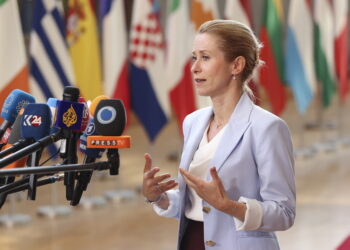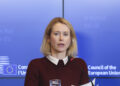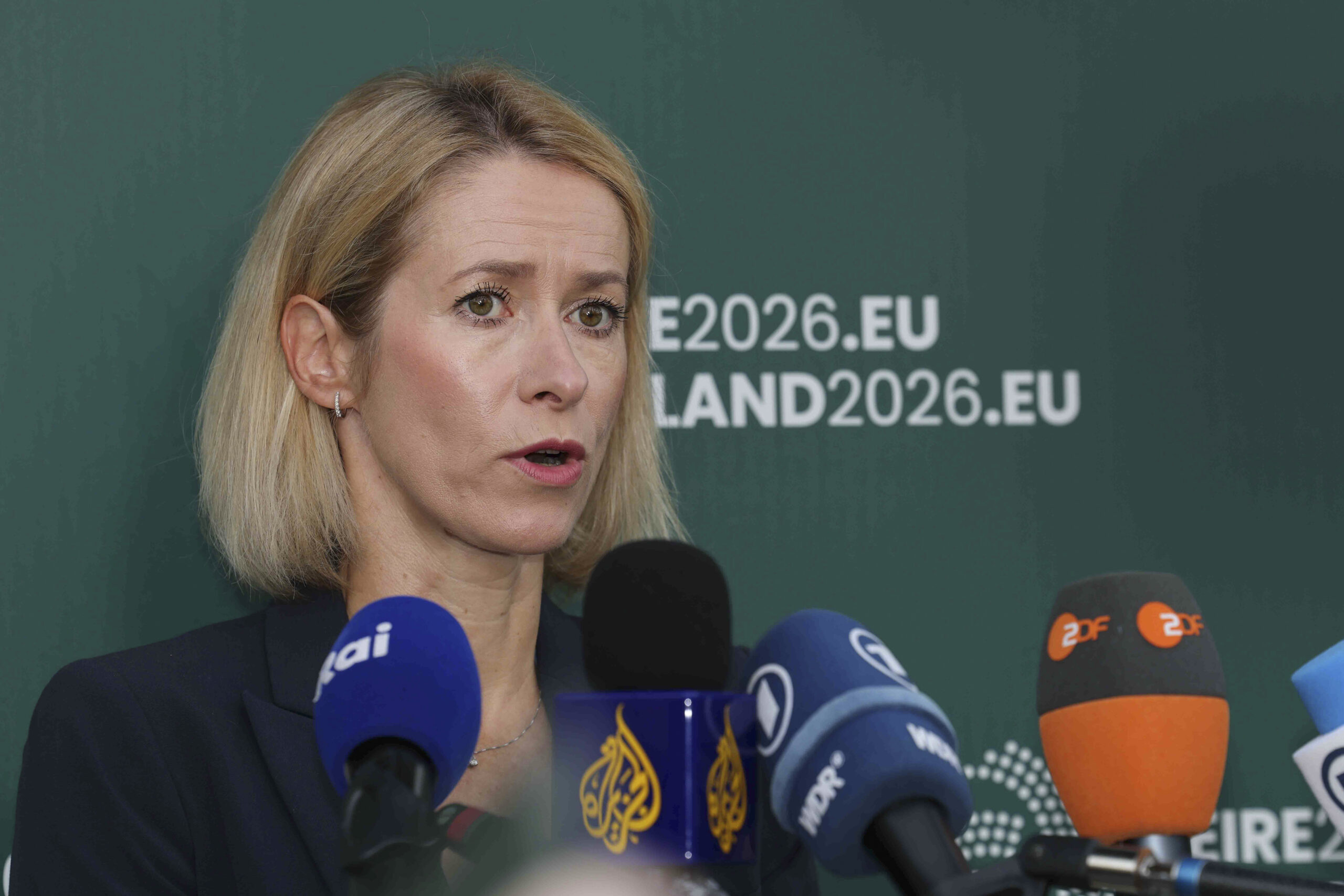
Brussels – Russia’s war against Ukraine is becoming “increasingly ruthless and destructive” and “unfortunately is far from over.” But the threat to Europe is also growing, and the countries of the European Union and NATO have not been quick enough to address the shortcomings identified. This is why a new High-Level Group on Defence will be established next week. The European Union’s High Representative for Foreign Affairs, Kaja Kallas, confirmed this at a press conference after an informal meeting of EU defence ministers in Wicklow, Ireland, the country currently holding the rotating presidency of the Council of the EU.
Kallas emphasises that “the Russian army is bogged down on the ground, which is why it is killing civilians from the air.” A “premeditated terrorism” by Moscow that is not confined to Ukraine. “In the Black Sea, Russian attacks on ships carrying grain are deliberately jeopardising global food supplies,” while Europe is being hit “by a wave of increasingly kinetic hybrid attacks.” For the former Estonian prime minister, these are clear actions with a specific aim: “Russia wants to frighten us and dissuade us from supporting Ukraine. It will not succeed. On the contrary, we will increase our support for Ukraine and invest in our defence. This is the best way to stop Putin.”
How can this be done? The High Representative explains that the EU is “planning the toughest sanctions against Russia to date” to target “the Russian military industry, so as to weaken their military production.” On another level, the High Representative notes and welcomes the fact that “Ukraine is putting pressure on Russia” and that Kyiv’s drones “are disrupting Russian logistics and striking refineries in the heart of Russian territory, causing the biggest fuel crisis in Russia in decades.” The toll on the Kremlin stands at “over 30,000 soldiers a month” lost, turning the past few months into “a difficult summer for Putin.”
The summer has been tough for Kyiv too. Last night alone, Russian attacks on Kyiv and the surrounding area left at least four people dead, and today (1 September) President Volodymyr Zelensky visited one of the schools in the Kyiv region, which has been rebuilt after being completely destroyed by Russia in 2022. “I would like to thank the parents who, despite the air-raid sirens and Russian attacks, are staying in Ukraine and, together with the teachers, are doing their utmost to ensure that our children can study at home, in Ukraine,” he said.
So the end is not in sight. “Air defence remains our top priority, but interceptors are in short supply everywhere,” emphasises Kallas, who thanks the Member States “for reconsidering their stocks.” With the war in Iran, the US has scaled back its supply of Patriot interceptors to allies and to Kyiv, while Zelenskyy needs at least 300 to get through the coming winter. For the High Representative, therefore, “in particular, Patriot missiles nearing their expiry date should be sent or sold to Ukraine” by EU countries: a subtle appeal to Spain and Greece and their stocks of these missiles. “Member States are also considering the possibility of reordering priorities and contacting partners,” notes Kallas, pointing out that “every interceptor we supply to Ukraine means one less Russian missile hitting a Ukrainian school, home or hospital.”
Among other measures to counter the Kremlin, Kallas points out that “EU naval operations are stepping up action against the Russian shadow fleet and are now taking a leading role in boarding suspect vessels, thanks to the diplomatic efforts of EU delegations around the world.” In fact, “fewer and fewer countries are allowing these vessels to sail under their flags” and “hundreds of vessels have removed their flags.”
As well as in Ukraine, the EU is stepping up its efforts in the defence sector. It is against this backdrop that Kallas announced the launch “next week of a new High-Level Group on Defence, comprising senior political and military leaders from various EU countries, as well as from the UK and Ukraine.” The starting point is that “Europe is investing in defence more than ever before, but spending alone is no automatic guarantee of success.” The litmus test is that, “despite the rising threat level,” “we have not been quick enough to address the gaps in Europe’s conventional capabilities within NATO that we have identified.” Hence, the Group’s objective is to “bring together some of the brightest minds in the field of security and defence to provide truly innovative solutions” to “close these gaps more quickly and be more effective. Especially now that the security threat in Europe is much more tangible.”
English version by the Translation Service of Withub