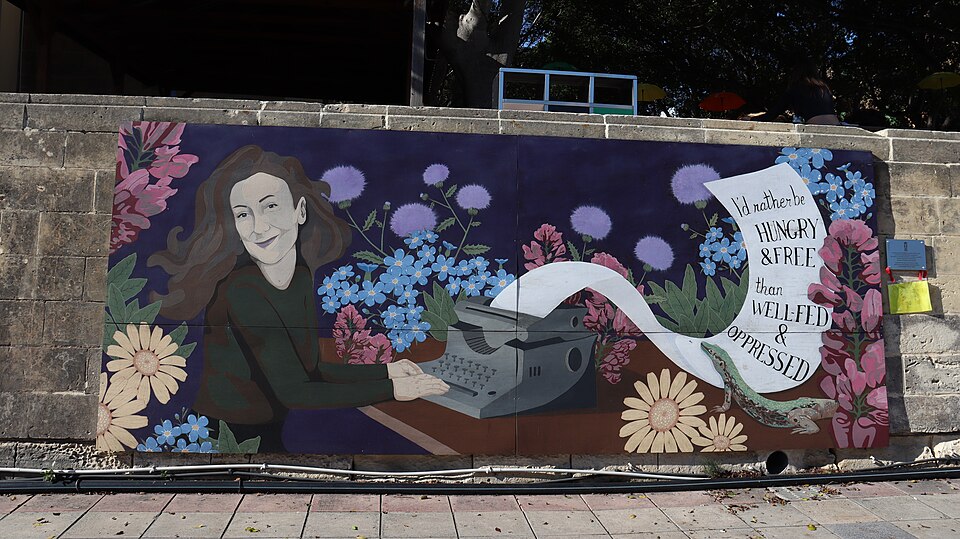
Brussels – Daphne Caruana Galizia: there is no justice. The alleged instigator of the murder of the Maltese journalist, who died on 16 October 2017 in a car bomb explosion, has been acquitted: Yorgen Fenech, a Maltese billionaire, is not behind the woman’s killing. This is what the judges have ruled, and so, almost nine years after the event, no one has been held accountable. Back to square one, with everything to be done over again, in a case that continues to be the talk of the island and throughout the European Union.
In 2017, the journalist had brought to light the corruption and money-laundering scandal in Malta, which turned out to be a truly far-reaching network. It was an investigation that made some people very uncomfortable, so much so that Daphne Caruana Galizia was silenced once and for all. But the murder sent shockwaves through the country: two ministers have resigned, and the EU has begun to question the state of the rule of law in Malta. It even went as far as accusing the Maltese government and authorities of attempting to cover up the investigations, and years later, the judges’ ruling is raising fresh fears over long-standing suspicions.
When they assassinated you, in broad daylight, outside your family home, we promised that we would not let them sweep it under the carpet.
— Roberta Metsola (@RobertaMetsola) 3 September 2026
“We promised we would not allow them to cover up the truth,” writes the President of the European Parliament, Roberto Metsola, on her personal X account. Words of despair, yet at the same time a renewed commitment to shedding light on the matter and, above all, to securing justice. Following the ruling dismissing all charges against the main suspect in the murder, Metsola has chosen to address the journalist as if she were still alive. A deliberate choice, signalling a determination to move forward. Which means starting afresh, at least as far as one line of inquiry and investigation is concerned.
The perpetrators were identified and sentenced in October 2022: the brothers George and Alfred Degiorgio were sentenced to 40 years’ imprisonment, along with the Maltese ex-convict Vincent Muscat, whose sentence was reduced to 12 years for cooperating with the authorities. It remains to be seen, however, who ordered the journalist’s murder.
“The decision by the Maltese jury to acquit Yorgen Fenech, accused of ordering the murder of Daphne Caruana Galizia, leaves us appalled,” commented the PD MEP, Sandro Ruotolo. Like Metsola, Ruotolo also says that “we cannot resign ourselves to this,” and that therefore “the search for truth and justice must continue.” Because, he emphasises, “the Daphne Caruana Galizia case does not concern Malta alone. It concerns Europe.”
Meanwhile, criticism is mounting from the Council of Europe: “It is deeply shocking that, almost nine years after the murder of Daphne Caruana Galizia, those who ordered the killing have still not been held to account,” comments Shami Chakrabarti, a member of the Council of Europe who is currently drafting a report for the Parliamentary Assembly of the international organisation on the delays in handling the Caruana Galizia case. There is a great deal at stake, she warns: “Failure to ensure individual accountability for the murder risks perpetuating a culture of impunity.” That is why “all those responsible for ordering the assassination must be brought to justice, and the broader recommendations of the public inquiry must be implemented in full.”
English version by the Translation Service of Withub
![[foto: European Council]](https://www.eunews.it/wp-content/uploads/2026/03/euco-260319-120x86.jpg)