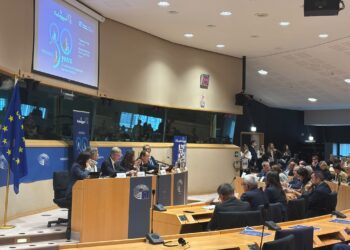
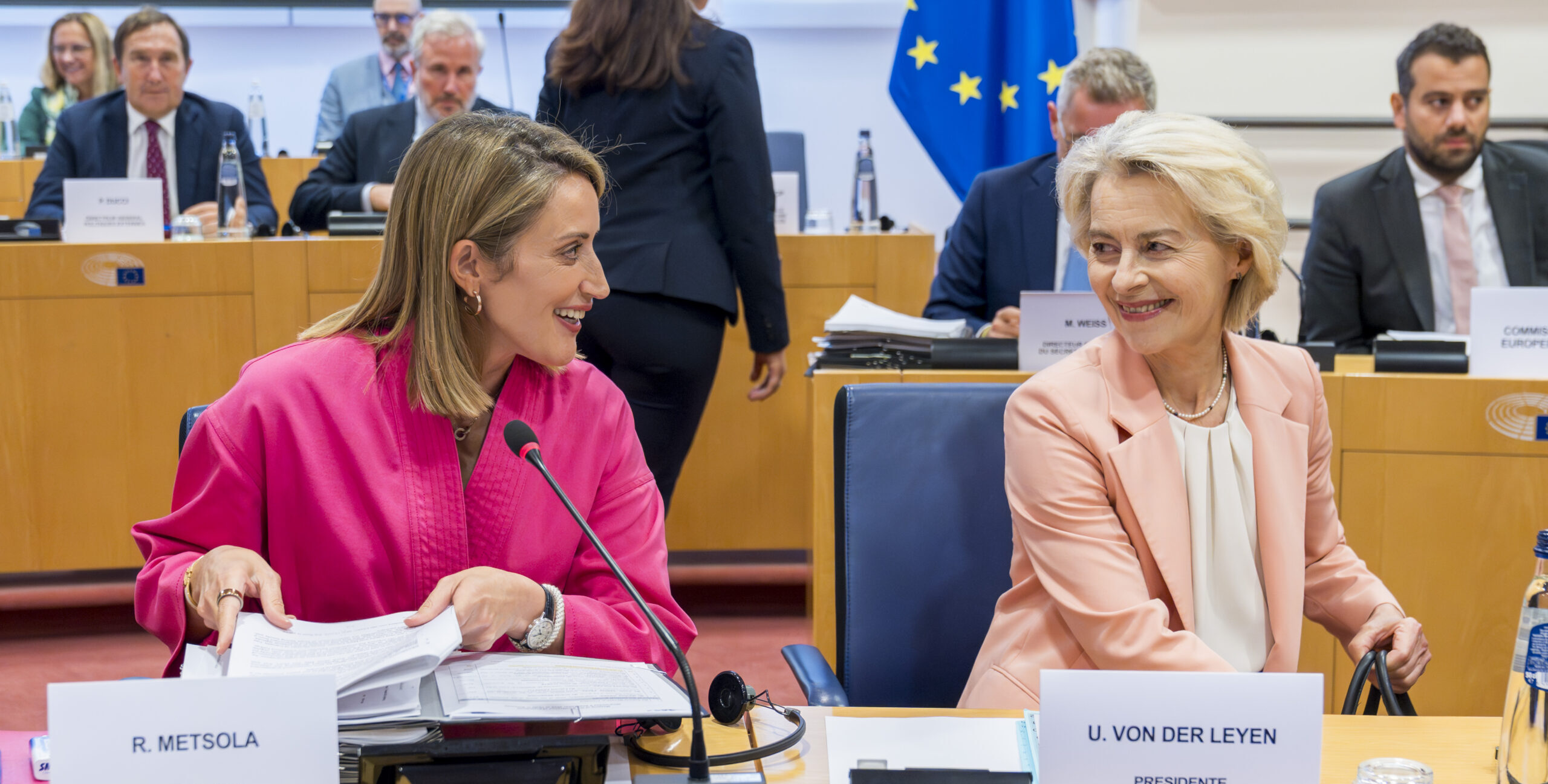
Brussels – Next week, the eyes – or rather, ears – of all of Europe will be on the European Parliament’s plenary session in Strasbourg, when, on Wednesday 16 September, the President of the European Commission, Ursula von der Leyen, will deliver the State of the Union address (SOTEU). A key annual event in which the head of the Commission outlines the political and legislative priorities for the coming year. A stage that, yesterday (September 9), von der Leyen addressed together with the leaders of the political groups in the European Parliament at the Conference of Presidents of the Eurocamera’s political groups, presenting her proposals to them and listening to their
The issue of “competitiveness” is close to the heart of the President of the European Parliament, Roberta Metsola, who believes the matter should feature prominently in the 2026 State of the Union address. This is because “we cannot ask our businesses to compete with heavily subsidised goods, nor can we allow low-cost products, manufactured under unfair conditions, to flood our market,” Metsola explained.
Echoing her views, Manfred Weber, the president of the European People’s Party – the same political family as Metsola and von der Leyen – stated that “the economy, business and employment” must be at the heart of “our ambitions.” In addition, according to Weber, it is necessary to recognise that today “migration remains a priority issue for citizens.” For the German, this means “regaining control of our borders” and “stopping illegal immigration.” On the subject of artificial intelligence, the German leader urged “striking the right balance between innovation and the protection of people in this new context” and reiterated the importance of the European Union’s support for Ukraine.
Migration remains a key issue for the sovereigntist movement. “We were all shocked in July when over 70,000 migrants travelled from Morocco to Ceuta,” recalled the leader of the Europe of Sovereign Nations party, Stanisław Tyszka. His party will therefore ask von der Leyen “whether she intends to change the policy that is leading to the closure of the Schengen area.” Another issue for Tyszka will be energy prices, because if “we do not put a stop to this economic suicide on the part of European economic policy, we will lag far behind the economic policies of other countries,” he added.
Similarly, the co-chair of the European Conservatives and Reformists (ECR) group, Nicola Procaccini, calls for “just one thing: to put common sense back at the heart of European policies.” This would involve “genuine deregulation – and therefore less bureaucracy – a green transition that is not overly ideological but based on what is happening in the world,” as well as “greater protection against illegal immigration.”
Within the ranks of the right, the Patriots for Europe appear to stand out. “Our priorities regarding the State of the Union address differ significantly,” admitted MEP Marieke Ehlers. Whilst she expects von der Leyen to “call for more EU, more funding and greater centralisation,” she believes “that the message we are receiving from our voters points in the opposite direction: less intervention.”
Even within Renew, immigration remains a key issue. The party’s president, Valérie Hayer, has called for “the Migration Pact to be translated into concrete action” through “the establishment of EU offices for legal entry channels, creating safe and regular pathways – particularly for work purposes – whilst safeguarding Schengen from populist attacks.” The Liberal group also expects “ambition on the climate front, including measures to adapt infrastructure”, as “this summer’s wildfires demonstrate that this issue is not a luxury.”
The Greens call for greater focus on environmental issues and wildfires. Their co-chair, Terry Reintke, expects the government to clarify its position both on the “phasing out of all fossil fuels in Europe” and on the formulation of “new measures to adapt to the new circumstances in which we live.”
The co-chair of the Left in the European Parliament, Martin Schirdewan, hopes that the head of the European Commission will tackle “the cost-of-living crisis” and “finally introduce legislative measures that give Europeans the chance to pay their rent and access affordable housing, energy, and food.” Together with members of his party, he hopes that von der Leyen will have “the courage to pursue social justice by taxing the rich” through “a digital tax on large technology companies and a European digital tax.” There is also a need for “a tax on windfall profits for large food retail chains and the arms industry.”
Similarly, the group’s chair (S&D), Iratxe García Pérez, hopes that the Commission’s commitment will be “aimed at improving citizens’ living conditions.” Issues close to the Socialists’ hearts include wages, pensions, education and healthcare, which is why “we must explain how to ensure affordable housing, quality jobs and a future for our young people,” the Spanish politician clarified.
English version by the Translation Service of Withub