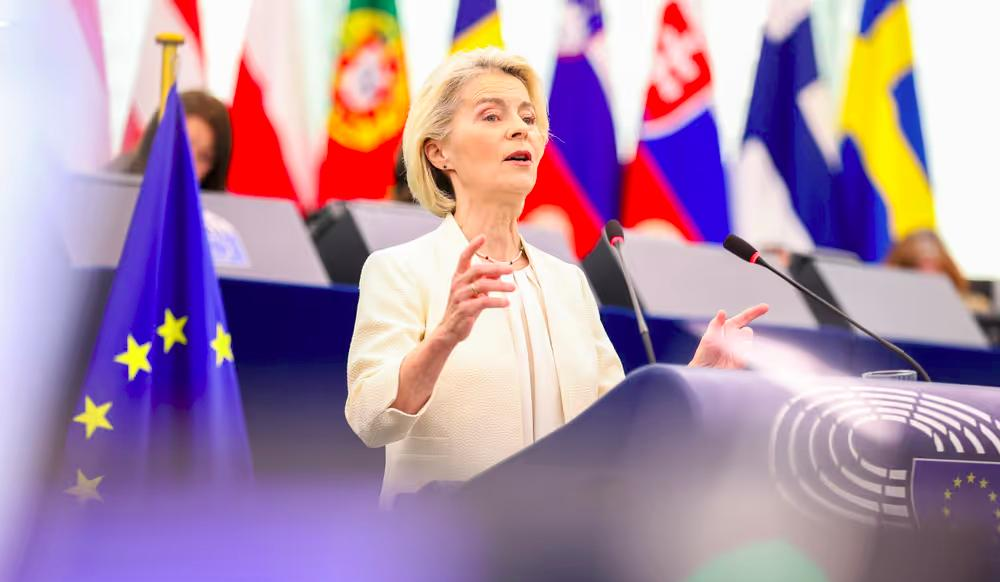
Brussels – A European Union with a threat-response model along the lines of NATO, and active on the international stage as a major power: Ursula von der Leyen is attempting to reshape the EU. In her State of the Union address, the President of the European Commission proposes a strong, even aggressive, bloc, determined to expand on the trade front and counter China, Russia, and even the United States. The decision appears inevitable, and stems from the manoeuvres orchestrated by the Kremlin: “Cyberattacks and sabotage, arson and drone incursions. They are ramping up every day,” she said, in a clear reference to the Russian President, Vladimir Putin. And this is where the transformation begins.
“We urgently need a consensus on how to respond to certain incidents. Those which fall below armed aggression but clearly threaten our national security,” the President of the European Commission said. In other words, “a mechanism to flank NATO’s Article 4,” the one that requires all members to consult one another, at the request of just one, whenever there is a threat.” “I believe it is time for Europe’s own Article 4 – or an Emergency Security Protocol,” von der Leyen stressed.
This mechanism, “when triggered by one Member State, all Member States would convene. To coordinate a European response. To deter further escalation. And to mitigate the impact,” the President of the European Commission noted, who nevertheless believes the initiative does not go far enough: “We will set out our ideas to make a European Security Council a reality.” The time has come: “For a long time, we have discussed a leaders’ format focused on the security of our continent. With partners like Canada, Norway, Ukraine, the United Kingdom and others involved. This is even more urgent now.”
Pinning Russia into a corner
While the EU’s defence policy stems from the threats posed by Russia, it is precisely against Russia that von der Leyen is leading an economic and trade counter-offensive. On the one hand, “further pressure must be applied to Russia”. For this reason, she explains, it is “not necessarily new sanctions, but above all the enforcement of existing sanctions.” Added to this is the desire to win over traditional partners through regional expansion. “I can announce today a new international connectivity project. It will link the South Caucasus and Central Asia directly to the European market – what we call the “Middle Corridor’,” she said. It is the EU expanding eastwards, at Russia’s expense, with renewed determination.
An alliance with Canada against Trump
This decision is not merely anti-Russian; it is a natural response to the challenge to the traditional world order. The announcement regarding the Middle Corridor forms part of the context of the trade agreements signed by the EU with the rest of the world, starting with Mercosur, in response to Donald Trump’s tariff policy. In this regard, the US president is never mentioned except on two occasions, and always implicitly: the first time, when von der Leyen recalls “when we stood up for Greenland when it was threatened”, a threat from the United States and its president in office; the second time is when von der Leyen emphasises that “in this new world, we must urgently reimagine our partnerships. And build global coalitions for our resilience and democracies.”
In this context, von der Leyen’s strategy is to “bring the relation with Canada to the highest level possible,” she said. “I would like to work with you on opening the door for Canada to be the first associate member of the EU,” she announced to the European Parliament, where the Canadian Prime Minister, Mark Carney, was invited for the occasion. In geopolitical terms, this would mean dismantling the UMSCA area, the customs union, and the free trade area that Trump sought to replace the NAFTA free trade agreement with Canada and Mexico.
The gauntlet has been thrown down at the never‑mentioned Trump. Together with Canada, “we will move from CETA (the bilateral free trade agreement, ed.) to an Alliance for the Future to create a common prosperity and economic security space.” Together, von der Leyen insists, “We will work on intelligent manufacturing. We will create a tech alliance.” Furthermore, “we will integrate defence industrial bases. We will make the Arctic a flagship joint project.” As part of this new partnership, “We will work on energy, critical minerals and batteries. On AI, quantum, cyber and economic security.” It is the EU that is “dumping” the United States in favour of a new partner.
A more muscular Europe in its approach to China
In this renewed drive, von der Leyen’s European Union – at least in the statements made in her policy address – is showing itself to be resolute and combative in its stance towards China. “Our trade deficit with China now stands at one billion euros a day,” she said. “It has reached a tipping point. Some say the second China shock is looming. But it’s already here. It shows in our communities and in factories across our Union.” The economic and trade imbalance “leads to deindustrialisation in the industrial heartlands of Europe. This is unsustainable.”
The President of the European Commission noted that “we are engaged in a dialogue with China to rebalance our trade. But this dialogue must now lead to results.” Von der Leyen imposes her diktat on Beijing: “We will use all the tools at our disposal to rebalance our relationship. Words are good. But deeds are better.” This is a Europe of power that seeks to emerge as a new force, and which employs the language and stance characteristic of the new EU that von der Leyen is proposing.
English version by the Translation Service of Withub![[foto: imagoeconomica]](https://www.eunews.it/wp-content/uploads/2025/09/ue-cina-350x250.png)
![La presidente della Commissione europea, Ursula von der Leyen, alla conferenza annuale degli ambasciatori [Bruxelles, 4 febbraio 2025]](https://www.eunews.it/wp-content/uploads/2025/02/vdl-ambasciatori-350x250.png)