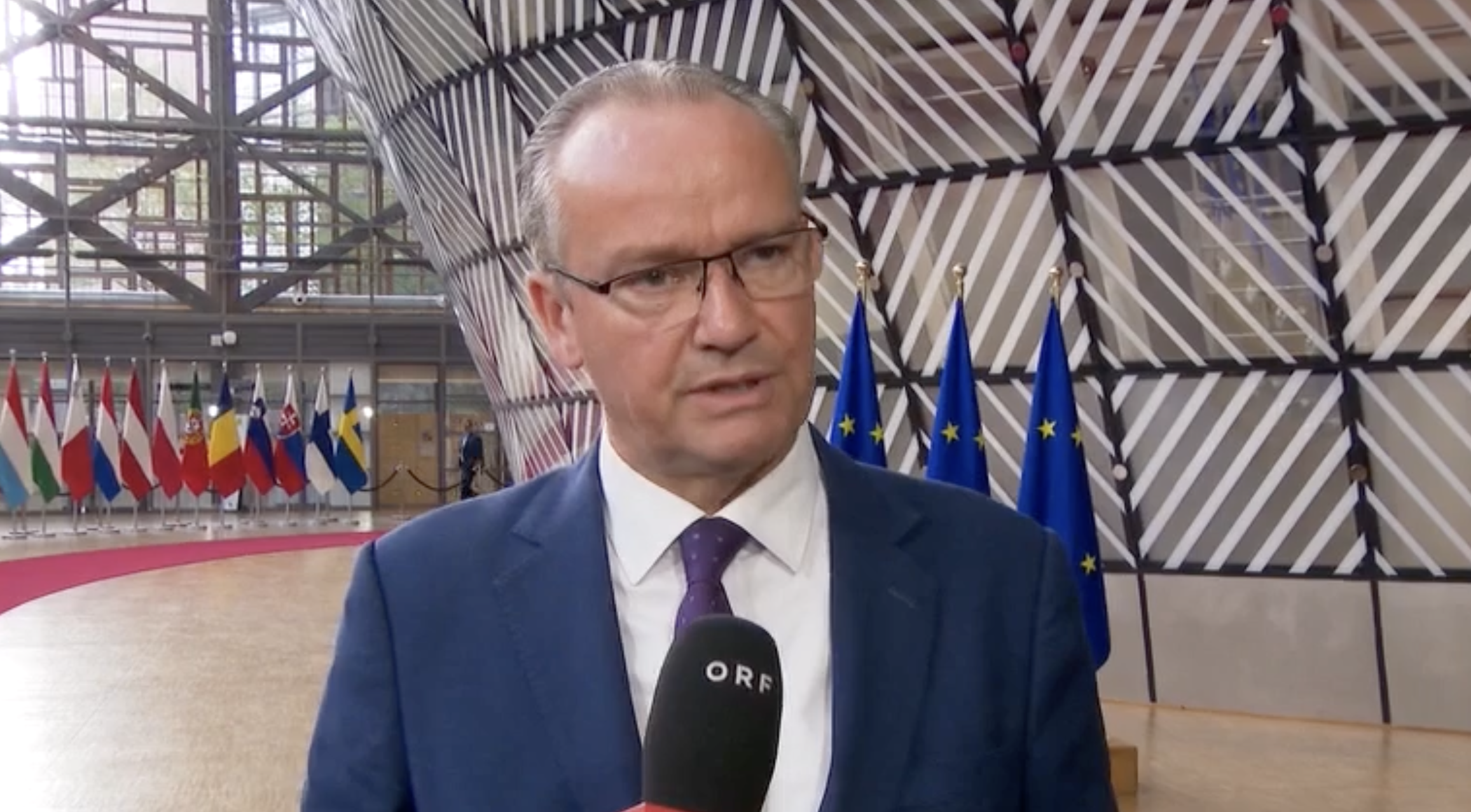
Brussels – More cuts and greater simplification of EU bureaucracy. In short, the opposite of what European Council President António Costa has argued — namely, introducing new own resources in the EU’s 2028–2034 budget. Germany has branded the former Portuguese Prime Minister’s stance as “out of touch with reality”. These are the clear warnings of the German Federal Minister for Europe, Gunther Krichbaum, and the Austrian Minister for Europe, Integration and Family, Claudia Bauer, issued upon their arrival at the EU General Affairs Council in Brussels today (22 September). On the agenda for the meeting is the policy debate on the future of the Multiannual Financial Framework (MFF) 2028–2034, and Germany and Austria are seizing the opportunity to reaffirm their alignment with the so-called frugal countries – alongside Denmark, Finland, the Netherlands, and Sweden – which are committed to fiscal discipline and opposed to excessive spending and shared debt.
Krichbaum reiterated that his government is calling for “a reduction in the Commission’s proposal by several hundred billion euros.” He also stressed Berlin’s opposition to the comments made yesterday (21 September) by President Costa, who, in an interview with Politico, said that the EU budget would require taxes that national governments are not already collecting. According to the German minister, these are “suggestions that are not exactly helpful” and “one has to wonder whether, in the meantime, Mr Costa has completely lost touch with reality.” On the contrary, Germany is calling for “greater realism”, because “national budgets are under enormous pressure”. Berlin aims to send “a clear signal towards modernisation.” This means “assessing which sectors to invest in,” such as new technologies and artificial intelligence, “sectors in which we must not fall behind China, the United States and many others.”
According to Minister Bauer, simplification remains the priority. The Austrian minister pointed out that “Commission President Ursula von der Leyen announced more than 20 new legislative initiatives in her State of the Union last week.” Therefore, “those who try to combat growing bureaucracy with ever more laws end up putting out fires with paper,” she noted. While supporting the ‘Omnibus’ simplification packages, Vienna believes that “the order of priorities should be reversed.” For this reason, the government will today present an informal document – which Italy also championed – calling on Brussels and the European Union to implement a year-long drive to reduce bureaucracy. “The point is that we should focus for a year on the implementation of regulations, on simplification and also on the elimination of superfluous regulations,” Bauer explained – a principle which, according to Austria, should also apply to the MFF. More specifically, its proposal for the EU’s multiannual budget calls for “the total volume to be significantly reduced” and that it be concentrated “on the sectors where the greatest benefits for Austria are expected”, such as “research and innovation, the scientific and business sectors, as well as agriculture and regional development”. We do not need “the largest possible budget in the European Union; we need the most effective one,” she said, seeking to summarise the position of the frugal states which, “despite representing less than a third of EU Member States”, provide “almost two-thirds of the EU budget.” For this reason, “a realistic landing zone” is needed.
English version by the Translation Service of Withub