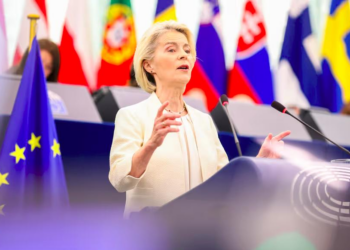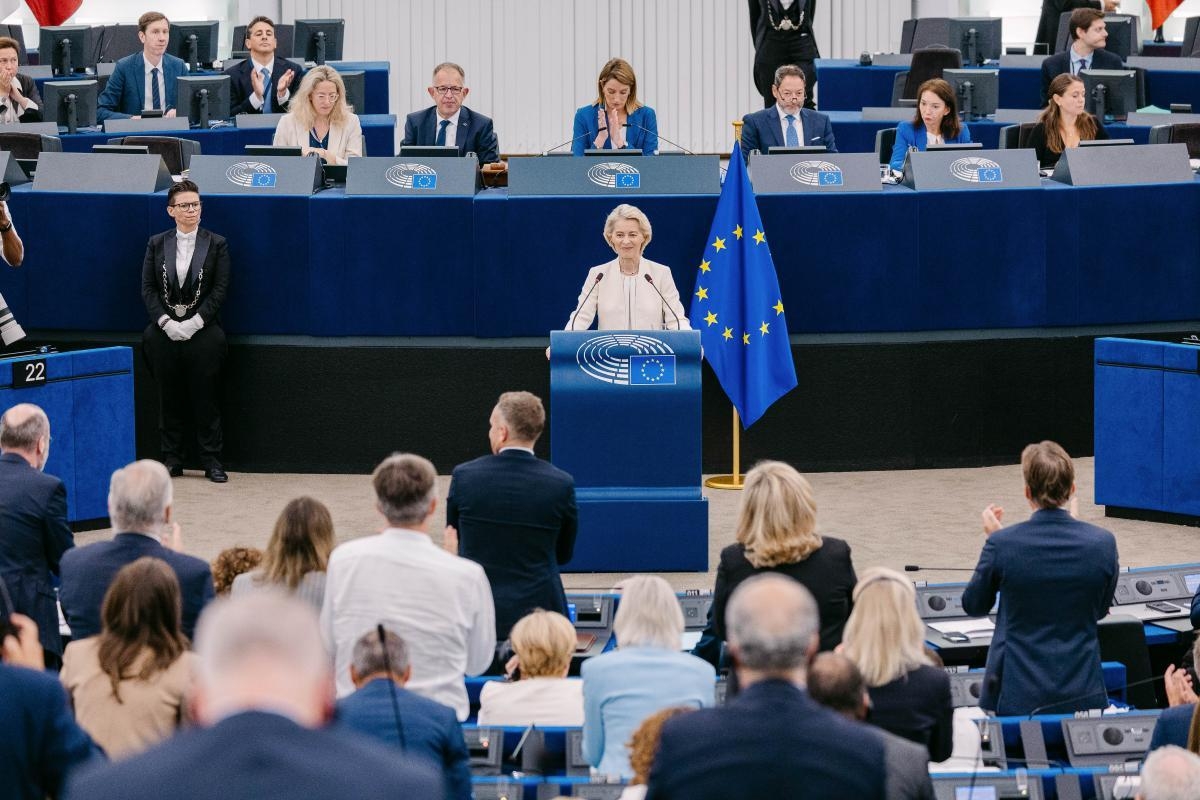
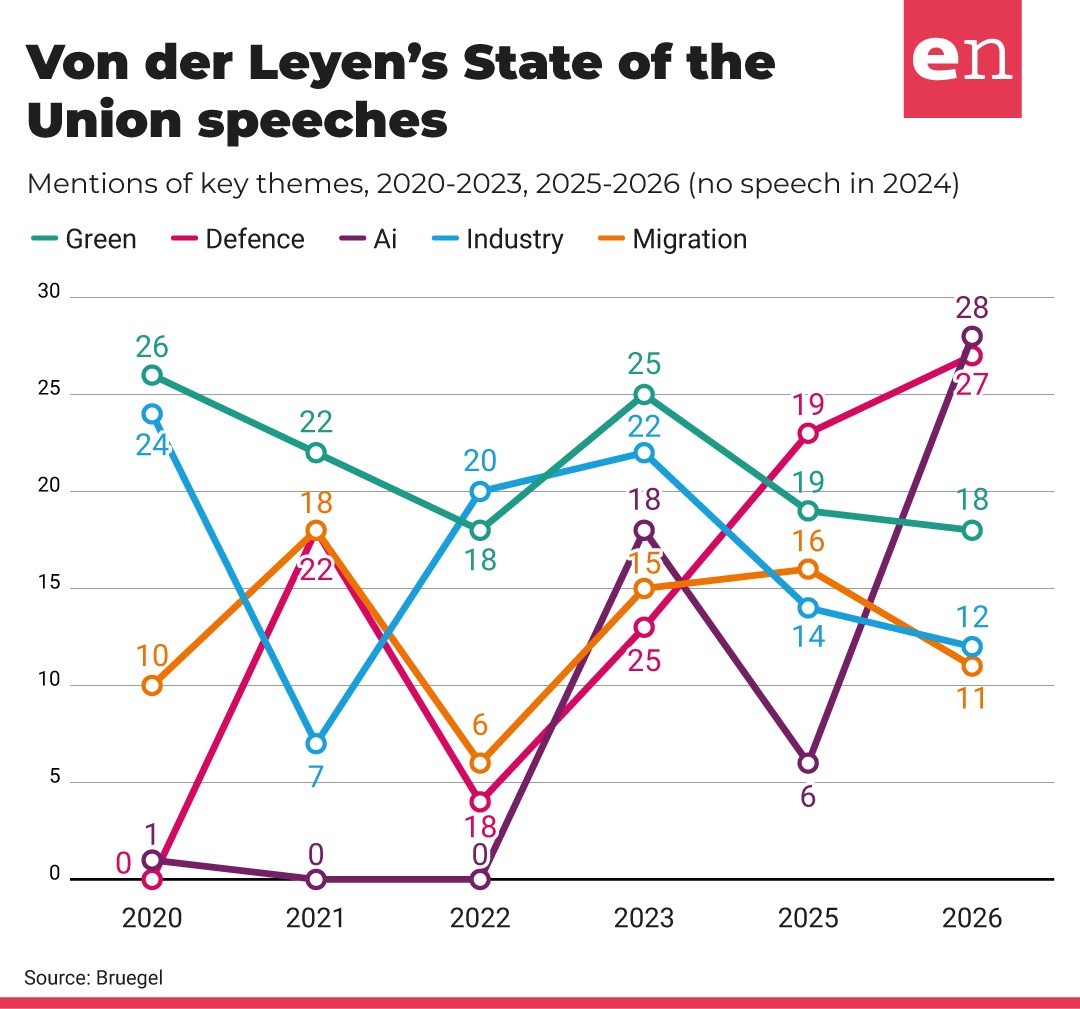
Brussels – A speech one hour and ten minutes long, punctuated by more than twenty rounds of applause, including four standing ovations. Neither the United States of America nor its president were ever mentioned. The word “climate” appeared seven times, and “defence” twelve. Ursula von der Leyen delivered today (16 September) her State of the Union address in a near-full chamber of the European Parliament in Strasbourg—with a few empty seats in the right-hand wing—and, from her very first words, described the current period as an “exceptional” moment in history, “a complex age of great possibilities and great perils,” in which the Union, to paraphrase Charles Dickens, “is the strongest it has ever been. The state of our Union can also feel as precarious as it has ever been.” But the goal, for von der Leyen, is clear: “To build an independent Europe
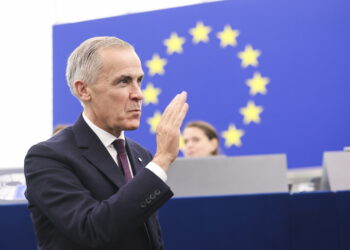
that has the power to act.” There were three guests of honour who inspired von der Leyen: the founders of the tech start-up, “Rafa, from Poland, and Pekka, from Finland”; the family of the Danish firefighting pilot, Rune Kyndal, who lost his life in a tragic accident alongside a liaison officer to whom the chamber paid its first standing ovation; the young Ukrainian gymnast Sasha—who received the second standing ovation—who, despite losing her left leg in a Russian attack, has resumed training and is winning medals once again. Also present in the chamber is the Canadian Prime Minister, Mark Carney, who received the third standing ovation and was at the heart of von der Leyen’s political message: the EU continues to believe in alliances.
Economy, market, and energy
The President makes it clear straight away that she intends to “complete by the end of next year this historic overhaul of the Single Market,” which is the roadmap for competitiveness, ‘One Europe, One Market’, and to continue on the path of simplification. On this point, “we will put forward proposals to further speed up permitting”—such as those relating to authorisations, forms, grid connections, and funding decisions—she explains, taking the opportunity to take a dig at the Member States: “At European level, we are doing our best to cut red tape, but I believe the time has come for Member States to play their part too.”
The EU is also stepping up efforts towards “affordable, homegrown, clean energy”—“Be it renewables and nuclear, or biomethane and others”—based on a technology-neutral approach. “But we also need to ensure that the electricity we generate is available”, which is why “we need the grids package so urgently,” to enable “faster investment, speed up grid connections and develop storage.” In essence, for the occupant of the Berlaymont Building, Europe’s future is “electric”, with the aim of doubling the share of electricity by 2040, thereby “cutting its fossil-fuel import bill by €260 billion a year. ”
The standoff with Beijing and independence in the raw materials sector
“Bringing down energy prices, investing and innovating more, reforming our economies” may, however, not be enough “if our businesses cannot compete on a level playing field.” And here, the finger is being pointed at China, with which the EU has a trade deficit of one billion euros a day. “This is an unsustainable situation,” comments von der Leyen, adding that the dialogue initiated with Beijing “to rebalance trade” “must now lead to concrete results.” She clarifies: “We will use all the tools at our disposal to rebalance our relations.
Words are good. But deeds are better,” she emphasised. Meanwhile, with regard to “dangerous dependencies,” she announced that “a new
European Corporation on Critical Raw Materials will be established, which will help us obtain and stockpile what we need: for electric cars, chips and batteries, clean tech and defence. And much more.”
To make progress, however, the EU needs funding, and for von der Leyen it is crystal clear that the EU’s next long-term budget, for 2028–2034, “needs new own resources,” that is, those new sources of revenue for the Union that are so unpalatable to Member States, particularly the so-called “frugal” countries, which are seeking to scale back the Commission’s and Parliament’s demands for the future EU budget. Support for businesses and the economy does not end there, and in addition to the “fundamental” work on the Savings and Investment Union, von der Leyen believes there is a “need for a banking system that is built for growth—not just for stability.” Therefore, “
we will put forward a new Banking Package focusing on simplification and tackling fragmentation.”
Climate and digital technology take centre stage
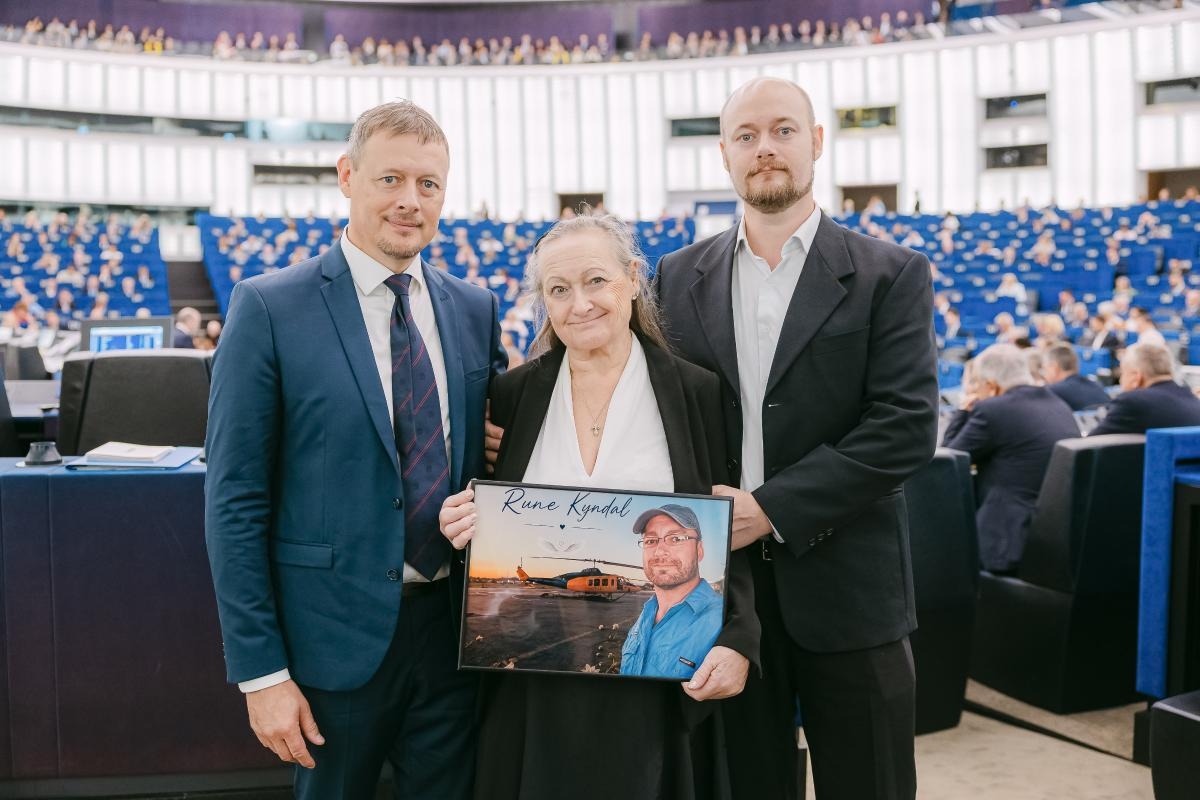
Tue, Margit, Kaare Kyndal: the family of Danish pilot Rune Kyndal, guests at the State of the Union address. 16 September 2026. Source: EU Commission
Concern and a call to action characterise this section of the speech. “This summer was the summer of truth,” notes von der Leyen, recalling that “almost no part of our continent was spared.” That is why, even though “the transition is complex”, “Europe can, must and will
stay the course on its climate targets.” In this endeavour, “we must dramatically step up our preparedness” and, to this end, “we will present a new framework for climate resilience next month. We will identify 100 of the most vulnerable territories in Europe. And we will assess the risks—and at which level they should be managed.
”
As for the consequences of extreme weather events, von der Leyen states that “at present, only around 25 per cent of l
catastrophe losses in Europe are covered by private insurance,” and to address this shortfall, “the Commission will set up a Climate Insurance Alliance.” Furthermore, to ensure “there can be no repeat of this summer,” “a European Heatwave Plan” will be presented “soon” to establish more effective early-warning systems and improve preparedness within the healthcare sector, while in terms of water and food security, there will be “a new European water initiative”—given the “enormous waste” in European water networks—as well as “proposals to improve risk management and bridge the insurance gap.” Here comes a message to the “tractor drivers”: “European farmers have risen to the challenge of this endless summer. They are the best in the world. We will support them every step of the way.” To conclude the section on environmental disasters, von der Leyen explains that she has asked the most experienced European heads of fire services and emergency services to examine every aspect of preparedness and prevention and “to make proposals,
including for a future European Firefighting Fleet.”
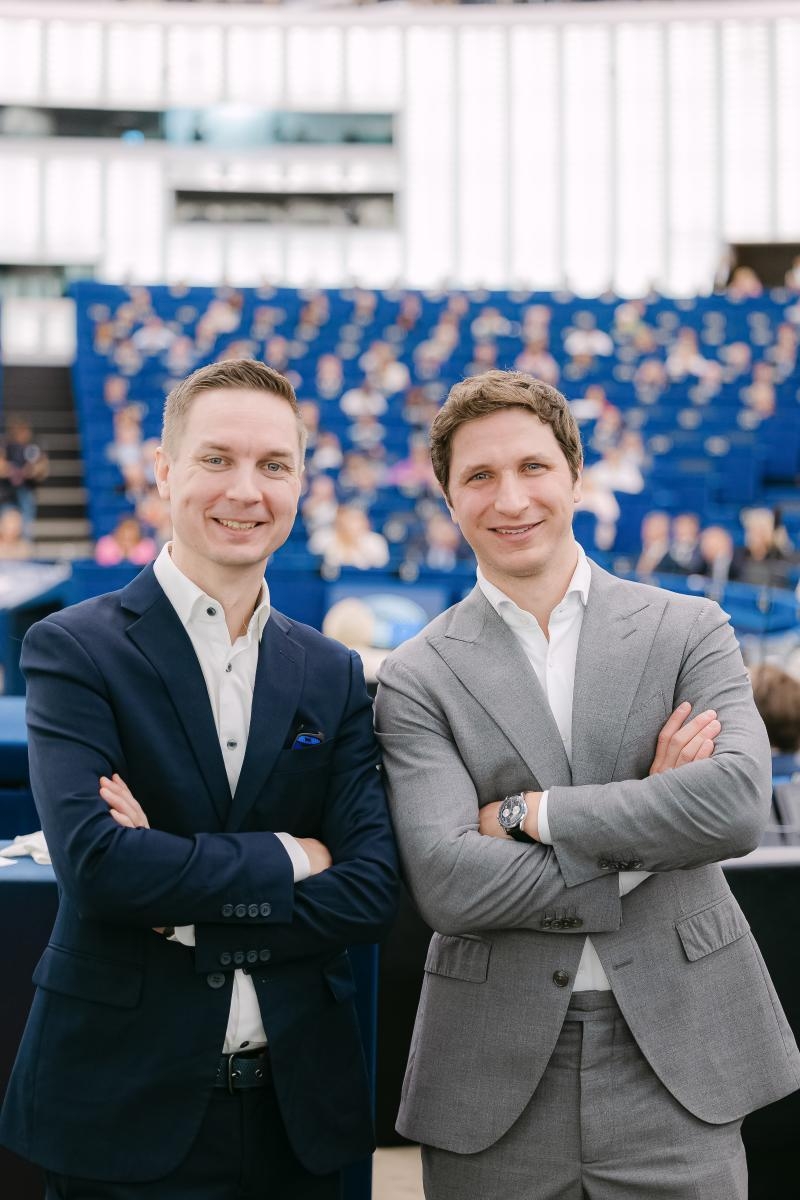
Rafal Modrzewski and Pekka Laurila as guests at the State of the Union address. 16 September 2026. Source: European Commission
To address the risks posed by Artificial Intelligence, von der Leyen announces that “we will step up together with our like-minded partners like Canada, the United Kingdom and others,” and I will invite the main frontier labs for a discussion on how we can support ongoing industry efforts to pace the frontier.” However, “Europe will need its own capabilities—in particular to protect our national security,” and “stay in the race” for technological leadership. In short, it must “massively boost computing capacity”, on which the Commission will present proposals. Furthermore, “we will also develop new ways to use public and private funds to invest in the most promising European start-ups and companies.” For the Commission President, when it comes to artificial intelligence, “the key lies in creating the value that AI has not yet delivered,” but without ever replacing humans. “We are now focusing on five of the highest-value sectors in which industrial AI has the biggest potential and we have the data: health, transport, agri-food, advanced manufacturing, and defence and space.
In November, we will announce game-changing initiatives across these sectors.”
Against the backdrop of digital technology and the protection of individuals, von der Leyen has taken the time to give a preview of the package on the protection of children online, which will be presented tomorrow: the EU Kids Act. “No social media under the age of 13. No personal account under the age of 15.
This means that, for 13- to 15-year-olds, only ‘mini-accounts’ set up and supervised by parents, with limited functionality and a time restriction of one hour a day.
And between 15 and 18, safe design will be an obligation for the platforms,” she explains, adding that “platforms will have to prove to us that they are safe.” She then moves on from children to adults, noting that “a broader regulatory framework is needed: the Digital Fairness Act”, which will be proposed “in the autumn” to tackle addictive design.
Work and the European Social Pillar in the age of new technologies
This approach—one in which humans are at the centre and in control of AI—also extends into the world of work. “From education to employment, AI must help develop skills, improve the quality of jobs and give workers a fair chance.
That is why we need our ‘Quality Jobs Act’ and we will present it before the end of the year,” she announced. It is in this context that the first female President of the European Commission emphasised that, to mark the tenth anniversary next year of the European Pillar of Social Rights, the EU will invest “in our regions, so that everyone has the ‘right to stay’” and does not have to emigrate if they do not wish to, and will launch “a European Care Deal to address the challenges linked to our demographic changes.” And she declares more emphatically, in the face of “those who would even like to roll back women’s rights”, that “women are here to stay.” For this reason, “together with my dear friend António Costa (President of the European Council), we will host a summit to uphold the enduring principles of our Social Pillar.”
International screenings: Canada, Ukraine and the Middle East
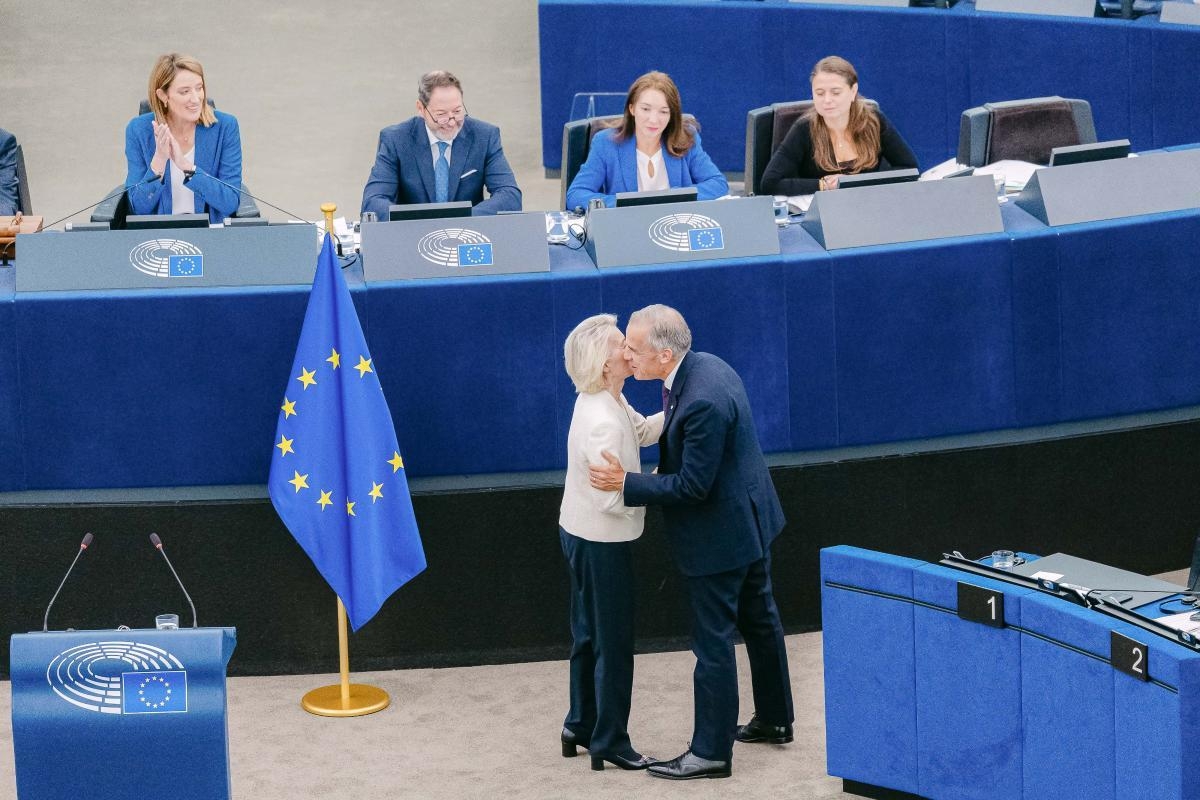
European Commission President Ursula von der Leyen and Canadian Prime Minister Mark Carney. 16 September 2026. Source: EU Commission
Von der Leyen highlights the work on trade alliances around the world, “with over 80 countries”, and announces, with regard to the East, “a new international connectivity project—“it will directly link the South Caucasus and Central Asia to the European market, what we call the ‘Middle Corridor’”—and, to the west, the intention to “take relations with Canada to the highest possible level,” working with Carney, who is present in the chamber, “to
opening the door for Canada to become the EU’s first associate member.”
According to von der Leyen, international relations are not enough to keep the EU safe. And in the face of “cyber-attacks and sabotage, arson and drone incursions” which are “constantly on the rise”, the President, together with the High Representative for Foreign Affairs, Kaja Kallas, will present “a new European security strategy.” In the President’s plans, “Europe needs its own counter-hybrid playbook.” In other words, “I believe the time has come for a European ‘Article 4’,” similar to that of the North Atlantic Treaty Organisation, “or an emergency security protocol.
When triggered by one Member State, all Member States would convene. To coordinate a European response. To deter further escalation. And to mitigate the impact.” But that is not all. “For a long time, we have discussed a leaders’ format focused on the security of our continent,” and “this is even more urgent now,” which is why “we will set out our proposals to make a European Security Council a reality.”
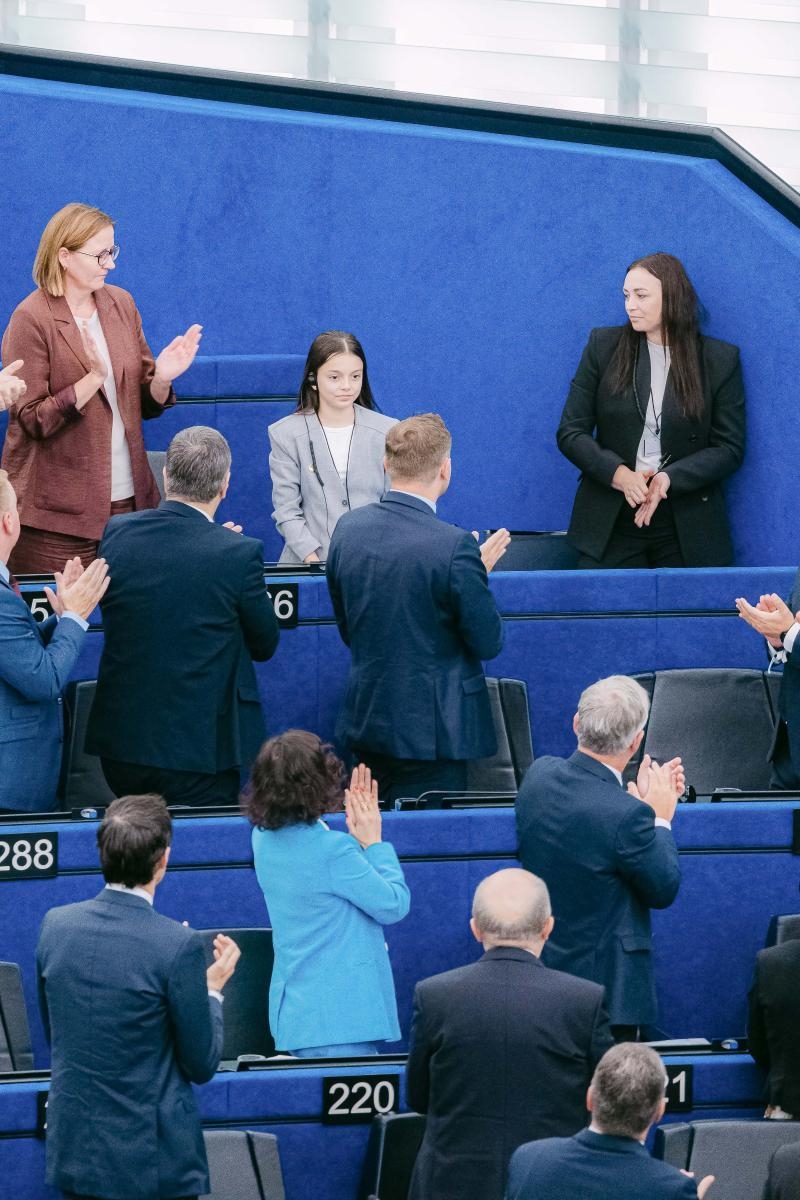
Sasha, a Ukrainian gymnast, was a guest during the State of the Union address. 16 September 2026. Source: European Commission
The stance towards Ukraine remains unchanged and, if anything, is being strengthened. “We will provide humanitarian aid and reinforce Ukraine’s supplies of power and heating,” and “Ukraine’s air defence,” she says. Furthermore, “
we would like to develop with Ukraine an affordable, modular missile-defence system,” and, “using the remaining SAFE funds, we will set up a new programme for joint projects with Ukrainian companies.” Thirdly, “we will tighten our sanctions against Russia.”
Little was said about Gaza. Von der Leyen points the finger at the lack of unity among Member States in reaching “a unified response” and notes that this behaviour on the part of the EU is “painful for many Europeans,” who are deeply “moved by the profound suffering in Gaza and the unchecked violence of the settlers in the West Bank.” She brands “the Israeli government’s decision to press ahead with the illegal E1 settlement project as unacceptable” and recalls having called on “Europe to act last year, proposing a series of measures.” These have been shelved. So, all that remains for her to do is to highlight the role played in supporting the Palestinians – “we have provided more aid than anyone else”—and to close the chapter by emphasising that “it is Europe’s role to keep the flame of a two-state solution alive.” No mention, however, of how to achieve this.
Migration since Ceuta
The migration issue features in von der Leyen’s speech in the context of the events in Ceuta in which she highlights “the exploitation of vulnerable people by callous traffickers and smugglers. And by our adversaries,” against whom the EU has proposed a sanctions regime, and the principle that “external borders are European borders.” In this context, “the only possible solution is a European one,” and it is called the “Pact on Migration and Asylum”. But that is not enough: “Europe must have the necessary means to protect its borders at all times” and “for this reason we will propose a new European emergency response framework.” Furthermore, “we will also step up work to strengthen Frontex, in particular to speed up returns;” “we will improve our early warning systems, including in collaboration with third countries”; “we will ensure that we can detect and anticipate online” and “we will keep tackling the root causes of irregular migration” through “a new
Mediterranean Youth Skills and Jobs initiative.”
Europe: a love to rediscover
Finally, a look ahead to the Europe of the future. Von der Leyen confirms that the enlargement process “will continue to be merit-based” and that “respect for our values is non-negotiable”. For this reason, she says she is “horrified by the images of Ratko Mladić’s funeral in Belgrade last week.” She then looks back to 1948, when “a Congress of Europe was held, bringing together the greatest minds on our continent to reflect on the future of European cooperation.” For von der Leyen, “we need to rediscover this ability to think European” and for this reason “I am announcing today the launch of a new Congress of Europe, which will bring together thinkers and writers, artists and scientists, citizens and civil society.” It will take place next year, to mark the 70th anniversary of the Treaty of Rome. The aim: to produce “a vision that can inspire the new generation of Europeans and recapture the European imagination. So that the next generation can write its own story.
” Because it is clear that something has been lost over the past few decades, and it needs to be rekindled. And for Europeans to fall in love with the EU all over again, more is needed from the institutions and the corridors of power.
At the end of the speech, there was a fourth standing ovation, but only a partial one: the MPs on the right and left remained seated without even clapping.
English version by the Translation Service of Withub
![La presidente della Commissione europea, Ursula von der Leyen, pronuncia il discorso sullo Stato dell'Unione [Strasburgo, 26 settembre 2026. Foto: Fred MARVAUX Copyright: © European Union 2026 - Source : EP]](https://www.eunews.it/wp-content/uploads/2026/09/soteu26_2-350x250.png)