I am convinced that Europe’s defence capabilities need to be improved. By this I mean that a Union such as this – which is almost entirely a member of NATO and has its own defence agreements – must have a central coordinating body capable of efficiently mobilising the armed forces of individual countries. And this concerns us all, from the Portuguese – who seem to be living peacefully over there, with the sea in front of them and friendly Spain behind – to the Poles, who share a border with belligerent Russia.
At present, if we were to send a tank to Poland – say, from Italy – the only way, if I understand correctly, would be to load it onto a truck or a ship and have it transported to Gdańsk. It doesn’t seem very efficient; it might work, but there must be a better way.
So, given the aggressive neighbour we have and the withdrawal of our long-standing ally across the Atlantic, it has been said (for years, many years) that the system needs improving. The defence system needs to be improved and coordinated; industrial production needs to be improved; a semblance of a chain of command capable of immediately taking the reins in an emergency needs to be introduced; transport needs to be coordinated, and so on. All good, all correct.
But nobody is doing that. The only thing happening is a huge increase in orders that governments place with various companies, each acting on its own, without any coordination or efficiency measures. And in military life – the first thing you learn when you enter this field – it’s all about efficiency: 1,000 rifles are worth less than 10 bows if they are handed to 1,000 uncoordinated riflemen, all of whom will soon be shot down by ten archers who know exactly what they are doing.
This really makes me furious. Because, in truth, I detest weapons (even though I did my military service – and did it well, with two promotions in 10 months, even though I come from a family – on my mother’s side – of military personnel) and it was hard for me to admit that, in any case, we cannot be dreamy pacifists while someone is bombing our neighbours and is already attacking our IT systems (because defence isn’t just about shooting). But I know we also need to educate our young people, care for our sick, make our rivers safe, pay decent pensions, keep our streets clean, build housing… and if, instead, we throw our money away on ordering tanks that won’t even be able to leave the province where they’re parked, then I get really angry!
The report published by the European Defence Agency (EDA) on 30 September is discouraging: 68 per cent of investment remains at the national level. In other words, Italy, Germany and Portugal (on average) order weapons to keep at home, without even consulting their neighbours, and without making any effort to form a united front. In practice, if Russia were to attack us, we would head to wherever the conflict was taking place to fight with 27 different armies, without even having automatic permission to pass through other friendly countries while armed. And in fact, we would never even get there.
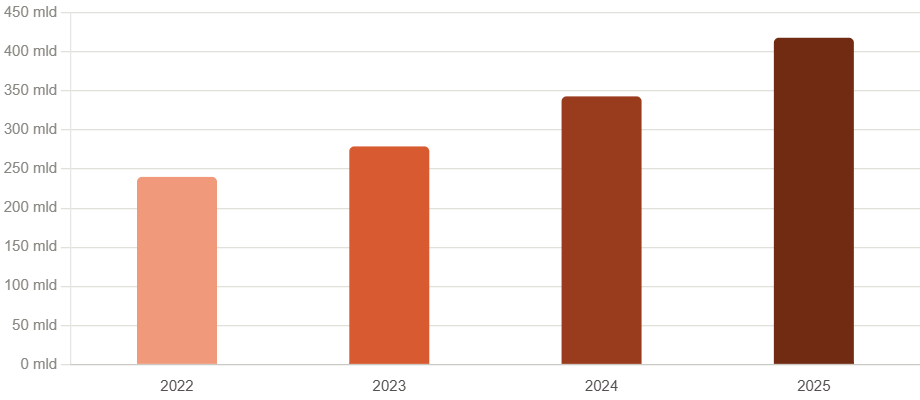
Yet, in 2025, defence spending by EU Member States reached 418 billion euros, equivalent to 2.2 per cent of the EU’s GDP, and is projected to rise to as much as 547 billion by 2029. A dramatic rise – see below.
According to data from the EDA, defence spending across the 27 EU Member States followed this trend: