Brussels – Inflation in the Eurozone accelerated once again, driven mainly by high energy prices. In September, the annual rate in the euro area rose to 3.8 per cent from 3.2 per cent in August, according to the flash estimate published today (2 October) by Eurostat, the European Union’s statistical office. The figure marks an acceleration following 2.9 per cent in July and 3.2 per cent in August, bringing inflation to significantly above the European Central Bank’s 2 per cent target.
The main factor driving the figure upwards is energy, where the annual rate rose from 14.3 per cent in August to 18.8 per cent in September. It is by far the component with the sharpest rise: on a month-on-month basis, energy prices rose by 3.9 per cent. This is followed by services, with inflation at 3.2 per cent, up from 3 per cent in August, while prices for non-energy industrial goods slowed slightly, from 1.2 per cent to 1.1 per cent.
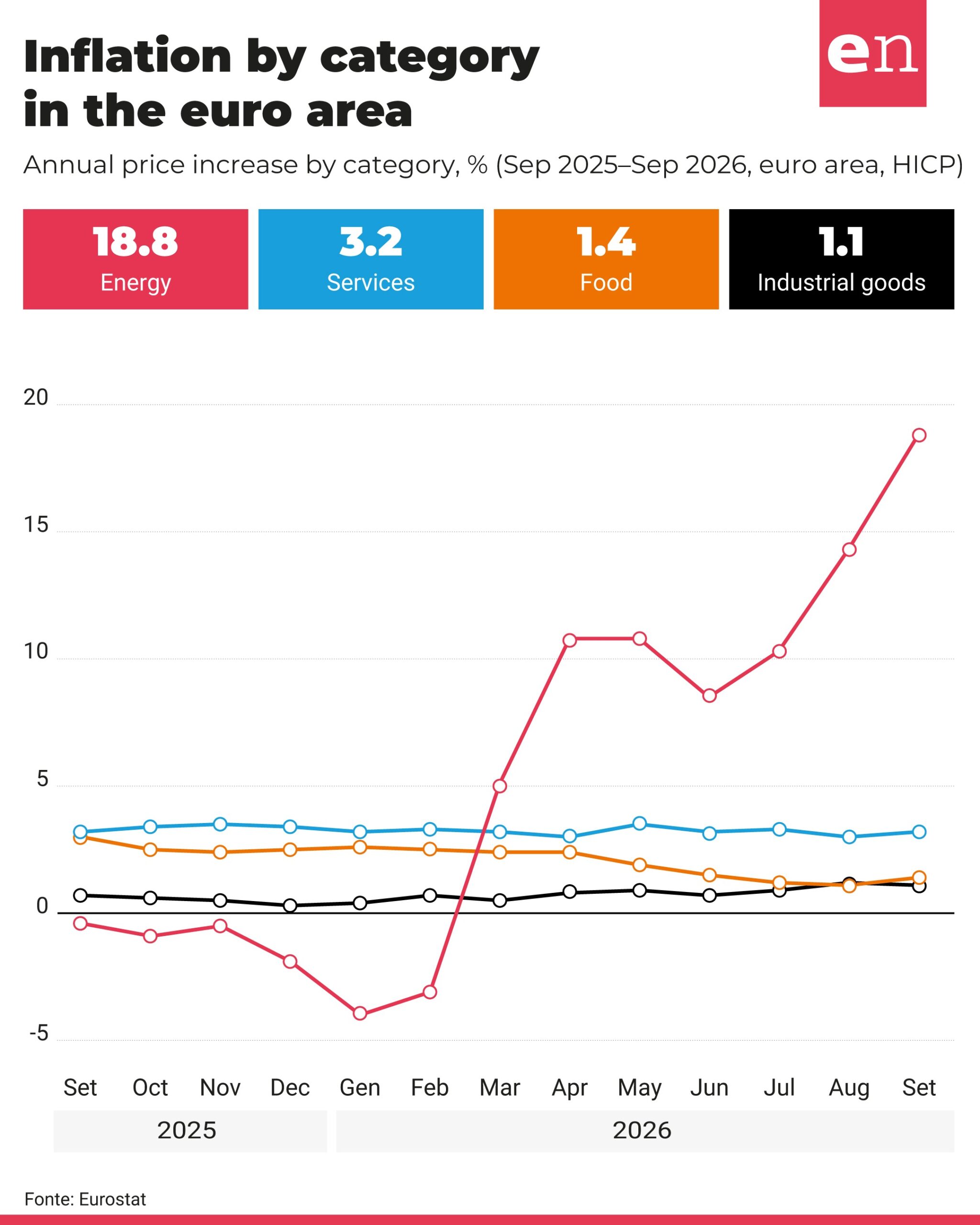
Inflation for food, alcohol and tobacco is also rising, from 1.1 per cent to 1.4 per cent. Within this category, however, the trends vary considerably: unprocessed food recorded an annual increase of 4 per cent, up from 2.7 per cent in August, while the rate for the processed food, alcohol, and tobacco category fell from 0.5 per cent to 0.4 per cent.
Furthermore, the overall figure remains significantly higher when energy and unprocessed food are excluded: core inflation, which strips out the most volatile components, stands at 2.5 per cent, just above August’s 2.4 per cent. Excluding energy alone, however, the rate rises from 2.1 per cent to 2.3 per cent. The acceleration in September, therefore, appears strongly linked to the energy component, although some signs of price pressure remain in services and food.
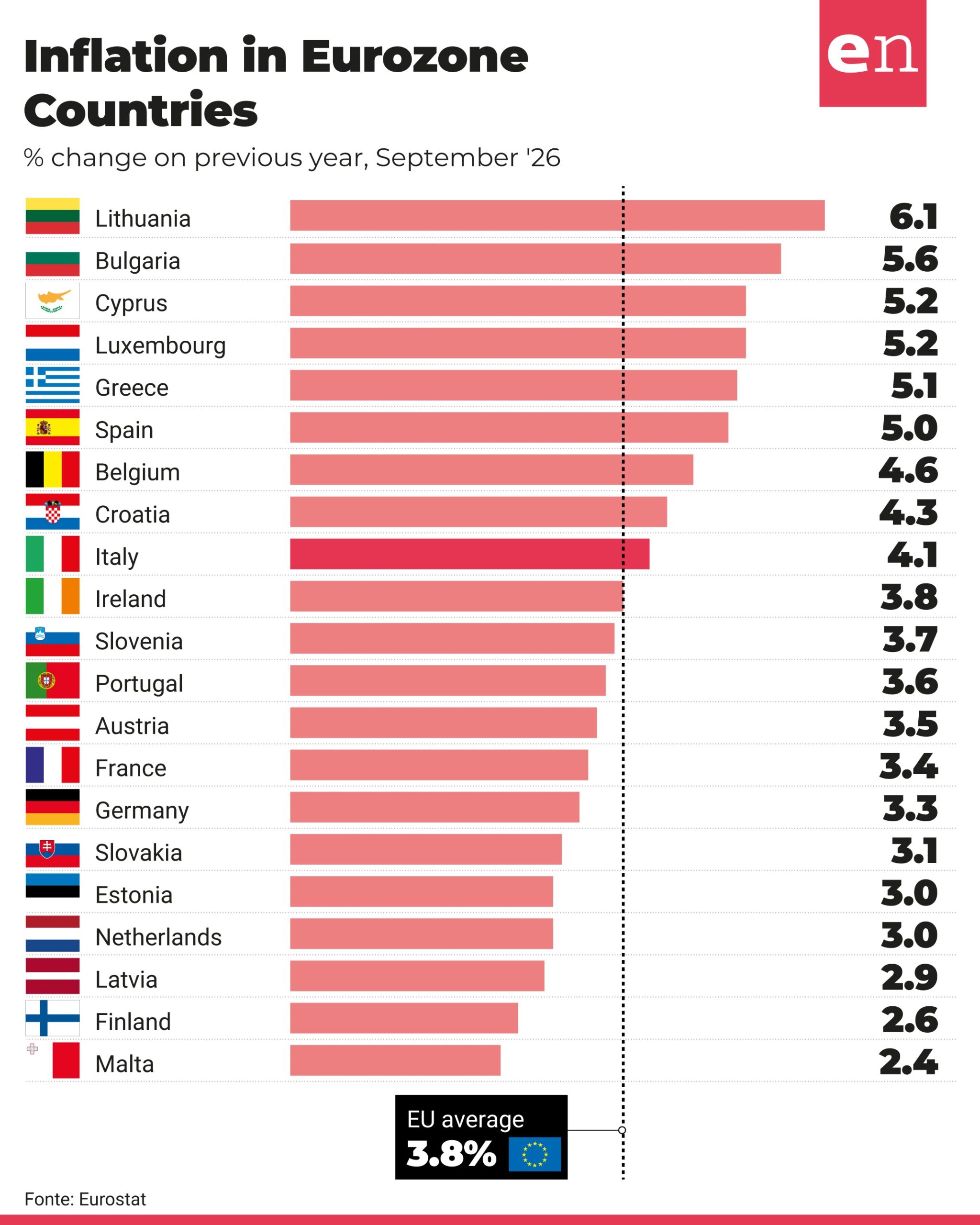
At the national level, inflation is accelerating in almost all the major eurozone countries. In Italy, the rate reached 4.1 per cent in September, up from 3.2 per cent in August and 2.9 per cent in July. The Italian figure is therefore higher than the eurozone average. In Germany, inflation rose to 3.3 per cent from 2.9 per cent in August, while in France it rose from 2.6 per cent to 3.4 per cent. The rise was more pronounced in Spain, where the rate reached 5 per cent from 4.6 per cent in August, and in Greece, where it reached 5.1 per cent, up from 3.7 per cent.
On the very issue of the impact of high energy prices on inflation, Prime Minister Giorgia Meloni wrote to the President of the European Commission, Ursula von der Leyen, asking for “additional flexibility to support households and businesses” amid rising energy costs. However, the Berlaymont issued a firm response: while stressing that they “will keep an eye on the letter” and will let her know “should the situation change,” they pointed out that they had already implemented flexibility measures.
Among the eurozone countries, the sharpest rise compared with August was recorded in Greece, followed by Italy and Spain, while some countries showed a more moderate trend. In France, for example, the monthly price rate is negative (-0.4 per cent), as it is in Malta and Cyprus.
This latest spike comes after several months during which European inflation had begun to rise gradually: it rose from 2.8 per cent in June to 2.9 per cent in July, then to 3.2 per cent in August. The rise in September, however, is particularly sharp, with a six-tenths-of-a-percentage-point increase in a single month.
English version by the Translation Service of Withub