



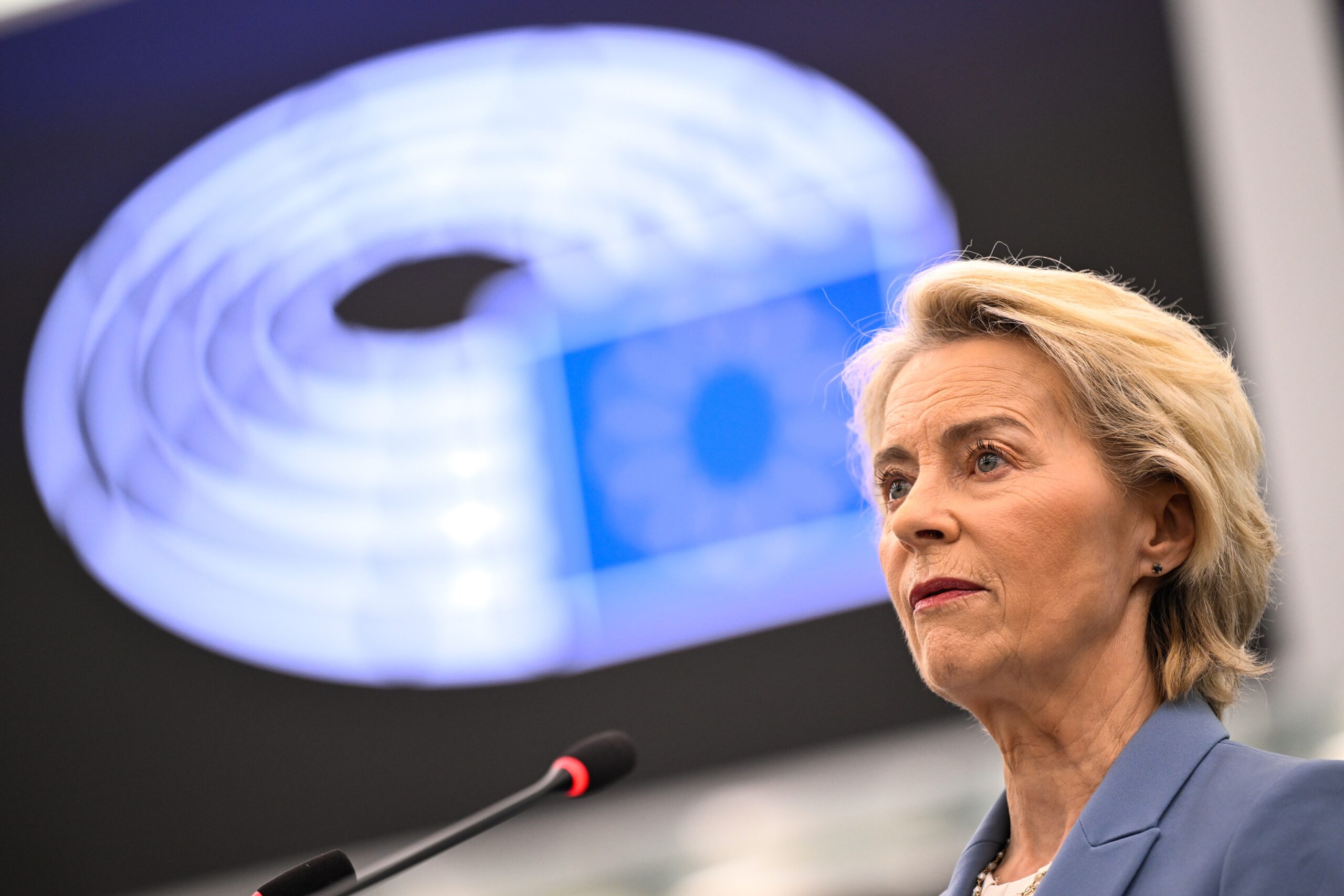
Brussels – Beware of cuts – excessive ones, that is. On the delicate issue of the EU’s multiannual financial framework (MFF 2028–2034), heads of state and government have received a joint warning from the Commission and the Parliament. It is not a new warning, but one centred on a word that seems to be becoming the linchpin of the whole issue: “excessive”. In the plenary debate on the budget ahead of the European Council summit – which is seen as decisive for the political negotiations on the dossier – a path seems to be emerging that favours cuts, provided they remain below the levels feared by member states’ leaders.
The President of the European Commission, Ursula von der Leyen, was the first to highlight the issue: “I would like to caution against large cuts. It would risk cutting deep into critical priorities that we all together have agreed on.” This was the first statement by a member of the European People’s Party (EPP) against excessive cuts to resources. The Vice-Chair of the EPP Group, Sigfried Muresan, also supports a position of allocating less money than the Commission’s proposal, provided the cuts are limited: “This Parliament will not be in a position to approve a budget with excessive cuts.” Ultimately, he noted, “the budget must be sufficient; otherwise, the challenges we face will not go away.”
https://www.eunews.it/en/2026/06/19/multi-annual-budget-october-will-be-the-moment-of-truth/
A moderate, but not excessive, reduction in the budget could be the way out of the inter-institutional standoff, given that at the level of Heads of State and Government, the EPP dominates, with 12 out of 27 leaders (Austria, Cyprus, Croatia, Germany, Greece, Finland, Luxembourg, Poland, Portugal, Slovenia, Sweden, Hungary). Contributing less to the common budget is certainly a choice that meets the needs of Italy, a country with high public debt, and of the Dutch government led by the liberal Rob Jetten, which is nevertheless mindful of spending.
The Socialists (S&D), led by their group chair Iratxe García Pérez, are trying to keep the stakes high: “It’s impossible to do more with less,” she insisted, proposing an agreement on new own resources – revenue for the Commission that does not affect national contributions. “We need a Europe with its own resources, funded by the major digital groups, online gambling and cryptocurrencies.” For the Socialists, the compromise could be this: to cut the proposed two thousand billion euros, but not indiscriminately, while in return introducing new EU taxes. In this regard, according to García Pérez, “we need a fair Europe, one that ensures that energy companies pay their fair share on windfall profits, using this revenue to create a social voucher to help families cover the costs of electricity, heating, fuel and essential foodstuffs.”
From the Greens’ benches, co-chair Terry Reintke warns: “If you think you can turn up after the fact with a take-it-or-leave-it document, then it will be a disaster.” The Greens’ representative points out that “this European Parliament is different from the previous one,” and so approval cannot be taken for granted.
English version by the Translation Service of Withub




![[foto: Mattia Calaprice/imagoeconomica]](https://www.eunews.it/wp-content/uploads/2026/10/ue-energia-120x86.png)
