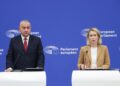

Brussels – To establish a European centre for critical raw materials and introduce an export control clause so that the European Commission can restrict the export of scrap and waste containing permanent magnets, ensuring that recyclable materials remain within the European Union: These are the objectives of the text approved by the European Parliament today (20 October). More specifically, these are amendments to the Regulation on critical raw materials (CRMA) to “channel targeted support towards strategic projects covering the entire value chain, from extraction and processing to refining and recycling.” The CRMA is an EU strategy to ensure a “secure, diversified, and sustainable” supply of the raw materials needed for the digital and green transitions, in particular for the zero-emission industry, the digital industry, the aerospace sector, and the defence sector. The measures adopted today aim to accelerate extraction, processing, recycling, and substitution capacities, thereby diversifying the EU’s supply chains. Having approved the text with 470 votes in favour, 83 against, and 108 abstentions, the European Parliament is ready to begin negotiations with Member States to finalise the legislation. The MEP (S&D) and rapporteur for the text, Mohammed Chahim, welcomed the green light, noting that “critical raw materials have become the currency of geopolitical power: whoever controls them controls our industrial future, our energy transition, and our security.” For this reason, “Europe cannot afford to stand idly by while others strengthen their grip on critical raw materials.”
Among the various measures adopted today, MEPs proposed the establishment of a Centre for Critical Raw Materials in the form of an independent EU agency. The body will be endowed with “dedicated funding, clear governance, and democratic legitimacy.” The body’s planned activities include “market analysis, resilience planning, stock management, joint procurement, stakeholder engagement, and financial instruments.” According to MEPs, for the centre to fulfil its mandate, it must “have the necessary resources, including a €2 billion Critical Raw Materials Fund, provided for under the EU’s long-term budget for the period 2028–2034 (MFF).” “We need a European Centre for Critical Raw Materials, equipped with the financial resources and the necessary mandate to act promptly, anticipate disruptions in supply chains and ensure that our needs cannot be turned into instruments of geopolitical pressure,” explained Chahim.
MEPs have also provided for a “conditional export control clause”. This means that the European Commission intends to restrict “exports of scrap and waste containing permanent magnets,” with the aim of recycling the materials and reusing them within the EU. In this context, it is up to the Berlaymont building, rather than individual Member States, to “identify the ‘large companies’ that use critical raw materials in specific strategic sectors (such as batteries, hydrogen technologies, aircraft, drones, satellites, or advanced chips).” Once these companies have been identified, the use of critical materials will trigger so-called “resilience obligations”, such as the mapping of supply chains and the adoption of measures aimed at reducing vulnerabilities. MEPs are also calling on the Commission to open calls for strategic projects at least twice a year, providing businesses with clear and predictable deadlines – applications are required to obtain the status of a strategic project under the CRMA. These are submitted by companies, consortia, and organisations to the European Commission.
In order to make the regulatory framework more effective, MEPs are calling for the introduction of “price stabilisation mechanisms, such as contracts for difference” with the aim of “providing developers of extraction, processing, and recycling projects with greater certainty regarding their revenues.” They also propose expanding the EU’s current joint procurement mechanism to facilitate the coordinated build-up of strategic stocks of critical raw materials amongst Member States and businesses.
The European Parliament finally turned its attention to the issue “relating to the defence and security of critical raw materials, calling for the future European Defence Industry Programme to be mobilised to fund projects on strategic raw materials, which are vital to the EU’s security and defence capabilities.”
The Critical Raw Materials Act (CRMA) was adopted by the European Parliament in December 2023. Since then, the text has laid the foundations for a set of EU instruments that guarantee industry access to the raw materials essential for the transitions to clean energy, digitalisation, defence, and aerospace. In December 2025, the Commission proposed amending the text in line with the RESourceEU Action Plan, adopted by the Berlaymont Building to secure the European Union’s supply of critical raw materials and reduce strategic dependence on foreign suppliers.
The vote in favour by the plenary in Strasbourg was also welcomed in Italy, where the Minister for Enterprise and “Made in Italy”, Adolfo Urso, commented: “The position expressed by the European Parliament is fully in line with what we had proposed to the Council and the European Commission, both regarding the restriction of exports of scrap and waste containing permanent magnets, and the establishment of a European centre for critical raw materials.” According to the minister, “this is the right path to achieving European strategic autonomy, to which our country is making a decisive contribution”, with the “Italian bid to host the first European strategic stockpile of critical raw materials and the recent selection of five Italian projects from among the 46 identified by the European Commission as part of the second call for proposals under the CRMA.”
English version by the Translation Service of Withub